English


Top Running vs Underhung Overhead Cranes: What’s the Difference?
Date: 2026-10-15 Share:
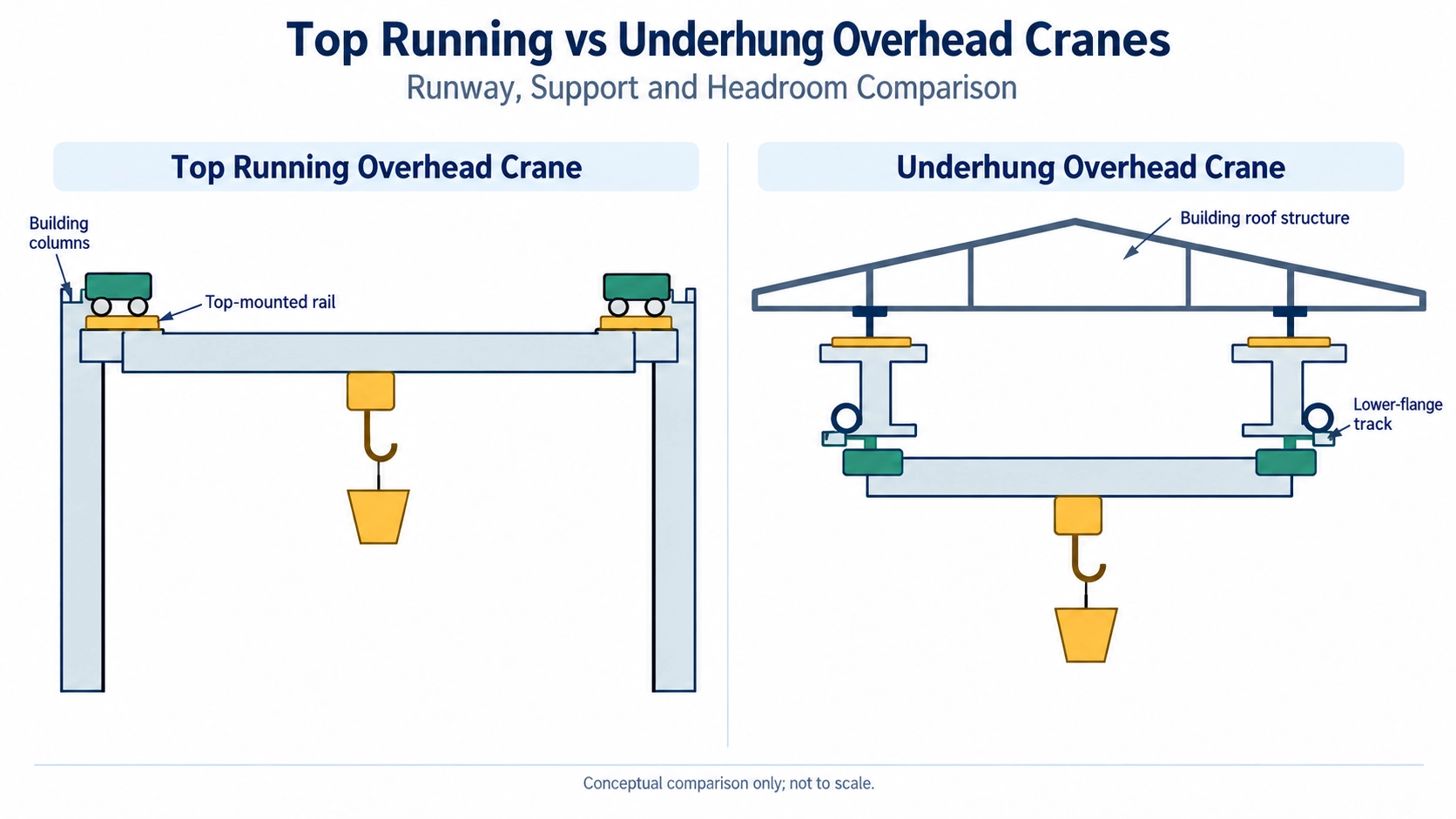
The main difference in top running vs underhung crane selection is where the bridge wheels travel and how the resulting loads enter the building structure.
A top running crane travels on rails installed above runway beams. An underhung crane travels along the lower flanges of runway beams suspended from, or connected to, the building structure.
This configuration affects headroom, capacity, span, wheel loads, hook coverage, installation and future expansion. Selecting between the two is therefore a structural and operational decision rather than simply a choice of crane style.
How Are Top Running and Underhung Cranes Supported?
Top running overhead crane support path
A top running overhead crane uses end-truck wheels that travel on rails mounted on top of runway beams. The runway beams are normally supported by building columns, corbels or a dedicated freestanding structure.
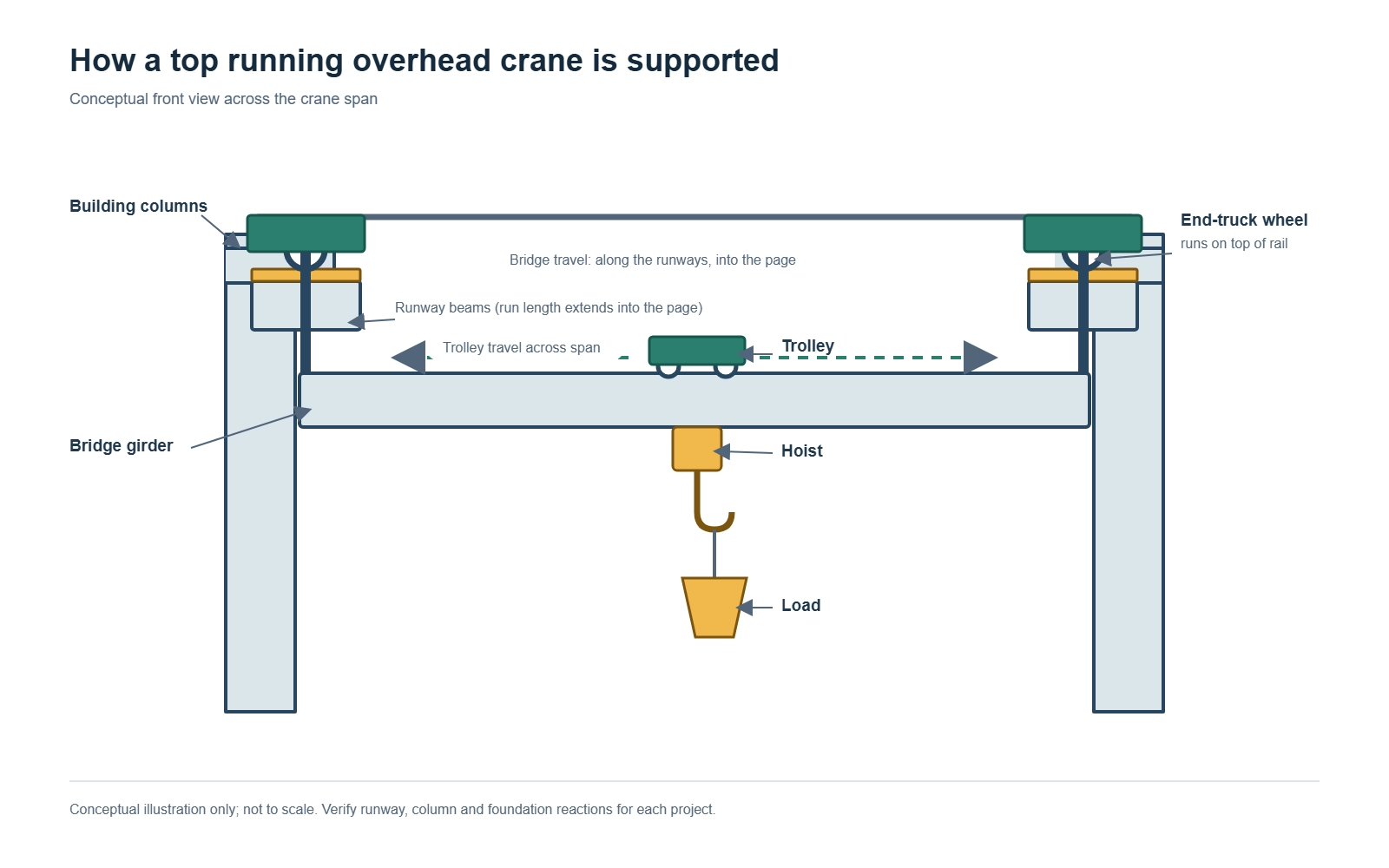
Conceptual illustration only; not to scale. Runway, column and foundation reactions must be verified for each project.
The bridge spans between the two runway systems. Its trolley moves across the bridge, while the complete bridge travels along the runway rails.
This arrangement creates a relatively direct load path from the bridge wheels into the runway beams, columns and foundations. The structural review should cover vertical wheel loads, lateral forces, impact effects, fatigue and rail alignment.
Underhung overhead crane support path
An underhung overhead crane uses end-carriage wheels that travel on the lower flange of an I-beam, H-beam or compatible enclosed track.
The runway may be suspended from roof trusses, connected to building columns or installed on a separate supporting frame.
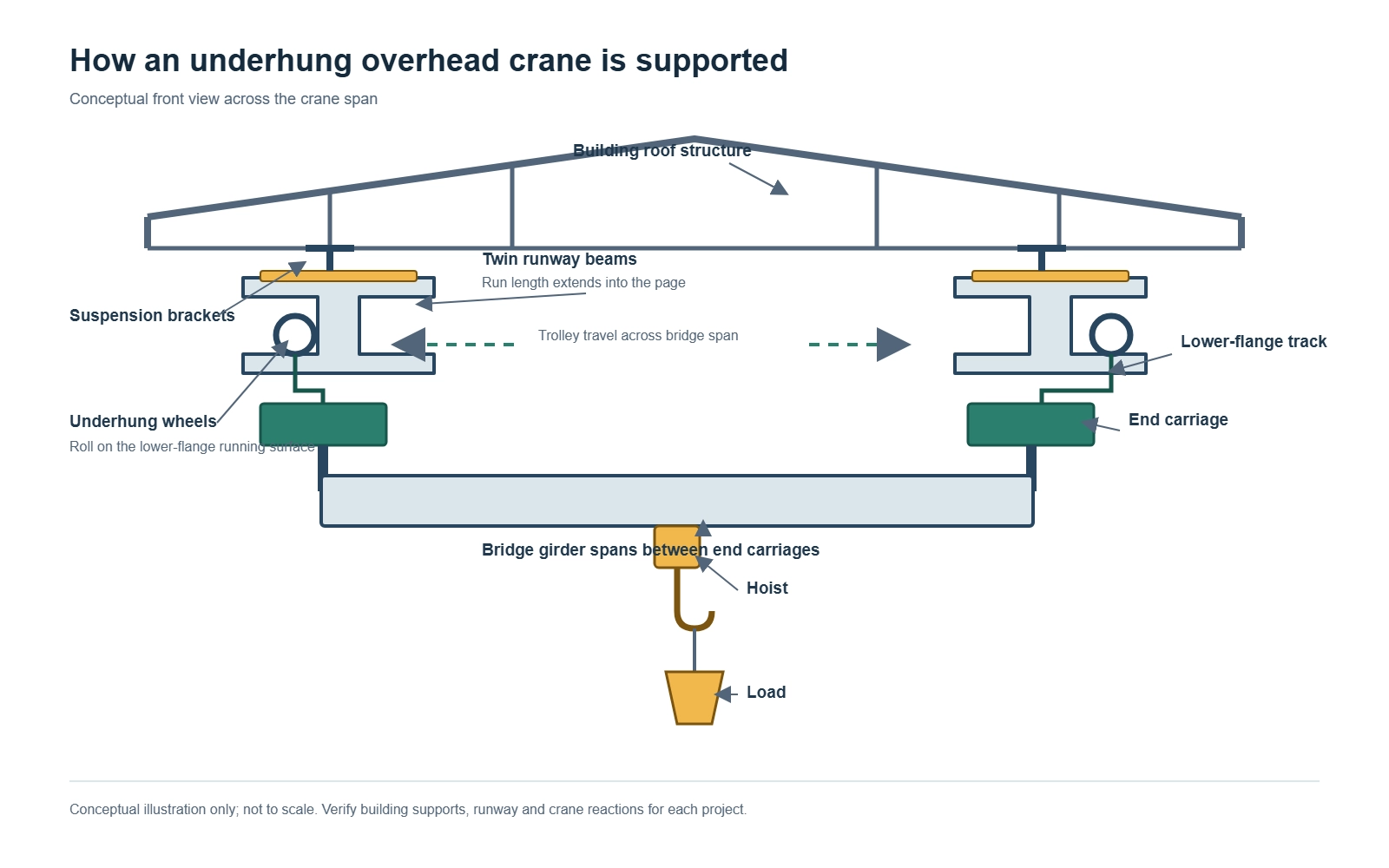
Conceptual illustration only; not to scale. Building supports, suspension points and crane reactions must be verified for each project.
The supporting steel must be checked for concentrated hanger loads, beam deflection, connection strength, lateral stability and fatigue. Existing roof members should never be assumed suitable based on appearance alone.
Top Running vs Underhung: Engineering Differences
Runway configuration
A top running system places the travel rail above the runway beam. End-truck wheels sit on the rail, and the bridge is supported between the two runway systems.
An underhung system suspends the bridge below the runway. Its wheels engage the lower flange or another engineered running surface.
This distinction changes the direction and location of structural reactions. It also affects erection methods, maintenance access and the amount of crane equipment occupying the upper part of the building.
Headroom and hook approach
Underhung cranes are often considered for buildings with restricted height. A compact end carriage and suitable hoist can reduce the structural depth below the runway.
However, an underhung crane is not automatically a low headroom crane. Actual hook height depends on the runway elevation, beam depth, suspension hardware, bridge girder, hoist dimensions and upper hook limit.
Top running equipment may require more space between the runway rail and hook. In a suitably designed building, it can still provide efficient lifting height and predictable clearance around the bridge.
The purchasing team should request a scaled section drawing showing roof steel, runway elevation, bridge depth, trolley or hoist envelope, upper hook limit and lowest building obstruction.
Capacity, span and duty
Top running cranes are generally the more flexible starting point for higher wheel loads, heavier lifts, longer spans or demanding operating cycles.
Their runway beams and columns can be designed as a dedicated crane-support system. The crane designer is therefore less dependent on lightweight roof framing.
Underhung cranes often suit light and moderate material-handling duties where the supporting structure can accept suspended runway loads. They may also serve production areas requiring multiple bridges or flexible workstation coverage.
Capacity and span cannot be selected from the crane type alone. Bridge deflection, wheel loading, beam torsion, hanger spacing, fatigue category, load spectrum and required duty must be evaluated together.
Building structure
A top running crane commonly requires runway columns, corbels or strengthened building frames. This can increase the steelwork and foundation scope, especially in an existing facility.
The resulting load path is usually easier to identify because crane reactions pass through dedicated runway supports.
An underhung crane can avoid new floor-level columns, preserving space for production lines, vehicles and storage. The trade-off is greater dependence on the roof or overhead supporting structure.
Roof trusses, building connections and suspension points must be surveyed and calculated for both stationary and moving crane loads.
Installation requirements
Top running installation may require substantial runway steel, rail alignment work and access above the runway elevation. Installation planning should address rail joints, tolerances, temporary lifting points and safe access.
An underhung runway may appear easier to install, but connection design and overhead access can be complex. Hanger positions must match the building structure, while runway alignment must remain within the crane supplier’s permitted tolerances.
The quotation should clearly assign responsibility for surveys, structural reinforcement, runway steel, rails, power supply, erection, alignment and commissioning.
Rail and end-carriage interfaces
Rail condition and alignment influence wheel wear, travel resistance, noise and skewing. The selected Crane Rail and Accessories scope should define rails, clamps, joints, pads and installation interfaces where applicable.
An underhung design also requires an end carriage compatible with the runway flange. The published underhung end carriage information describes wheel arrangements for different beam forms.
Maintenance teams should confirm access to wheels, gear motors, brakes, travel limits, conductor systems and replaceable components before approving either layout.
Underhung Crane Advantages and Limitations
Principal underhung crane advantages
The main underhung crane advantages are reduced obstruction around the runway, efficient use of overhead building space and the possibility of avoiding new floor-level runway columns.
Potential benefits include:
- Better use of low-elevation workshops.
- Reduced interference with vehicles and production equipment.
- Flexible coverage across connected work areas.
- Compatibility with certain light-crane and workstation systems.
- Improved side approach when the bridge and hoist are properly configured.
These benefits must be confirmed on a project drawing. Excessive runway movement or deflection can cause poor wheel contact, travel resistance, impact and commissioning problems.
Important limitations
Underhung systems depend heavily on the strength and stiffness of their supporting structure. Existing roof steel may require reinforcement, additional bracing or a separate support frame.
Maintenance access can also become difficult when end carriages, motors or electrical systems are located close to roof members.
Top running cranes are often the stronger starting point when the project involves frequent heavy lifts, large hook coverage, long travel distances, high wheel loads or a new building designed around crane operations.
Neither configuration is inherently safer. Both require appropriate buffers, travel limits, emergency stops, guarding, electrical isolation, inspection access and other protections required by the applicable project rules.
Application Fit: A Procurement Comparison
Select according to the building and workflow
The following table provides an initial screening framework:
| Project condition | Likely starting point | Main verification |
| New heavy-duty production bay | Top running | Rail, column and foundation reactions |
| Existing low-height workshop | Underhung | Roof steel, hangers and hook clearance |
| High lift frequency or severe load spectrum | Top running | Duty class, fatigue and wheel loads |
| Light production stations across a wide area | Underhung | Beam continuity, deflection and coverage |
| Maximum hook approach near walls | Either | Hoist dimensions and end clearances |
| Possible future capacity increase | Top running often easier | Runway and structural reserve |
| Floor area must remain unobstructed | Underhung | Overhead support capacity |
This table is a screening tool, not design approval. Final selection should be supported by a dimensioned general arrangement, structural calculations and a responsibility matrix separating crane supply from building work.
Normalize quotation scope before comparing price
Comparable quotations should state whether the scope includes:
- Bridge girders, hoist, trolley and end carriages.
- Runway beams, rails, hangers, columns or corbels.
- Electrical conductors, controls and safety devices.
- Inspection, factory testing and documentation.
- Packing, freight, installation and commissioning.
- Operator or maintenance training.
- Recommended spare parts and warranty terms.
- Civil work, structural reinforcement and exclusions.
A lower equipment price may not produce a lower installed cost if runway steel, reinforcement, access systems or commissioning services are excluded.
How to Evaluate the Proposed Crane Design
Request engineering evidence
Supplier evaluation should focus on traceable submittals rather than a catalog description.
Useful evidence includes a general arrangement drawing, wheel-load schedule, support reactions, runway interface drawing, component datasheets, design calculations, inspection and test plan, factory acceptance records, operating manuals and spare-parts recommendations.
For a low headroom crane, the hook path and maintenance envelope deserve a separate review. A compact hoist that cannot be inspected or removed safely may increase lifecycle cost.
Check the available product configurations
The official Nante Crane website provides product and component references for overhead material-handling projects. The final configuration should still be confirmed against the required capacity, span, duty, building reactions and destination requirements.
The overhead crane product category provides starting points for comparing crane arrangements. The single-girder overhead crane page also identifies configurable hoist and end-carriage options.
These pages support initial selection but do not replace project-specific drawings, calculations or structural approval.
FAQ: Top Running vs Underhung Crane Selection
Is an underhung crane always a low headroom crane?
No. Underhung geometry may support a low headroom arrangement, but the final hook height depends on the hoist, bridge, runway beams, hangers and building geometry.
Which crane type is better for a long span?
The answer depends on capacity, bridge deflection, wheel loads, runway continuity and building support. Top running is often more practical for heavier or longer-span service, but every project requires engineering verification.
Can an underhung crane use existing roof steel?
Potentially, but only after structural review. Member strength, connection capacity, lateral restraint, fatigue, deflection and the complete load path must be checked.
What information is needed for a comparison?
A useful project brief includes capacity, span, lifting height, hook approach, duty class, operating hours, load spectrum, building drawings, support elevations, environment, power supply, controls, destination and installation scope.
Request a Project-Specific Crane Comparison
For a defensible top running vs underhung decision, purchasing teams should submit the required capacity, span, lift, duty, operating pattern, building drawings, available supports and hook-clearance requirements. Nante Crane can review these inputs and prepare a configuration-specific technical response through the Nante Crane contact team.