English



Jib Crane vs Overhead Crane: Which Is Better for Your Workshop?
Date: 2026-10-22 Share:
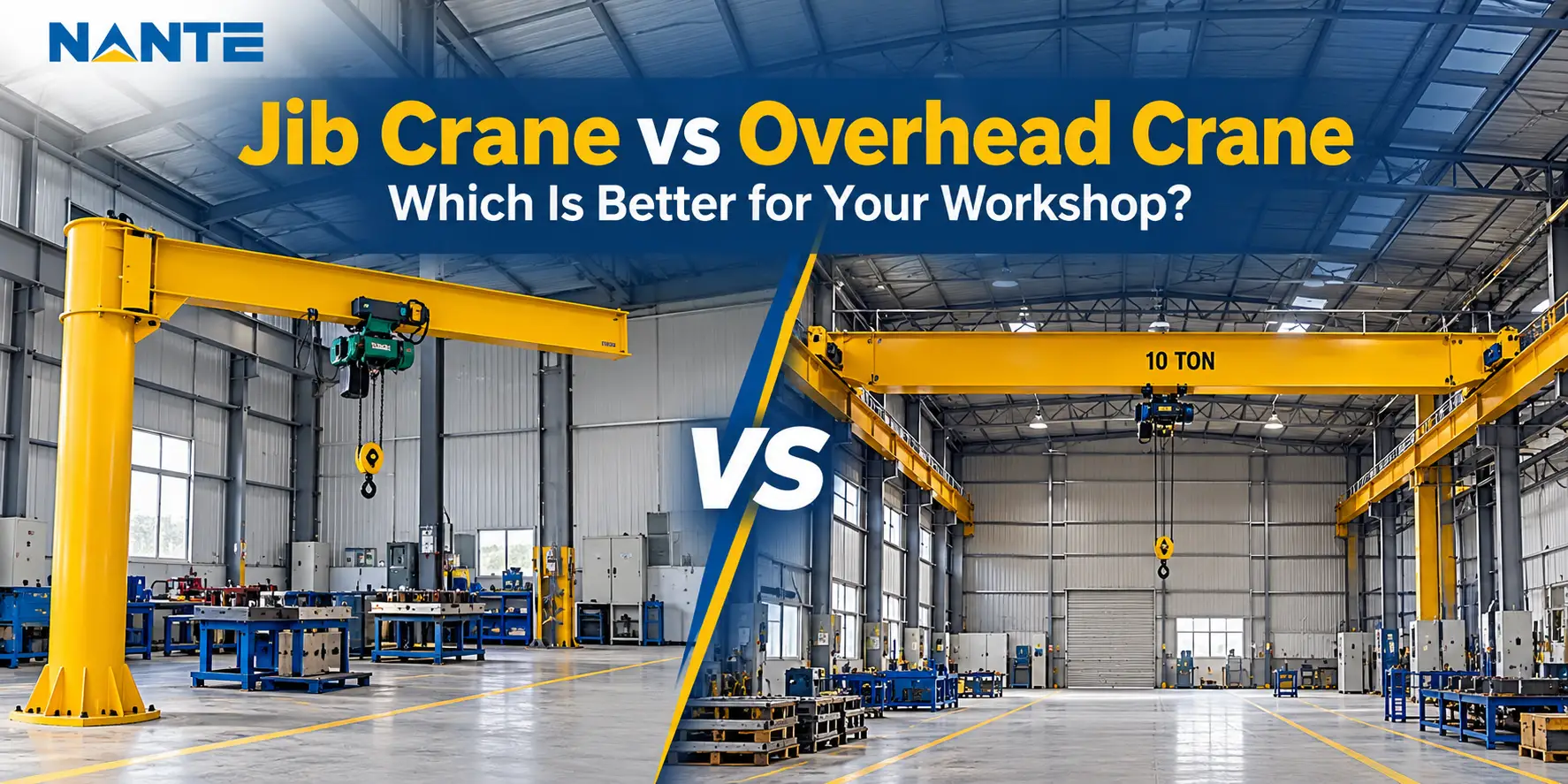
The better workshop lifting crane depends on movement. A jib crane concentrates lifting around a column, wall, or workstation. An overhead crane moves a hoist and trolley across runways for broader coverage.
The decision affects structural work, installation downtime, workflow, maintenance access, and the quotation. Compare load paths first, then normalize capacity, duty, controls, documents, installation, and service before judging price.
What the Comparison Actually Means
Coverage and movement pattern
A jib crane serves a circular or sector-shaped envelope around its mounting point. It fits repeated lifts at one machine, bench, cell, or loading position. The arm can be manual or motorized, depending on slewing effort and cycle frequency.
An overhead (bridge) crane travels along runway beams, moving its trolley and hoist longitudinally and transversely within a rectangular area.
Request a plan view showing pickup points, set-down points, exclusion zones, aisle widths, and the hook path. A jib crane fits local paths; an overhead crane is stronger when one system connects several work areas.
Installation and building interface
Jib installation may involve a foundation, base plate, column, or wall connection. Check overturning loads, anchor forces, concrete condition, column capacity, and arm clearance. Wall-mounted or wall-travelling designs preserve floor space but require suitable support.
An overhead crane requires runway beams or brackets, end-truck paths, power distribution, end stops, and headroom. Existing building steel is not automatically suitable. Review runway alignment, wheel loads, deflection, maintenance access, and conflicts with building services or production equipment.
Installation scope can reverse a price advantage. A low equipment price may exclude runway steel, reinforcement, conductor rails, cabling, commissioning, or access equipment. Quotations should state inclusions and exclusions line by line.
Capacity, Duty, and Control Requirements
Where a jib crane fits
Jib cranes are normally selected for localized lifting, short travel distances, and repeatable handling at a defined station. The design still has to account for rated load, working radius, hook height, outreach, rotation angle, load spectrum, lifting speed, and floor or wall reaction forces.
Published product data is a starting point, not a substitute for an engineered selection. For example, the current Jib Crane page describes free-standing, mobile, wall-mounted, and wall-travelling options and lists a product range that must be matched to the actual radius and duty. The final specification should identify the hoist type, controls, braking, limit devices, and any special environment requirements.
Where an overhead crane fits
An overhead crane is better suited to distributed handling, heavier or more frequent transfers, and a workshop where the hook must reach multiple bays. Selection normally covers capacity, span, runway length, lifting height, duty class, hoist speed, bridge and trolley speeds, control method, headroom, and power supply.
Single-girder arrangements are often considered for light- or medium-duty handling where compact design and lower self-weight matter. A current Overhead Crane product page describes those application characteristics, but the final choice still depends on the load spectrum, building interface, and required duty.
The wider envelope can reduce transport and forklift crossings, but adds moving equipment, power systems, and runway inspections. The safety case should address travel limits, overload protection, emergency stops, controls, and visibility.
Cost and Total Ownership
Compare the complete installed scope
Jib cranes often have a smaller equipment and installation footprint when a sound foundation or column already exists. Overhead cranes can require more steel, power distribution, access planning, and commissioning, especially in an existing workshop. Neither statement is a reliable budget without a site-specific scope.
For a fair comparison, place these items in one cost matrix:
- Crane, hoist, controls, brakes, hooks, and limit devices.
- Foundations, brackets, runway beams, end stops, and structural reinforcement.
- Conductor rails, festoon systems, cable reels, isolators, and control wiring.
- Engineering drawings, calculations, inspection records, factory testing, packing, and freight.
- Installation, alignment, commissioning, training, spare parts, warranty, and exclusions.
The Crane Cost guide helps separate equipment price from the factors driving a complete overhead-crane budget. Apply the same discipline to a jib quotation.
Evaluate operating and maintenance cost
A localized jib crane may use less travel infrastructure. An overhead crane may reduce forklift movements, manual carrying, and production delays across a larger area. Operating cost depends on utilization, travel distance, energy, maintenance access, and downtime.
Request a preventive-maintenance schedule, critical spares list, inspection intervals, fault response, and handover documents. A low initial price is weak evidence if parts, access equipment, or software-dependent controls are unclear.
Flexibility and Workstation Applications
Workstation crane vs overhead crane
The workstation crane vs overhead crane decision usually comes down to granularity. A workstation system is designed around operators and cells, supporting ergonomic lifting, short transfers, and modular expansion.
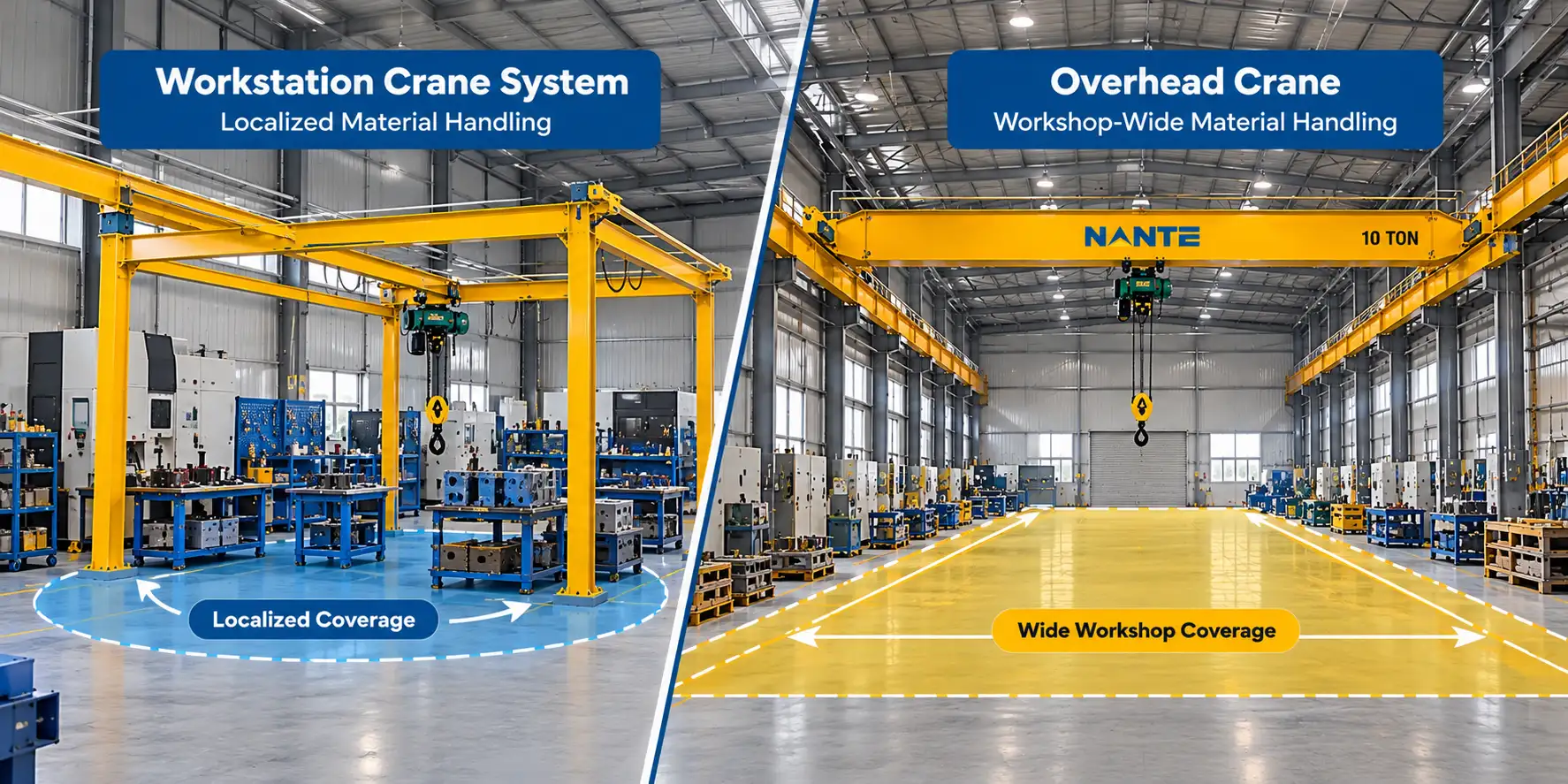
An overhead crane provides a shared lifting resource across a larger rectangle. It is stronger when several departments need the same hook, when loads change location often, or when a future layout requires cross-bay movement. The trade-off is greater building coordination and a more formal runway and maintenance plan.
For a mixed workshop, a workstation crane can handle repetitive component lifts while an overhead crane handles dies, assemblies, motors, or finished units. That hybrid layout should be assessed for hook interference, traffic rules, load segregation, and whether the smaller cranes reduce demand on the main bridge crane.
Jib crane or bridge crane for a workshop
Choose a jib crane when the load cycle is concentrated, the hook path is short, and a verified mounting point is available. It is a strong candidate for machine loading, welding cells, repair bays, tooling stations, and localized pallet handling.
Choose a bridge crane when the load must travel between bays, the workshop has a clear runway route, or one system must cover a broad production footprint. A bridge crane also offers a more direct path for planned future expansion when runway length and building clearances have been reserved.
Map movements: heavy cross-building lifts may justify an overhead crane, while frequent short lifts may favor jib or workstation cranes. Follow the load data.
A Practical Workshop Selection Checklist
Select a jib crane when these conditions are verified
- Most lifts stay within one cell or a defined radius.
- The floor, wall, or column can support calculated reactions.
- Rotation, hook height, outreach, and clearance fit the process.
- A localized crane avoids forklift crossings or manual handling.
- The project benefits from phased installation or modular expansion.
Select an overhead crane when these conditions are verified
- Loads must move between multiple bays or departments.
- A runway route can be engineered without unacceptable headroom loss.
- Capacity, span, lifting height, and duty require a shared bridge system.
- Building services and maintenance access can be coordinated.
- The business case includes reduced transport, handling, and downtime.
The Workshop Crane Selection resource can support the early specification stage. A layout, load schedule, operating hours, and delivery destination will produce a more useful technical response than a request for a generic price.
How to Compare Supplier Proposals
Normalize technical scope before price
Every bidder should receive the same plan, load cases, lifting heights, duty expectations, environmental conditions, electrical data, applicable standards, and installation boundary. Proposal comparisons should identify what is designed by the supplier and what remains the responsibility of the building contractor.
Check whether drawings, calculations, welding and inspection records, material traceability, test plans, calibration records, FAT results, manuals, and as-built documents are included. Use change control when site measurements alter the design.
Verify supplier evidence and support
From the midpoint of the process, supplier verification becomes as important as crane type. Nante Crane publishes crane, component, service, and application information that can be reviewed alongside the technical offer. The purchasing team should verify the legal entity, certificate scope, site, warranty terms, response process, and spare-parts plan.
The Workstation Crane System category is relevant when a proposal includes cell-level lifting. Compare it with the bridge option using the same load paths, duty assumptions, controls, documents, and commissioning responsibilities.
FAQ: Jib Crane vs Overhead Crane
Is a jib crane always cheaper than an overhead crane?
No. A jib crane often has a smaller infrastructure scope, but foundations, reinforcement, rotation requirements, and the number of required stations can change the installed cost. An overhead crane may deliver better value when one system replaces repeated local handling across several bays.
Is a bridge crane the same as an overhead crane?
In common industrial usage, bridge crane describes the bridge-and-hoist arrangement that travels on elevated runways, while overhead crane is the broader category used for the installation. The technical proposal should define the runway, bridge, trolley, hoist, controls, and duty class rather than relying on terminology alone.
Can a workshop use both crane types?
Yes, when the load map supports separate roles. Local repetitive lifts can remain at workstations while the overhead crane handles long transfers or heavier assemblies. The layout needs clear operating zones, collision prevention, inspection responsibilities, and a coordinated lifting procedure.
Request a Project-Specific Comparison
For a useful jib crane vs overhead crane recommendation, the project owner should provide capacity, working radius or span, lifting height, duty class, load spectrum, operating hours, layout drawings, building support conditions, power and control preferences, environment, delivery destination, and installation scope. Share the workshop project brief for a technical comparison that can identify a suitable configuration, quotation basis, documentation package, and next engineering questions.