English



How to Choose the Right Jib Crane Boom Length
Date: 2026-10-22 Share:
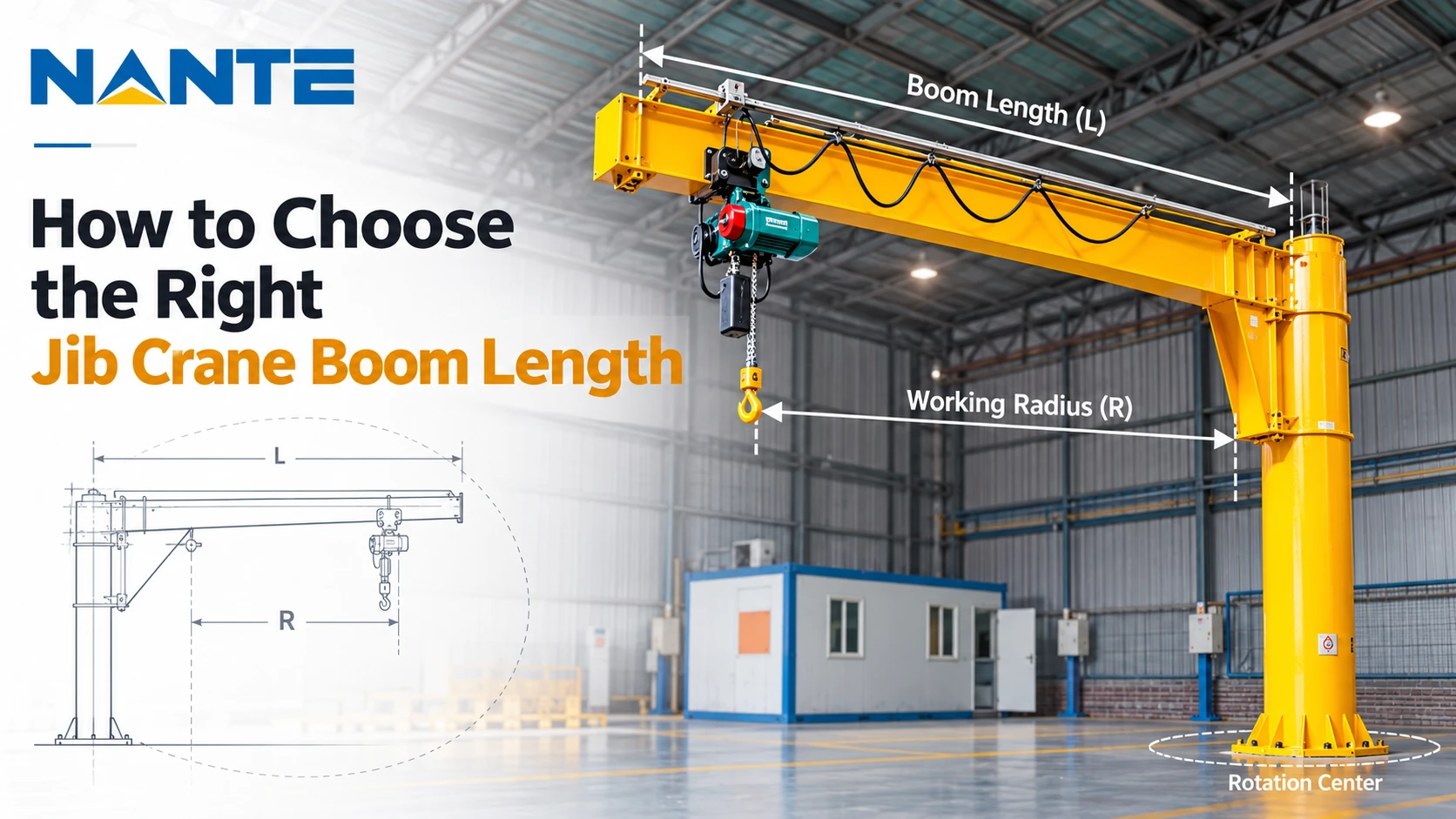
Choosing the correct jib crane boom length is a layout and safety decision, not simply a way to increase reach. The boom must place the hook over the load while preserving rated capacity, structural stability, operator visibility, and clearance from buildings, machinery, and people.
A short boom may leave parts of the workstation outside the lifting zone. An unnecessarily long boom can increase overturning moment, foundation loads, deflection, and cost. The right selection starts with the load path and ends with a verified crane drawing.
What Jib Crane Boom Length Controls
Jib Crane Arm Length and Basic Geometry
The jib crane arm length is the horizontal distance from the pivot or mounting point toward the hook. Depending on the design, the boom may be an I-beam, box girder, or KBK profile.
The effective reach is usually less than the physical boom length. The column radius, end stops, trolley position, hook approach, and hoist dimensions all consume part of the available distance.
A preliminary relationship can be expressed as:
Working radius ≈ boom length − pivot offset − trolley and hook offsets
This is only a planning estimate. The final value must come from the manufacturer’s general arrangement drawing and the selected hoist.
Jib Crane Reach Versus Working Radius
Jib crane reach describes how far the hook can travel from the supporting column or wall. Jib crane working radius describes the usable horizontal distance between the rotation center and the hook centerline.
Those terms are related but not always interchangeable. A boom may be physically long while the hook cannot reach the extreme end because of trolley travel limits or end clearance.
Conceptual diagram: boom length versus working radius
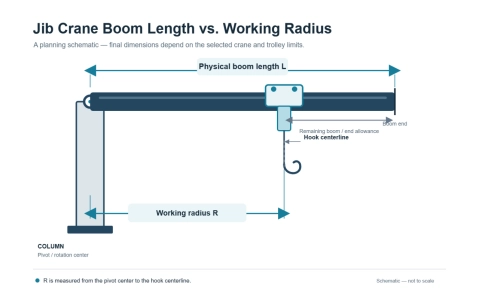
For a layout review, the engineering team should mark the rotation center, minimum and maximum hook positions, load pickup points, and no-go zones on the same plan.
Match Boom Length to the Load Path
Capacity, Radius, and Overturning Moment
A jib crane does not experience the same structural demand at every radius. As the load moves farther from the pivot, the overturning moment generally increases:
Moment = load × horizontal radius
The crane’s rated capacity must therefore be checked at the intended radius, not only at the column. A longer boom can provide more coverage but may require a heavier boom, a stronger column, a larger foundation, or a reduced capacity at the outer position.
The purchasing specification should identify:
- Maximum lifted load, including below-the-hook devices
- Load center of gravity and shape
- Required pickup and set-down points
- Maximum and minimum working radius
- Load spectrum and lifting frequency
- Whether the load is handled at the boom tip or at an intermediate trolley position
A capacity schedule or load chart should show the relationship between radius and allowable load. The jib crane capacity data can be used as a reference document during the initial comparison, while the final rating must match the selected configuration.
Workspace, Obstructions, and Rotation
The required reach should be based on the farthest routine load position, not the largest possible circle around the crane. Excess reach can create interference with doors, columns, sprinkler systems, conveyors, roof trusses, or adjacent cranes.
A practical workspace review includes:
- Draw the crane center and the required pickup and delivery points.
- Add the hook approach distance and trolley travel limits.
- Show the full swept area for the boom and load.
- Mark fixed obstructions and pedestrian exclusion zones.
- Check whether the boom can rotate without collision.
- Confirm access for installation, inspection, and maintenance.
A 180-degree slewing crane may be sufficient where a wall or machine blocks the rear area. A 270-degree or 360-degree arrangement may be justified when loads must be transferred between several workstations.
Read Jib Crane Dimensions Before Ordering
Vertical Dimensions and Clearances
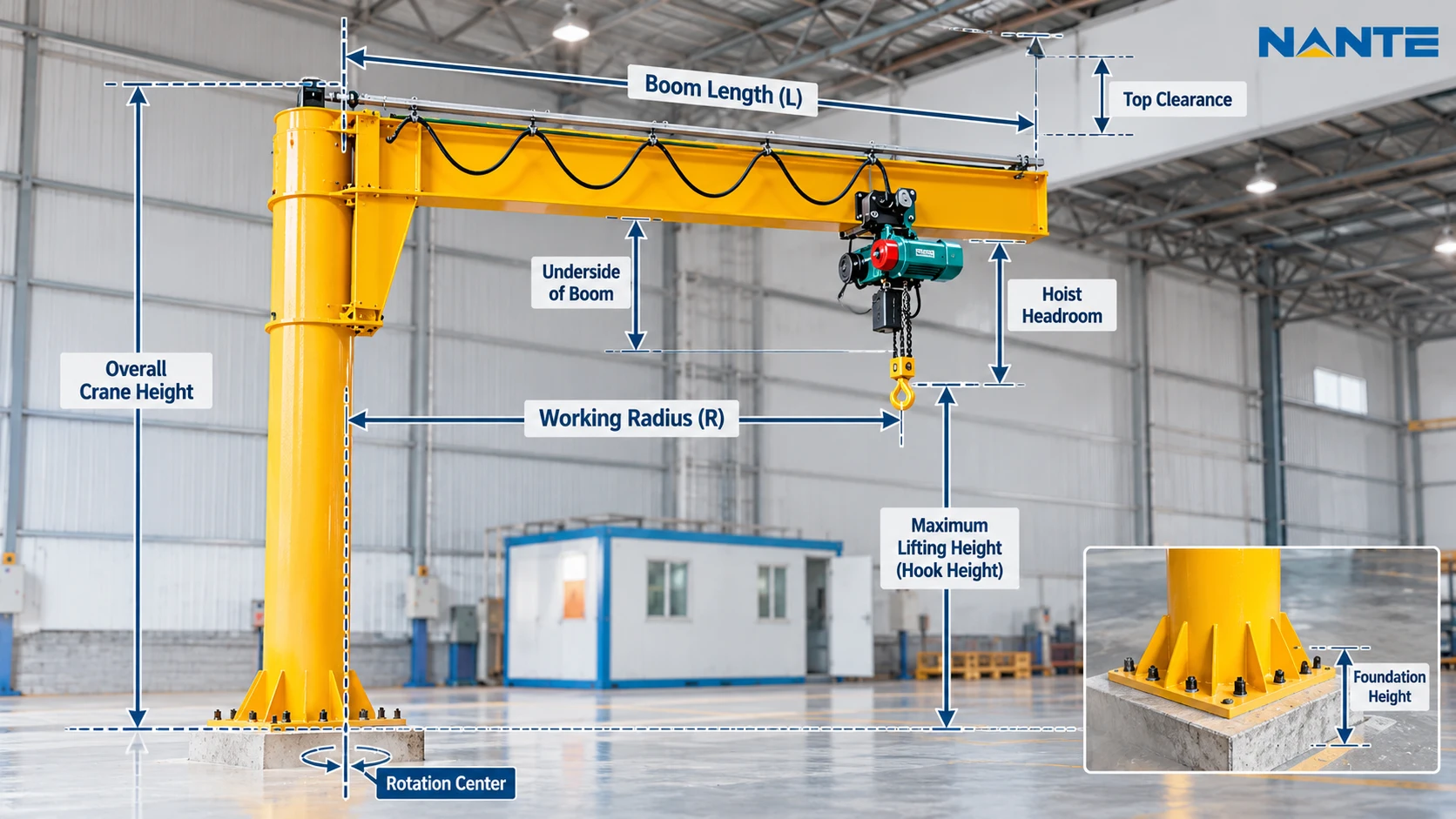
Jib crane dimensions include more than boom length. The vertical arrangement can determine whether the crane fits beneath a roof or whether the hook can reach a pallet, fixture, or vehicle.
The specification should identify:
- Overall crane height
- Underside of boom
- Minimum hook height
- Maximum lifting height
- Hoist headroom
- Required top clearance
- Foundation or bracket height
- Clearance from adjacent equipment
A low-headroom hoist may improve the usable lifting height without increasing the building height. However, the hoist body, hook block, power festoon, and upper limit position must all appear on the dimensional drawing.
Foundation, Wall, and Structural Interfaces
A free-standing jib crane transfers loads into a foundation. A wall-mounted or wall-travelling jib crane transfers loads into the supporting structure. These are different engineering decisions.
The quotation package should state the required anchor arrangement, base plate, bracket spacing, concrete assumptions, steelwork interface, and reaction loads. Existing columns should not be treated as suitable without a structural review.
The jib crane dimensions drawing should be reviewed alongside the building plan. The project owner can then confirm that the selected arm length, rotation envelope, and vertical clearances fit the actual work area.
Select the Crane Configuration and Hoist
Slewing, Trolley, and Control Method
Manual slewing can be appropriate for light, infrequent handling over a small radius. Motorized slewing may provide better control for heavier loads, longer arms, or repetitive production cycles.
The selection should also cover:
- Manual or powered trolley travel
- Pendant, radio, or fixed control
- Variable-speed requirements
- Emergency stop arrangement
- Upper and lower hoist limits
- Mechanical slewing stops
- Festoon or cable management
- Outdoor or indoor protection level
The hoist determines hook speed, headroom, control behavior, and service requirements. A review of available crane hoist systems helps align the lifting mechanism with the boom and duty requirements.
Environment and Duty Class
The same jib crane boom length can perform differently in a clean assembly area, a foundry, a washdown zone, or an outdoor loading point. Temperature, dust, moisture, corrosive chemicals, wind exposure, and impact risk should be included in the equipment specification.
Duty information should cover operating hours, lift frequency, average load, peak load, starts per hour, and expected service life. These inputs affect the hoist, gearbox, bearings, brake, electrical enclosure, and inspection plan.
Compare Suppliers on More Than Price
Technical Documents and Verification Records
A reliable comparison normalizes the complete supply scope before comparing price. Request the following documents where applicable:
- General arrangement and foundation drawings
- Load chart and rated-capacity schedule
- Structural calculations or design basis
- Material and welding records
- Motor, brake, and hoist data sheets
- Electrical schematic and control description
- Factory testing and calibration records
- Installation and commissioning method
- Operation, inspection, and maintenance manuals
- Recommended spare-parts list
The supplier should explain whether runway work, electrical connections, foundation construction, freight, installation, training, and commissioning are included or excluded.
Product Fit and Support Scope
The official product information for Nante Crane identifies free-standing, movable, wall-mounted, and wall-travelling jib crane options. Its published technical table lists different capacity, lifting-height, jib-length, and slewing ranges by configuration.
That information is useful for narrowing the equipment family. The project-specific quotation should still confirm capacity at the required radius, structural reactions, duty, controls, and installation conditions.
Additional selection-focused crane articles can support the research stage, but the final purchase decision should rely on an approved drawing, technical offer, and clarified scope.
Use a Repeatable Selection Workflow
Inputs Required for a Technical Offer
A concise project brief should include:
- Maximum capacity and any lifting accessories
- Required hook locations and working radius
- Boom or arm clearance requirements
- Lifting height and headroom limit
- Slewing angle and operating area
- Indoor or outdoor environment
- Operating hours and load spectrum
- Available foundation, wall, or column
- Power supply and control preference
- Delivery location and installation scope
- Applicable site standards and documentation needs
Clear inputs reduce assumptions and make supplier quotations easier to compare.
Example: Assembly Workstation
Consider an assembly station where loads must move from a staging pallet to a fixture and then to a nearby inspection bench. The correct boom length is the shortest option that covers all three points with the required hook approach and safety clearance.
If the outer point is reached only at the boom tip, the engineering review should check rated capacity at that position. If the load is handled repeatedly, powered slewing and trolley travel may provide more consistent positioning than manual movement.
The final selection may use a shorter boom with better capacity and lower structural demand, or a longer boom with a reduced outer-radius rating. The preferred option depends on the actual load path and production cycle.
Jib Crane Boom Length FAQs
How is jib crane boom length measured?
It is normally measured along the boom from the pivot or support reference to the boom end. The usable hook radius depends on trolley travel, hoist geometry, and required clearances.
Is a longer jib crane arm always better?
No. A longer arm can increase coverage but may increase moment, deflection, foundation reactions, and cost. It may also create more interference with nearby equipment.
Which jib crane dimensions should be shown on a layout?
The plan should show the pivot center, boom length, working-radius arc, hook positions, rotation limits, overall height, underside of boom, hook height, obstructions, and maintenance access.
Does capacity stay constant across the working radius?
Not necessarily. The allowable load may vary with radius and configuration. The approved load chart should be used for procurement, operation, and training.
Request a Project-Specific Jib Crane Proposal
A purchasing team can request a technical review by submitting capacity, load dimensions, pickup and set-down points, required jib crane reach, lifting height, duty cycle, environment, rotation angle, structural conditions, and installation scope. Nante Crane can then review the application and prepare a configuration for comparison, including the relevant boom length, hoist arrangement, dimensions, and documentation scope. Send the project brief through the jib crane quotation request.