English



Pillar Mounted vs Wall Mounted Jib Crane: What’s the Difference?
Pillar Mounted vs Wall Mounted Jib Crane What's the Difference
Date: 2026-10-01 Share:
A pillar mounted jib crane stands on its own mast and transfers crane forces into a dedicated foundation. A wall mounted jib crane attaches to an existing building column or engineered wall and transfers those forces into the building structure.
That difference controls foundation work, structural verification, rotation, floor use, and installation risk. The right choice is an engineering decision, not simply a mounting preference.
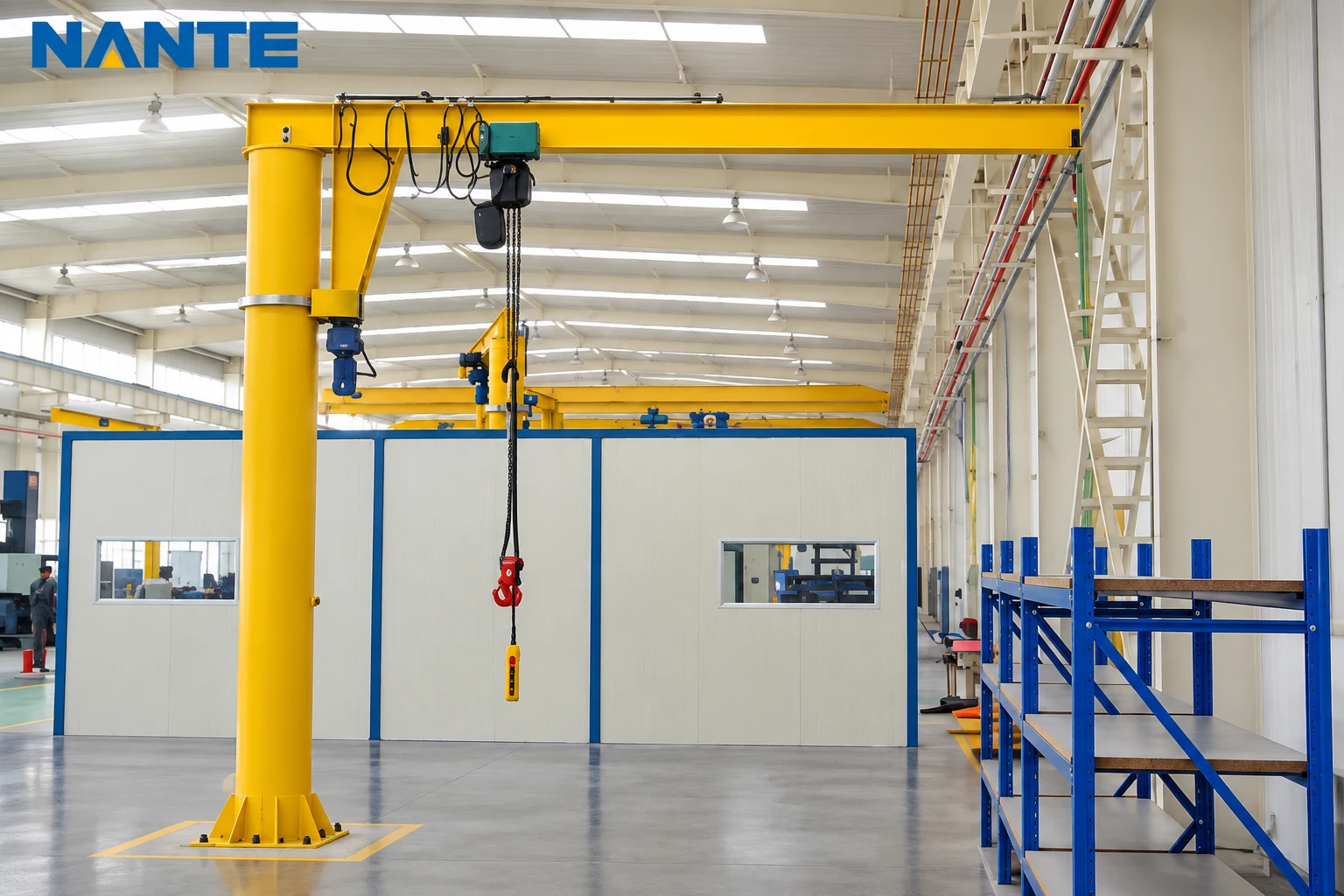
Pillar Mounted vs Wall Mounted Jib Crane at a Glance
Quick Engineering Comparison
| Decision factor | Pillar mounted jib crane | Wall mounted jib crane |
|---|---|---|
| Primary support | Independent steel mast | Existing column, frame, or engineered wall |
| Load path | Mast, base plate, anchors, foundation, soil | Jib brackets, connections, building member, frame, foundation |
| Foundation need | Usually a dedicated engineered footing | No separate mast footing, but the building support must be verified |
| Rotation | Broad coverage; near-full-circle rotation may be possible when designed for it | Commonly limited by the wall or column line |
| Floor use | Mast and base occupy floor space | Keeps the floor below the support clear |
| Retrofit impact | Civil work and possible slab removal | Structural survey, connection work, and possible reinforcement |
| Relocation | Requires a new foundation at the new position | Requires another verified structural support |
Neither arrangement is automatically cheaper. A pillar unit may need concrete work, while a wall-mounted unit may require reinforcement, access equipment, or building changes.
How a Pillar Jib Crane Transfers Loads
Foundation and Anchor-Bolt Load Path
With a pillar jib crane, the hoist load acts at a horizontal radius from the mast. This creates an overturning moment in addition to vertical force and horizontal reactions. The mast carries these actions to the base plate, anchor rods, reinforced concrete footing, and supporting soil.
A useful engineering illustration should show the suspended load at the trolley, the resulting moment at the mast, compression beneath one side of the base, and anchor tension on the opposite side. This makes clear why a standard floor slab cannot be assumed to be an adequate foundation.
The Jib Crane Foundation review should address concrete strength, footing dimensions, reinforcement, anchor layout, grout, soil bearing, underground services, and tolerances. Slab thickness alone does not establish adequacy.
Where Pillar Mounting Works Best
An independent mast is useful when the building frame is unavailable, too distant, or not suitable for added crane reactions. It also lets the project team place the work cell around the required hook coverage instead of following the building column grid.
Typical candidates include open production areas, outdoor pads, work cells, and retrofits where structural modification would be disruptive. The tradeoff is a floor obstruction and early foundation work.
How a Wall Mounted Jib Crane Uses the Building Structure
Bracket Reactions and Structural Support
A wall mounted jib crane normally connects through vertically separated upper and lower brackets. The bracket forces form a reaction couple that resists the jib’s overturning moment, while the support also receives vertical and horizontal loads.
An engineering load-transfer diagram should trace forces from the boom through both brackets into the column or frame, then down to the building foundation. It should also identify local connection forces, because the supporting member may be adequate globally but weak at the flange, web, bolts, welds, or bracket locations.
The term column mounted jib crane often describes the same support principle when brackets attach to a structural column rather than a wall surface. Attachment to masonry, cladding, or an unverified concrete wall should never be assumed acceptable.
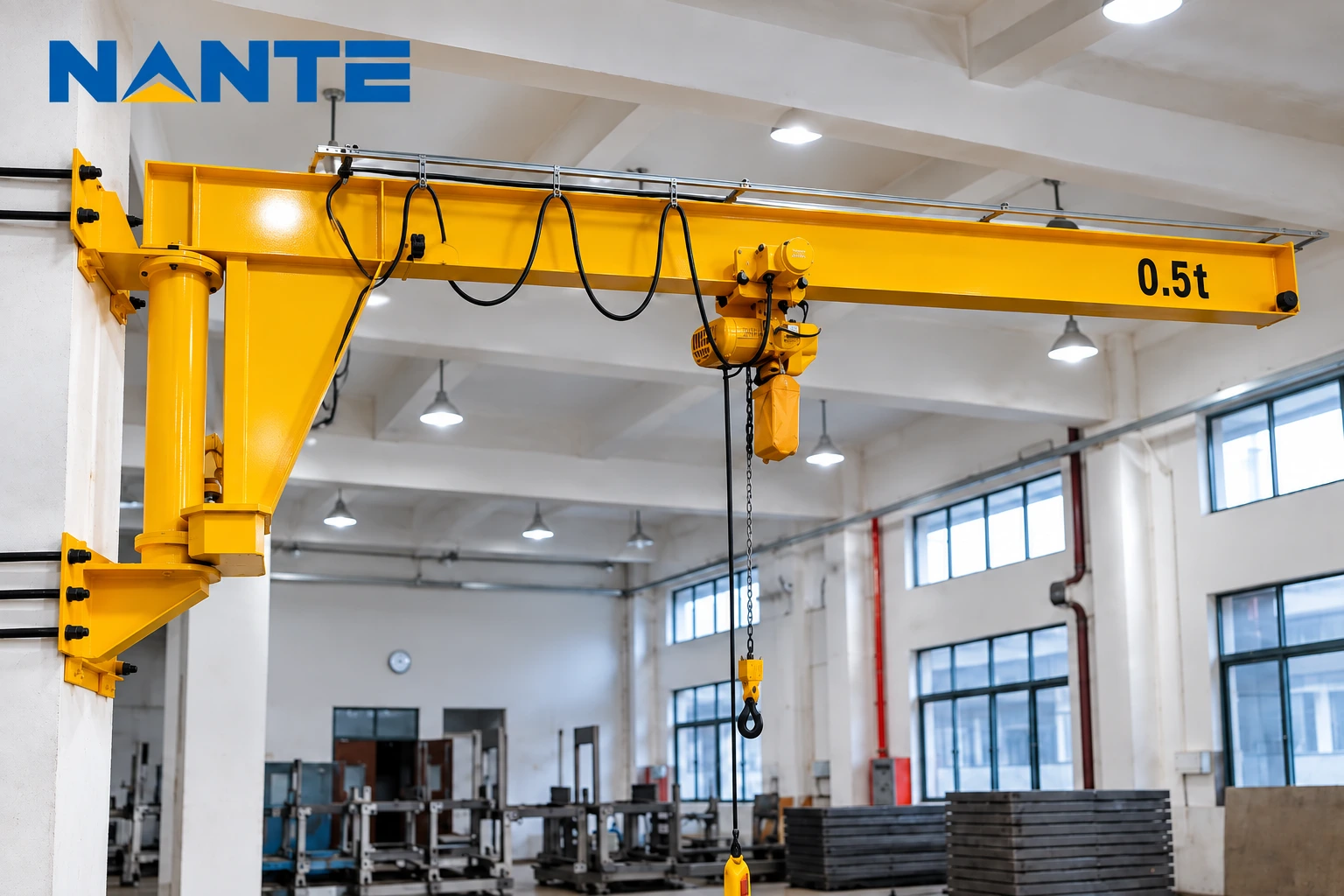
What Must Be Checked Before Mounting
The structural review should confirm member size and grade, connection geometry, condition, load combinations, local buckling, torsion, deflection, fatigue, and effects on the frame. Field measurements and material verification may supplement original drawings.
The Jib Crane Mounting package should define bracket elevations, bolt or weld details, permitted tolerances, erection sequence, inspection hold points, and responsibility for structural reinforcement. These details prevent the crane supplier and building contractor from working to different assumptions.
Rotation and Working Coverage
Pillar-Mounted Coverage
Because an independent mast is not backed by a wall, a pillar-mounted system can provide a wider circular work envelope. Near-full-circle rotation may be possible, but actual travel depends on the crane design, rotation stops, power supply, surrounding equipment, and collision clearances.
The nominal boom radius is not the usable hook coverage. Check the inner dead zone, trolley end approaches, hoist dimensions, and sectors restricted by controls or power feeds.
Wall-Mounted Coverage
A wall-mounted system works mainly on one side of its supporting structure. Its coverage resembles a sector or semicircle rather than a full circle, and building columns, walls, ducts, lights, or machines may reduce the usable area further.
For a machine-side handling task, that limited sector can be exactly what is required. If loads must move between stations on opposite sides of the support line, a pillar arrangement or another material-handling solution may fit better.
Capacity, Radius, and Building Interface
Why Rated Load Alone Is Not Enough
Jib crane capacity must be evaluated together with radius and duty. A load farther from the support produces a larger overturning effect, while the hoist, trolley, boom self-weight, operating motion, and dynamic effects also contribute to design actions.
The Jib Crane Capacity discussion should begin with lifted load, hook position, operating frequency, load spectrum, handling method, and required standard. Capacity alone cannot define support reactions.
Information Needed for Structural Coordination
The crane supplier should issue reactions for the specified configuration. The structural engineer then checks the support using applicable load combinations and site conditions.
The coordination package should include:
- Rated load and below-the-hook device weight.
- Boom length, trolley travel, hook approaches, and rotation range.
- Hoist and trolley weights, speeds, and control method.
- Vertical, horizontal, torsional, and overturning reactions at the interface.
- Duty, operating hours, environment, and applicable codes.
- Base-plate or bracket drawings, anchor details, tolerances, and erection loads.
Jib Crane Mounting: Installation and Retrofit Risk
Installing a Pillar-Mounted Unit
Pillar installation can involve utility scanning, slab opening, excavation, reinforcement and anchors, concrete placement, grouting, mast alignment, and commissioning.
The schedule must include civil work, curing, survey control, and production access. Check anchor templates and as-built dimensions before crane delivery.
Installing a Wall-Mounted Unit
Wall mounting avoids a separate mast footing but can require work at height, restricted access, reinforcement, controlled welding, bolt installation, alignment, and temporary support.
In the latter project stages, Nante Crane can be evaluated through its published jib-crane information and the project-specific drawings, interface reactions, documents, testing scope, and service responsibilities included in the quotation. The jib crane product range provides a useful starting point for configuration discussions.
How to Choose Between the Two Mounting Styles
Select a Pillar-Mounted Crane When
- Broad rotation and a circular work envelope are important.
- No verified building support is available at the required location.
- The crane position must be independent of the column grid.
- Dedicated foundation work is practical.
- The mast footprint will not interfere with production or traffic.
Select a Wall-Mounted Crane When
- A structurally suitable column or frame is available.
- Floor space beneath the support must remain clear.
- A one-sided working sector covers the complete handling task.
- The building owner permits attachments and any reinforcement.
- Structural access and installation shutdowns are manageable.
Use a Formal Decision Gate
Before purchase, compare both options on the same basis: crane equipment, hoist and controls, foundation or reinforcement, structural engineering, electrical supply, access, installation, inspection, load testing, production downtime, documentation, freight, warranty, and exclusions.
Final approval should include the true hook envelope and obstacles, plus an authorized structural design where required. Crane and building calculations must share the same reactions and interface geometry.
FAQ
Is a pillar jib crane the same as a column mounted jib crane?
Terminology varies. “Pillar” often means a freestanding mast fixed to a foundation, while “column mounted” may mean a jib attached to an existing building column. Procurement documents should define the support and connection rather than rely on the name alone.
Can a wall-mounted jib crane be fixed to any wall?
No. The support must be engineered for the crane reactions and connection forces. Cladding, ordinary partition walls, and unverified masonry are not structural evidence.
Does a wall-mounted crane eliminate foundation checks?
It usually eliminates a separate mast footing, but crane forces still travel through the building frame to its foundation. The affected columns, beams, bracing, connections, and foundations may all require verification.
Which design provides more rotation?
A pillar-mounted design generally offers broader rotation because no wall blocks the boom. Actual rotation for either design must be confirmed on the supplier drawing and checked against obstructions, stops, and power-delivery arrangements.
Request a Project-Specific Mounting Review
Submit the Design Basis
Purchasing teams comparing these configurations should submit the rated load, boom length, hook height, duty, rotation requirement, layout, support drawings, site photos, environment, power supply, destination, and installation scope. Nante Crane can use those inputs to review the configuration and prepare a project-specific technical and commercial response through the jib crane project inquiry.