English


5 Types of Rubber Tyred Gantry Cranes and Their Applications
5 Types of Rubber Tyred Gantry Cranes and Their Applications
Date: 2026-04-23 Share:
A rubber tyred gantry crane delivers high mobility for container handling and heavy lifting without fixed rails. This versatile equipment moves freely on rubber tires across ports, shipyards, and logistics yards. Buyers often search for rubber tyred gantry crane types to match specific load requirements and site conditions. The guide explores structural components, five primary designs, applications, comparisons like RTG crane vs RMG, and practical selection tips. Every rubber tyred gantry crane features robust girders, hoisting mechanisms, and tire-mounted bases that enhance flexibility in dynamic environments.
What is a Rubber Tyred Gantry Crane (RTG Crane)?
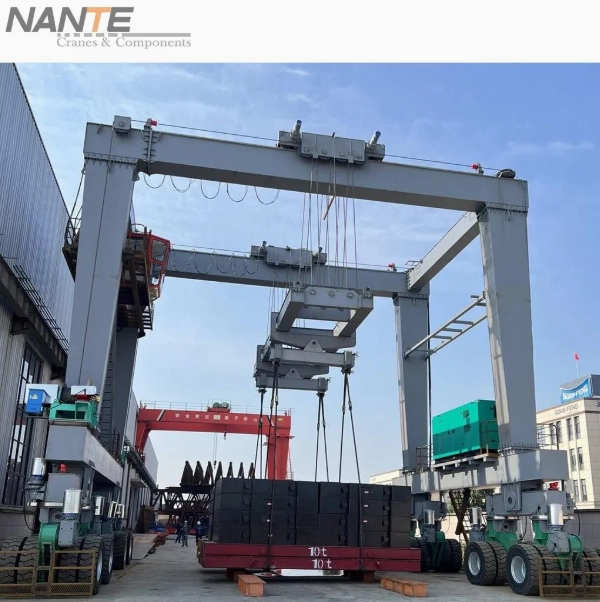
A rubber tyred gantry crane serves as a mobile lifting solution that operates without rails. Operators use the equipment primarily for container handling, general cargo, and heavy materials in outdoor yards. The design combines a gantry structure with rubber tire mobility for quick repositioning.
The rubber tyred gantry crane offers exceptional flexibility compared to rail-dependent systems. Facilities in ports and shipyards benefit from its ability to adapt to changing layouts without major infrastructure changes.
Structural Components of RTG Crane
The supporting and mobile section of RTG crane includes legs, wheel assemblies, and rubber tires that provide stability and movement. These components allow the crane to travel in multiple directions on concrete or asphalt surfaces.
The RTG crane load-bearing structure design uses welded girders made from high-strength materials with controlled deflection. This construction ensures safe operation under repeated heavy loads.
The RTG crane hoisting mechanism explained covers electric hoists or winches with dual brakes for safe lifting. Nante Crane supplies reliable hoisting mechanisms and crane components that integrate seamlessly into these systems.
The RTG crane gripping components types typically include spreaders or hooks suited for containers and bulk loads. These attachments enable precise handling of 20-foot to 45-foot containers.
Key Features and Specifications of RTG Crane
The RTG crane mobility and flexibility advantages allow multi-directional travel and adaptation to varying yard layouts. Operators can reposition the crane easily between different operational blocks.
Benefits of rubber tires in gantry cranes include shock absorption, no rail installation costs, and operation on concrete or asphalt surfaces. The tires provide good traction while protecting the ground.
The RTG crane load capacity and lifting height range typically spans 5–100 tons and 3–60 meters depending on configuration. Common models handle 20–65 tons under the spreader with stacking heights up to 1-over-6 containers.
The customizable span and width of RTG crane supports operations from small yards to wide container stacking areas. Spans often range from 5–40 meters to fit specific site dimensions.
5 Types of Rubber Tyred Gantry Cranes – Designs and Uses
Rubber tyred gantry cranes come in several configurations. Each type addresses different operational needs in ports, shipyards, and logistics yards.
Single Girder Rubber Tyred Gantry Crane
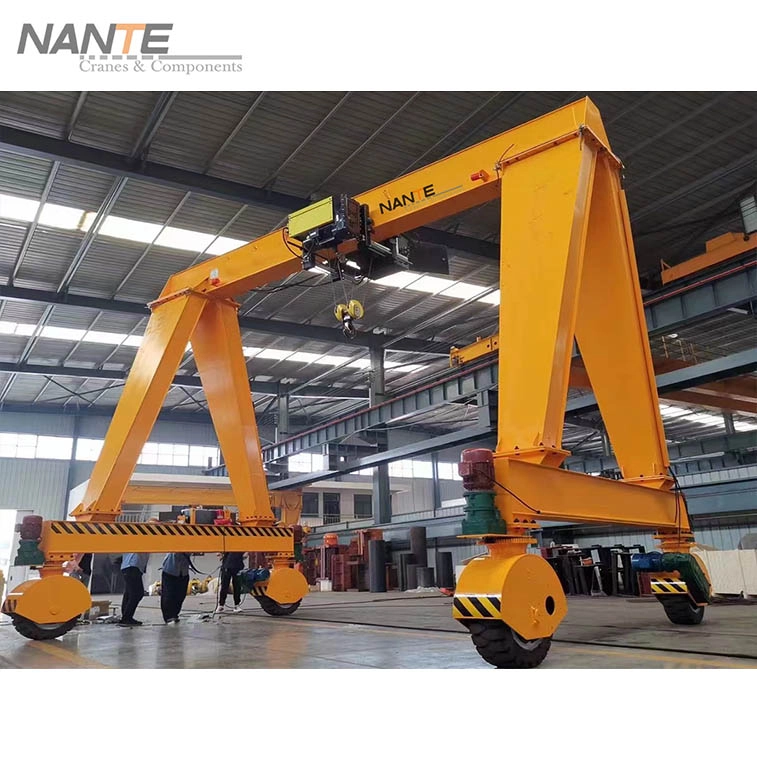
Structural features of single girder RTG crane include one main beam for lighter self-weight and cost efficiency. The design reduces overall crane mass while maintaining adequate strength for lighter duties.
The single girder RTG crane offers load capacity typically up to 20 tons and spans of 5–40 meters. Lifting heights usually reach 6–12 meters, making the model suitable for moderate operations.
Best use cases for small yard operations involve light-to-medium duty handling in logistics yards or precast plants. The single girder RTG crane performs well where space is limited and high capacity is not required.
Advantages include lower initial investment and easier handling for infrequent or moderate operations. Facilities with budget constraints or smaller throughput often select this type.
Double Girder A-Frame Rubber Tyred Gantry Crane
Structural features and stability advantages of the A-frame design provide excellent rigidity for heavy loads. The A-frame legs converge at the top, creating a stable triangular structure.
The heavy duty lifting capacity reaches 5–100 tons or more with spans up to 35–40 meters. Lifting heights can extend to 30 meters in customized setups.
Applications in container terminals include stacking and transferring containers efficiently in busy ports. The A-frame RTG crane handles high-volume operations where stability matters most.
Double Girder U-Frame Rubber Tyred Gantry Crane
Structural advantages for container stacking come from the U-frame opening that accommodates wider loads. The open U-shape allows containers or vehicles to pass underneath easily.
The load capacity and operational efficiency support high stacking heights in dense yards. The design improves workflow by enabling direct passage under the frame.
Applications in logistics yards focus on container handling where clear passage under the frame improves workflow. The U-frame RTG crane excels in areas requiring frequent internal transport.
Tire-Mounted Straddle Carrier
The structural design and mobility benefits allow the straddle carrier to straddle and transport containers directly. The carrier moves loads without additional lifting equipment in many cases.
Key components and control systems include robust tire assemblies and operator cabins or remote controls. Advanced steering enables 90-degree turns and crab movement.
Applications in port container transport emphasize short-distance movement and stacking within terminals. The straddle carrier boosts efficiency in busy yards by combining transport and lifting functions.
Tire-Mounted Ship Hoisting Crane (Mobile Ship Crane)
Structural features for marine lifting include reinforced frames suited for dockside conditions. The design withstands wind and uneven surfaces near water.
The load capacity for ship handling supports heavy ship components or equipment transfer. Capacities often reach dozens of tons for large assemblies.
Applications in shipyards and docks involve assembly, maintenance, and loading operations near water. The mobile ship crane provides flexible lifting where fixed equipment cannot reach.
Comparison with Other Types of Gantry Cranes
 Buyers frequently evaluate options before investing. Clear comparisons help match equipment to operational realities.
RTG Crane vs Rail-Mounted Gantry Crane (RMG)
The RTG crane vs RMG comparison highlights rubber tyred gantry crane flexibility versus rail-mounted stability. RTG models move freely across yards without rails, while RMG cranes follow fixed tracks.
Rubber tyred models require no fixed infrastructure but may have slightly lower automation potential in some setups. Rail-mounted versions offer higher precision and wind resistance in large fixed terminals.
Key differences include initial cost, mobility, and suitability for expandable versus permanent yards. RTG cranes suit medium-sized or changing terminals, while RMG cranes fit high-density, automated ports.
RTG Crane vs Overhead Crane
The rubber tyred gantry crane operates outdoors without building support, unlike overhead cranes limited to indoor runways. The RTG crane reaches open yards where overhead systems cannot function.
Mobility advantages make the RTG crane ideal for open yards where overhead systems cannot reach. Overhead cranes provide precise indoor handling but lack the outdoor flexibility of rubber tyred designs.
RTG Crane vs Mobile Crane
The rubber tyred gantry crane provides higher lifting heights and spans compared to standard mobile cranes. Dedicated gantry structure delivers better stability for repetitive container or heavy load cycles.
The RTG crane maintains consistent performance in dedicated yard operations. Mobile cranes offer greater portability but lower precision for continuous container stacking.
Additional Operational Considerations for Rubber Tyred Gantry Cranes
Power options and control systems range from diesel generators to electric drives with remote or cabin operation. Modern setups often incorporate hybrid or fully electric systems for efficiency.
Safety features include overload protection, anti-collision systems, and stable tire configurations. These elements protect operators and loads during daily operations.
Environmental adaptability allows operation in ports and shipyards under varied weather conditions. The rubber tyred gantry crane handles dust, wind, and temperature fluctuations common in outdoor settings.
Practical Recommendations for Buyers
Selecting Models Based on Operational Requirements
Buyers should define RTG crane operational needs by assessing daily load volumes and container sizes. Accurate needs analysis prevents under- or over-specification.
The evaluation of worksite conditions for gantry crane includes ground bearing capacity and available space. Site surveys ensure the chosen model operates safely on existing surfaces.
Operators must assess operating frequency and intensity to choose appropriate duty classes. High-cycle environments demand heavier-duty designs.
Specialized RTG models become necessary for unique marine or high-stack applications. Customization addresses specific challenges in shipyards or logistics yards.
Discover Tailored Rubber Tyred Gantry Crane Solutions with Nante Crane
As one of the most reputable manufacturers of cranes, Nante Crane has been serving its clients for more than 30 years by providing quality services in the field of cranes and parts for cranes. Among other products, the company offers various types of rubber tyred gantry cranes, such as single girder and double girder cranes along with different types of lifting devices. By offering intelligent, energy-saving, and reliable solutions, Nante Crane provides its services to clients from all over the world. Contact Nante Crane today.
FAQ
What is the typical load capacity of a rubber tyred gantry crane?
Rubber tyred gantry cranes commonly handle 5–100 tons, with single girder models suited for lighter duties and double girder versions for heavier container operations.
What are the main advantages in an RTG crane vs RMG comparison?
The RTG crane provides superior mobility and lower infrastructure costs, whereas RMG cranes excel in fixed, high-precision, and automated terminal setups.