English



How to Calculate Jib Crane Capacity
How to Calculate Jib Crane Capacity
Date: 2026-09-24 Share:
Jib crane capacity calculation starts with the heaviest total suspended load, not only the workpiece weight. Add removable lifting accessories, confirm the maximum working radius, then match the crane, hoist, hook, support structure, and duty class to the same operating case.
The selected rated capacity must equal or exceed the maximum payload plus rigging and below-the-hook device weight. Structural design then applies code-specific factors, which never permit operational overloading.
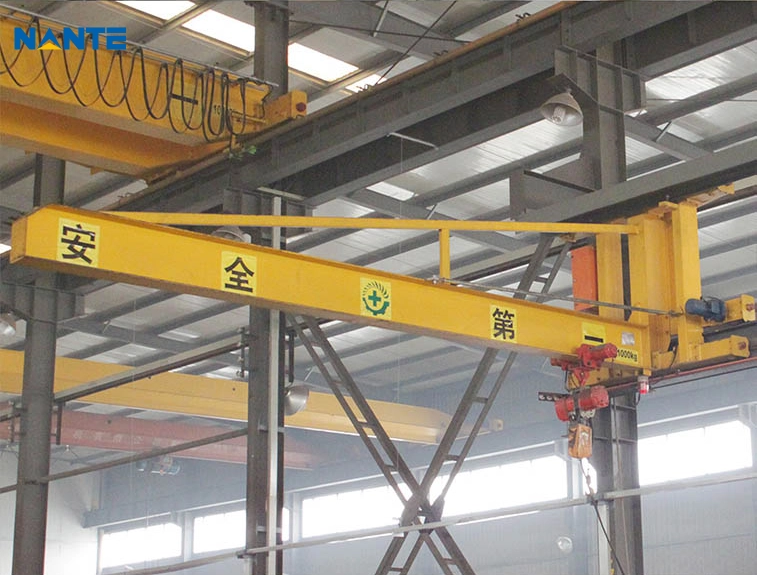
Start With Jib Crane Rated Load
What Rated Capacity Actually Means
The jib crane rated load is the manufacturer-designated maximum for operation under stated conditions. It should appear on the equipment and agree with the supplier’s documents.
For a fixed industrial jib, the rating normally covers the most demanding permitted trolley position near maximum radius. Moving inward does not increase the allowable load unless the manufacturer provides another marked rating.
The hook block supplied with the hoist is normally included in hoist design. Removable slings, clamps, magnets, grabs, vacuum lifters, and spreader beams generally count as lifted load. Confirm this boundary in the quotation.
Basic Jib Crane Load Capacity Formula
Use the following procurement calculation:
Required rated capacity ≥ maximum payload + rigging + removable below-the-hook device
In symbols:
C_required ≥ W_payload + W_rigging + W_BTH
Suppose a cell handles a 1,800 kg assembly with a 110 kg lifting beam and 40 kg of slings. The suspended mass is 1,950 kg, so a 2 metric ton (2t) rating may cover that lift. The remaining 50 kg is not an overload allowance.
An arbitrary “safety factor” is not a complete design. Capacity selection, engineering factors, proof testing, and operational limits serve different purposes.
Convert Working Radius Into Structural Demand
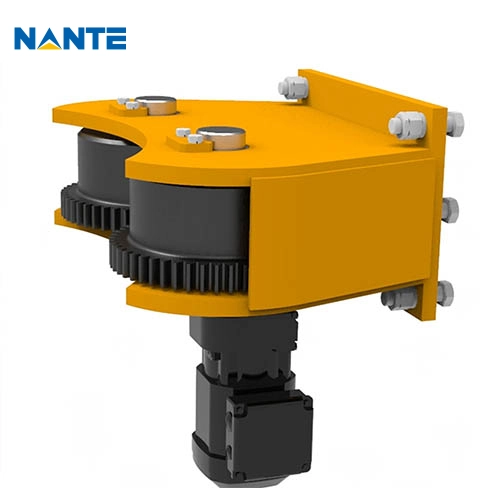
Measure the Actual Working Radius
Working radius is the horizontal distance from the rotation axis to the load line through the hook. It differs from nominal boom length because end stops, the hoist, column, and clearances restrict travel.
Capacity must be available at the farthest required pick or set-down point, where the load creates the greatest bending and overturning effect.
Estimate Jib Crane Design Load From Service Moment
A useful screening equation for the suspended-load moment is:
M_suspended = m_suspended × g × R
For the 1,950 kg example at a 4 m radius, the suspended-load service moment is approximately 1,950 × 9.81 × 4 = 76.5 kN·m. At 3 m, the same load produces about 57.4 kN·m.
This is not the final jib crane design load. Engineering must also include equipment dead weight, acceleration, braking, slewing, load swing, required load combinations, and applicable environmental actions.
The mast, boom, connections, anchors, and foundation must resist the calculated actions. Wall- or column-mounted jibs also require a documented building-structure check.
Account for Load Spectrum and Duty Class
Why Maximum Load Is Only Half the Duty Question
Two cranes can share a rating but face different fatigue demand. Occasional maintenance lifts are not equivalent to hundreds of production cycles per shift.
The load spectrum records the share of cycles at each load level. Many ISO/FEM methods weight high-load cycles approximately with a cubic relationship, then combine the spectrum with total use.
As a screening example, a shift with 70% of lifts at 30% load, 20% at 60%, and 10% at full load has a cubic load-spectrum index of:
0.70(0.30³) + 0.20(0.60³) + 0.10(1.00³) = 0.162
The index alone does not determine duty class. The governing standard, lifetime cycles, starts per hour, motions, environment, and hoist classification still matter.
Data Needed for Jib Crane Lifting Capacity Selection
Record operating data rather than calling the service only “light” or “heavy”:
-
Maximum, typical, and minimum lifted masses
-
Percentage of lifts in each load band
-
Lifts and motor starts per hour
-
Operating hours per shift and shifts per day
-
Required lifting, trolley, and slewing speeds
-
Indoor, outdoor, corrosive, hot, dusty, or hazardous conditions
-
Planned production changes
An underestimated class can shorten component and structural fatigue life even without an overload.
Capacity Examples for 1t, 2t, 3t, and 5t Applications
Worked Selection Cases
The following examples use metric tons, where 1t equals 1,000 kg. They screen rated capacity only; they do not replace structural calculations or manufacturer approval.
| Application | Maximum payload | Accessories | Total suspended load | Initial capacity check |
|---|---|---|---|---|
| 1t jib application | 850 kg | 100 kg | 950 kg | Within 1t, with 50 kg remaining |
| 2t jib application | 1,800 kg | 150 kg | 1,950 kg | Within 2t, with 50 kg remaining |
| 3t jib application | 2,700 kg | 220 kg | 2,920 kg | Within 3t, with 80 kg remaining |
| 5t jib application | 4,500 kg | 350 kg | 4,850 kg | Within 5t, with 150 kg remaining |
How to Interpret the Numbers
These margins are narrow. Part tolerances, residue, revised fixtures, or heavier rigging can consume them.
If the payload alone is 1t, 2t, 3t, or 5t, adding the example accessories raises the required ratings to 1.10t, 2.15t, 3.22t, and 5.35t respectively. The purchasing team should then select the next verified standard rating or request an engineered capacity—not round the calculation down.
Reserve capacity must be reflected across the crane, hoist, hook, support, electrics, and testing. A larger hoist on an under-rated boom does not increase system capacity.
After the capacity screen, buyers can compare available jib crane configurations against the required radius, rotation, headroom, and support arrangement. A listed nominal capacity remains a starting point; the selected configuration still requires project-specific verification.
Match Every Component to the Same Rated Load
Hoist, Hook, and Boom Compatibility
System capacity is limited by its lowest-rated relevant component, including the hoist, hook, trolley, boom, anchors, and supporting structure.
The hoist must match capacity, lift height, speed, headroom, power, environment, and duty. The supplier should state the selected hoist configuration and duty-group information in the technical proposal.
Hooks and lifting devices need compatible load limits, geometry, markings, and inspection criteria. Final acceptance should rely on manufacturer data and the governing project standard.
Support and Foundation Checks
For a freestanding jib, request reactions and anchor loads for the exact capacity and radius. Structural review should cover the concrete, footing or slab, reinforcement, anchors, and installation tolerances.
For a wall-mounted unit, request reactions and moments at each bracket. The building owner should approve the attachment after structural evaluation.
For supplier evaluation, Nante Crane can be reviewed against the same documentation requirements. Product information helps define the configuration, but project-specific drawings, reactions, interfaces, and component ratings should be confirmed in the proposal.
Use a Repeatable Engineering and Selection Workflow
Seven Steps for Jib Crane Capacity Calculation
-
Define the heaviest payload and verify how its weight is controlled.
-
Add all removable rigging and below-the-hook lifting devices.
-
Map the required hook path and maximum working radius.
-
Record the load spectrum, starts per hour, operating time, and environment.
-
Select a rated capacity that covers the total suspended load without rounding down.
-
Match the crane structure, hoist, hook, trolley, support, electrics, and controls.
-
Obtain reviewed drawings, reaction loads, calculations, test procedures, and rating labels.
The crane duty group guidance can support the workload discussion, but the purchase specification should name the applicable classification system and required class. Terms such as “heavy duty” are not technically comparable without that reference.
Documents to Request Before Purchase
A comparable proposal should include the arrangement, hook radii, rated load, lift height, rotation, duty classes, speeds, controls, component ratings, support reactions, design standards, inspection plan, and load-test procedure.
Clarify exclusions for foundations, reinforcement, installation, commissioning, training, spares, and inspection so quotations cover equivalent scope.
Jib Crane Capacity Calculation FAQs
Can a 1t Jib Crane Lift a 1t Part With a Clamp?
Not if the clamp and other removable rigging add weight beyond the 1t rating. A 1,000 kg part plus a 75 kg clamp creates at least 1,075 kg of suspended load, so a higher verified system rating is required.
The hook and attachment must also carry suitable markings, working load limits, and inspection criteria. Additional capacity, safety-factor, and standards considerations should be confirmed from the hook manufacturer’s technical data.
Does Jib Crane Capacity Increase at a Shorter Radius?
Not operationally unless the manufacturer provides and marks a radius-dependent rating. A shorter radius reduces structural moment, but operators must follow the stated rated load rather than calculate an informal higher capacity.
What Is the Difference Between Rated Load and Design Load?
Rated load is the maximum permitted operating load stated by the manufacturer. Design load is the set of factored actions engineers use to size and verify the structure and components, including lifted load, dead loads, dynamic effects, and other required combinations.
Request a Project-Specific Capacity Review
Information for a Technical Proposal
Purchasing teams planning a 1t, 2t, 3t, 5t, or custom jib crane should provide the maximum payload, accessory weights, radius, lift height, rotation, load spectrum, starts per hour, duty classification, environment, supporting structure, power supply, destination, and installation scope.
With those inputs, Nante Crane can review the operating case and prepare a project-specific equipment proposal with the relevant configuration and interface requirements. Submit the calculation brief through the jib crane project inquiry page.