English



How to Choose the Right Jib Crane for Your Application
How to Choose the Right Jib Crane for Your Application
Date: 2026-09-24 Share:
A jib crane is a focused lifting station: a horizontal boom (jib) rotates around a column, wall bracket or other support while a hoist raises and lowers the load. The right choice is the smallest, safest configuration that covers every required pick, set-down point and operating cycle.
Poor selection creates hidden costs. An undersized structure can limit safe working load; an overlong boom can overload a foundation or block aisles; insufficient height can make a correct-capacity crane unusable. A disciplined specification turns a broad request into comparable quotes.
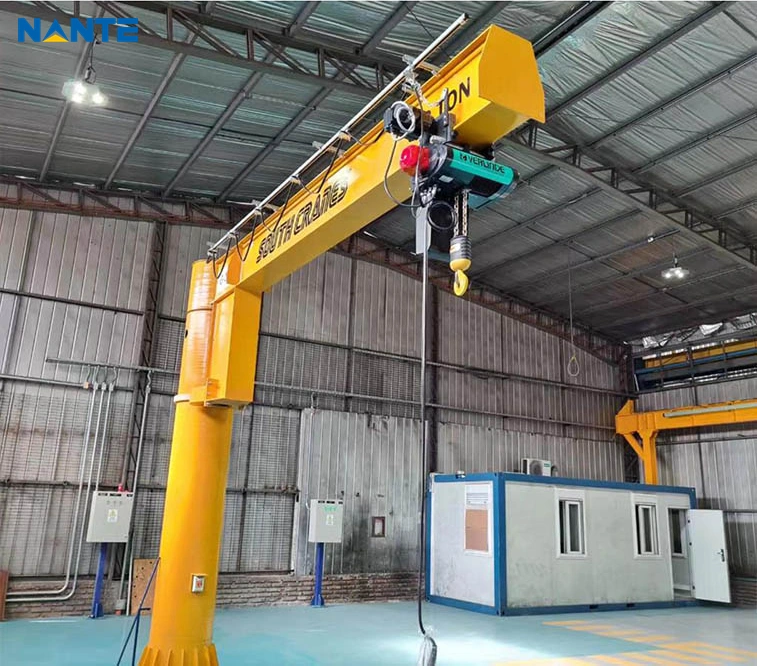
Why Jib Crane Selection Starts with the Application
Define the lifting task
List the heaviest handled load, not only the product name. Include pallets, fixtures, spreader beams, slings, hooks and any process tooling suspended from the hook. Record the maximum load, typical load, load dimensions, center of gravity and whether the load can swing.
The rated capacity must cover the complete lifted assembly at the working radius. A Jib Crane product page can illustrate common configurations, but the final rating still requires a project-specific load case and engineering review.
Map every pick and drop point
Create a plan view showing the crane center, furthest hook position, doors, machines, walkways and no-go zones. Mark the shortest and longest reach used in normal work. This reveals whether one station is adequate or several smaller stations will reduce travel.
How to Choose a Jib Crane: Step-by-Step Checklist
1. Set capacity and load spectrum
Specify safe working load in the units used at the site, plus the maximum lifted accessory weight. Then describe use: lifts per hour, operating hours per shift, shifts per day, days per week and the share of lifts at maximum load. A crane that moves a light part frequently may need a different duty class from one that makes occasional heavy lifts.
Do not add an arbitrary percentage as a substitute for design. Ask for structural calculations, hoist selection, hook approach and overload protection based on the stated load spectrum. The quotation should clearly define jib crane capacity and every load included in the rating.
2. Choose working radius and boom length
Working radius is the horizontal distance from the rotation axis to the hook center. Boom length is not automatically the usable radius: end clearances, trolley travel, hook approach and a required buffer from walls can reduce coverage.
Measure the farthest load center and nearest obstruction. Specify whether the hook must reach below the boom, beside a machine or through a doorway. Request a dimensioned general-arrangement drawing so radius, trolley stops and clearances are unambiguous.
3. Confirm lifting height and headroom
Define hook upper and lower positions, floor-to-ceiling height, roof beams, lights, sprinklers and required clearance. Low-headroom hoists can preserve usable lift where structural depth is constrained; a standard hoist may suit open headroom.
The specification should separate maximum lift from hook approach. A high hook may still leave too much dead space if the hoist cannot travel close to the support or floor. Ask for a section view with the fully raised hook and the tallest load.
4. Select rotation angle and control zone
Rotation can be manual or powered. A 180-degree arc may serve a machine-to-bench transfer; 270 degrees can cover two work faces; 360 degrees suits a central workstation when traffic is controlled. Stops or interlocks may protect walls, adjacent cranes and people.
Control location matters as much as angle. Compare pendant, radio and local controls for line of sight, operator distance and emergency-stop access. Specify speeds, acceleration limits and whether variable-frequency drives are needed.
Industrial Jib Crane Selection: Match Type to the Structure
Free-standing and foundation-mounted
A free-standing jib gives an independent work envelope where building steel cannot carry the moment. The foundation, anchor bolts and reinforcement become part of the package. Confirm slab thickness, concrete strength, anchor layout, overturning moment and installation sequence before design freeze.
Wall-mounted and column-mounted
Wall-mounted units save floor space but transfer reactions into a wall or column. Obtain structural approval for actual bracket elevations and load cases. Existing steel may require reinforcement; a visual inspection alone is not evidence of capacity.
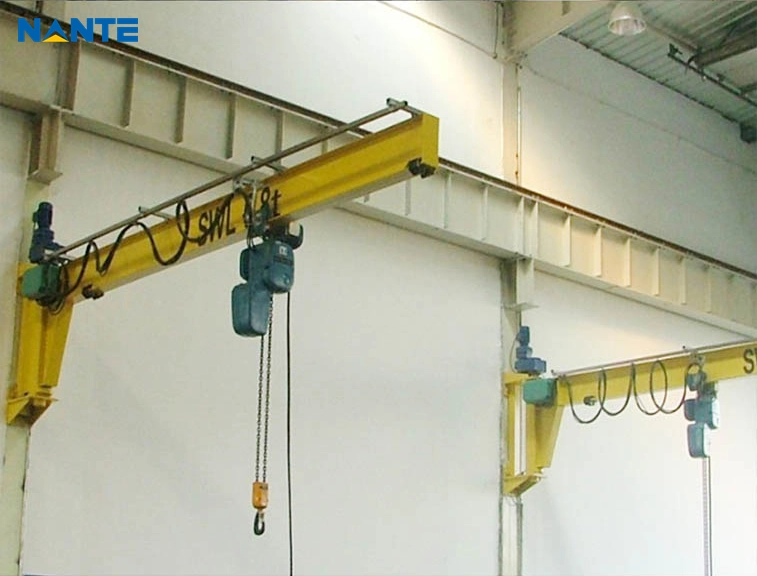
Wall-travelling and mobile options
A wall-travelling jib moves horizontally along a wall-mounted runway to serve multiple work areas, while a mobile jib can be repositioned for changing work cells. Both need a defined path, parking position, load check and procedure preventing movement with an unsecured load.
The jib crane types comparison is useful when the application could fit more than one mounting method. The decision should be based on structural feasibility and workflow, not on a catalog label.
Specify the Hoist, Duty Class and Environment
Select a compatible hoist
Electric chain hoists suit many compact stations; wire-rope or monorail arrangements may suit greater lift or duty. Check reeving, lifting speed, motor power, brake behavior, hook type, pendant length and maintenance access.
Use the selected jib crane hoist configuration to structure a comparable bill of materials. The hoist, trolley and boom must be engineered as a system, including wheel loads and electrical interfaces.
Assign duty class from real cycles
Duty classification should reflect load spectrum and expected life, not a default. Ask the supplier to state classification, design standard, design life and assumptions for starts per hour, average load and impact. For US projects, confirm applicable OSHA requirements and relevant ASME or CMAA guidance.
Account for the environment
Document indoor or outdoor location, temperature, humidity, dust, washdown, corrosion, wind, explosive-area classification and power. Specify enclosure ratings, coating, heaters, limit switches and grounding. Hazardous-area equipment requires a documented classification review; “spark-resistant” alone is insufficient.
Validate Design, Installation and Documentation
Check the support and interfaces
Request foundation or bracket reactions, anchor-bolt data, rail loads, power entry and building modifications. Confirm who supplies concrete, reinforcement, cable track, isolator, disconnect, runway interface and guarding. Interface ownership often causes change orders.
Require a test and handover plan
The quotation should identify material certificates, weld and inspection records where applicable, dimensional checks, brake and limit tests, electrical results, calibration and factory acceptance testing. Define site load testing, commissioning, training, manuals, drawings, spares and warranty before purchase order release.
Keep compliance specific
Standards depend on destination, industry and installation. A management-system certificate does not automatically prove product compliance. Verify the certificate scope, legal entity, manufacturing site, issuer, validity and expiry, then map required clauses to the supplied design and documentation.
Jib Crane Buying Guide: Compare Total Scope and Cost
Normalize quotations before comparing price
Use a comparison sheet with identical fields: structure, hoist, trolley, controls, electrics, foundation or bracket work, guarding, drawings, calculations, testing, freight, installation, commissioning, training, spares, warranty, exclusions and change terms. Put deviations in a separate column so a low equipment price cannot hide omitted scope.
Jib crane price comparisons should include the complete project scope. A sound business case also includes foundation work, downtime for installation, inspections, lubrication, chain or rope replacement, electrical consumption and expected residual value.
Evaluate supplier evidence
Ask for an organization chart showing design responsibility, approval drawings, calculation ownership and service contacts. Review anonymized inspection forms, a sample manual, spare-parts lead-time policy and a clear warranty process. References should match the proposed type, capacity, environment and duty rather than merely the same industry.
Jib Crane Applications: Turn the Decision into a Specification
Use a one-page data sheet
The purchasing package should capture:
- Load: maximum gross load, accessories, dimensions and center of gravity.
- Geometry: radius, boom length, hook approaches, lifting height and headroom.
- Motion: rotation angle, manual or powered slewing, trolley travel and speeds.
- Structure: free-standing, wall, column, travelling or mobile mounting; support data.
- Duty and environment: cycles, shifts, temperature, corrosion, dust and hazardous-area status.
- Controls and power: voltage, frequency, pendant or radio, isolation and grounding.
- Delivery: destination, installation responsibility, training, documents and spares.
Run the selection checklist at the design review
Before requesting a final offer, verify hook reach, boom clearances, engineer-approved support reactions and hoist duty. Confirm emergency stops, limits, guarding, inspection access and operator sight lines on the drawings.
Late changes to radius, height or mounting can affect the foundation and the entire quotation. A signed data sheet and controlled drawing revision protect both the buyer and the fabricator.
From Selection to a Project-Specific Proposal
Build a documented supplier conversation
In the latter stage of industrial jib crane selection, Nante Crane presents product information for free-standing, mobile, wall-mounted and wall-travelling jib configurations, with options such as manual or motorized slewing and several hoist arrangements stated on its official jib-crane page. The project team should still request calculations and drawings matched to the actual site.
Submit the right inputs for review
For a useful budgetary and technical response, include the one-page data sheet, a plan and section sketch, photos of the support area, operating hours, load spectrum, power supply, destination, standards, installation scope and service expectations.
The final inquiry can ask for a recommended type, preliminary arrangement, document list, testing plan and clearly separated supply exclusions. Send those details through the jib crane project inquiry channel.