English


How to Choose the Right Gantry Crane for Your Project: Gantry Crane Selection Framework
How to Choose the Right Gantry Crane for Your Project Gantry Crane Selection Framework
Date: 2026-09-17 Share:
The right gantry crane is a configuration decision, not a catalog choice. A sound selection matches the lifted load, geometry, operating pattern, site risks, utilities, and required documents before a quotation is compared.
The framework below helps purchasing teams turn a lifting need into a comparable technical brief. It also reduces late changes caused by underestimated headroom, weak rail foundations, unsuitable duty classification, or an incomplete supply scope.
Review the available gantry crane range only after the project duty and layout have been defined.
Start With the Lifting Duty
Define gantry crane capacity from the real load
Gantry crane capacity starts with the heaviest load that must be lifted, not the average load. The specification should state the load itself plus below-hook equipment such as spreader beams, magnets, grabs, lifting beams, or slings.
The load chart should identify rated capacity, hook positions, and capacity changes caused by a dual trolley, auxiliary hook, or special attachment. Buyers should ask the designer to confirm design load cases and governing local lifting regulations rather than adding an arbitrary percentage.
Convert production data into a duty class
Duty depends on how the crane is used: operating hours, starts and stops, average load spectrum, travel distances, and the share of lifts near rated capacity. A crane that moves light loads continuously can experience a different fatigue demand from one that lifts near maximum capacity a few times per shift.
Request a stated FEM, ISO, or CMAA classification and the assumptions behind it. The duty-classification reference is useful when normalizing terminology, but the quotation should still show the selected class, design life assumptions, and applicable standard edition.
Match Span, Lift Height, and Layout
Verify gantry crane span against the working envelope
Gantry crane span is normally the distance between the runway or rail centerlines. The required value comes from the load path: pickup and set-down points, aisle width, storage positions, truck or rail interfaces, and clearance to buildings or process equipment. A longer span can improve coverage but increases structural demand, wheel loads, and foundation work.
Treat lifting height as a clearance calculation
Lifting height should describe the usable hook travel, with the lowest hook position, highest hook position, load height, sling angle, and obstruction envelope shown. Headroom includes the girder, trolley or hoist, hook block, and any service platform. A nominal lift height can be misleading if the hook cannot reach the required loading point.
Ask for a general-arrangement drawing with floor-to-hook dimensions, top-of-rail elevation, building clearances, and maintenance access. Include future equipment or taller loads if the crane is expected to support expansion.
Choose the Structural Arrangement
Compare single-girder and double-girder designs
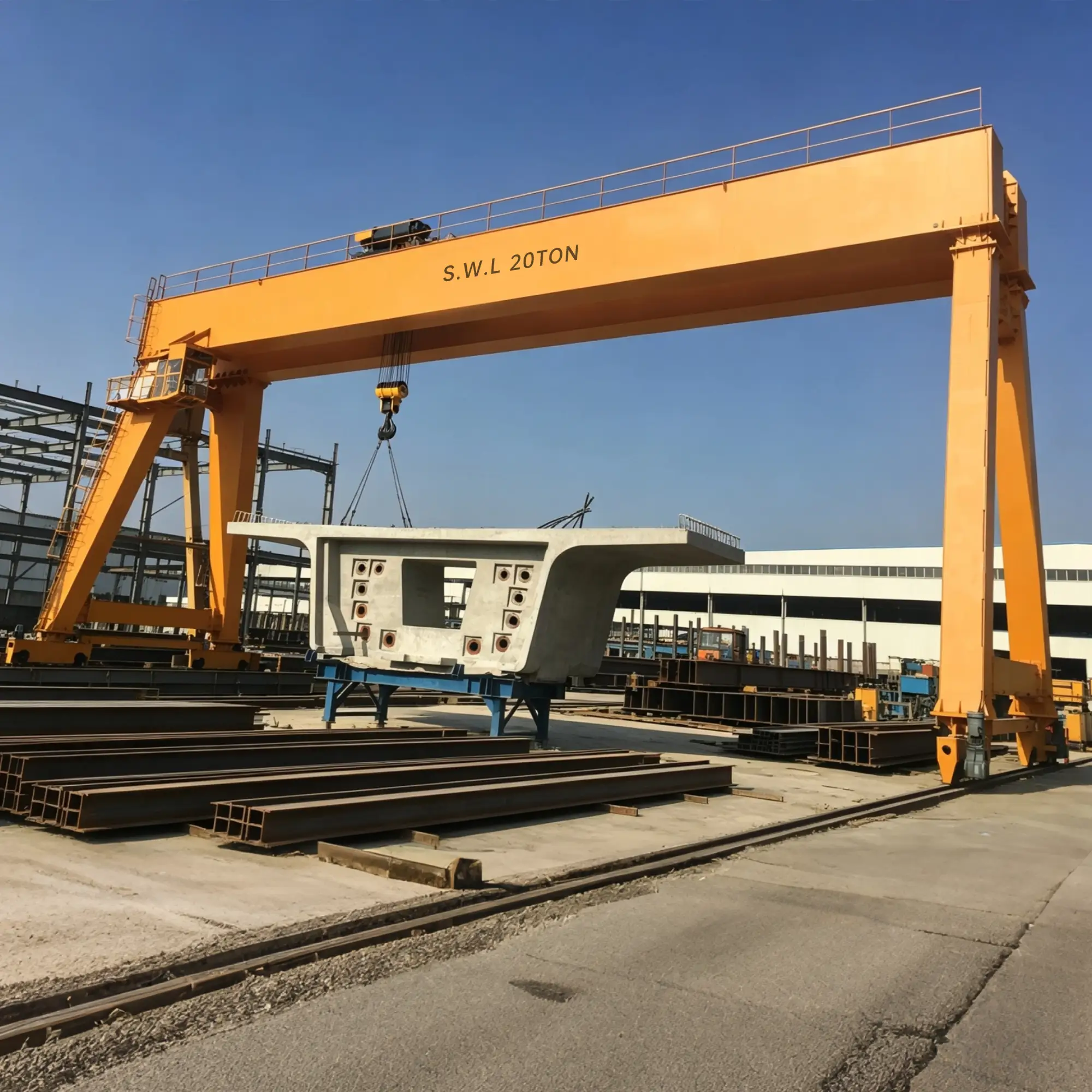
A single-girder gantry crane can suit moderate loads, shorter spans, and applications where a compact trolley keeps headroom and dead weight under control. A double-girder arrangement can provide a larger trolley envelope and a platform for heavier or more demanding lifting mechanisms. Neither is automatically better; the load spectrum, span, lift height, wheel loads, and inspection access determine the fit.
Use the single-girder gantry crane and double-girder gantry crane product pages to frame a like-for-like technical comparison. The supplier should state girder type, trolley arrangement, wheel configuration, buffers, travel limits, and maintenance access in the offer.
Decide how the legs and travel system fit the site
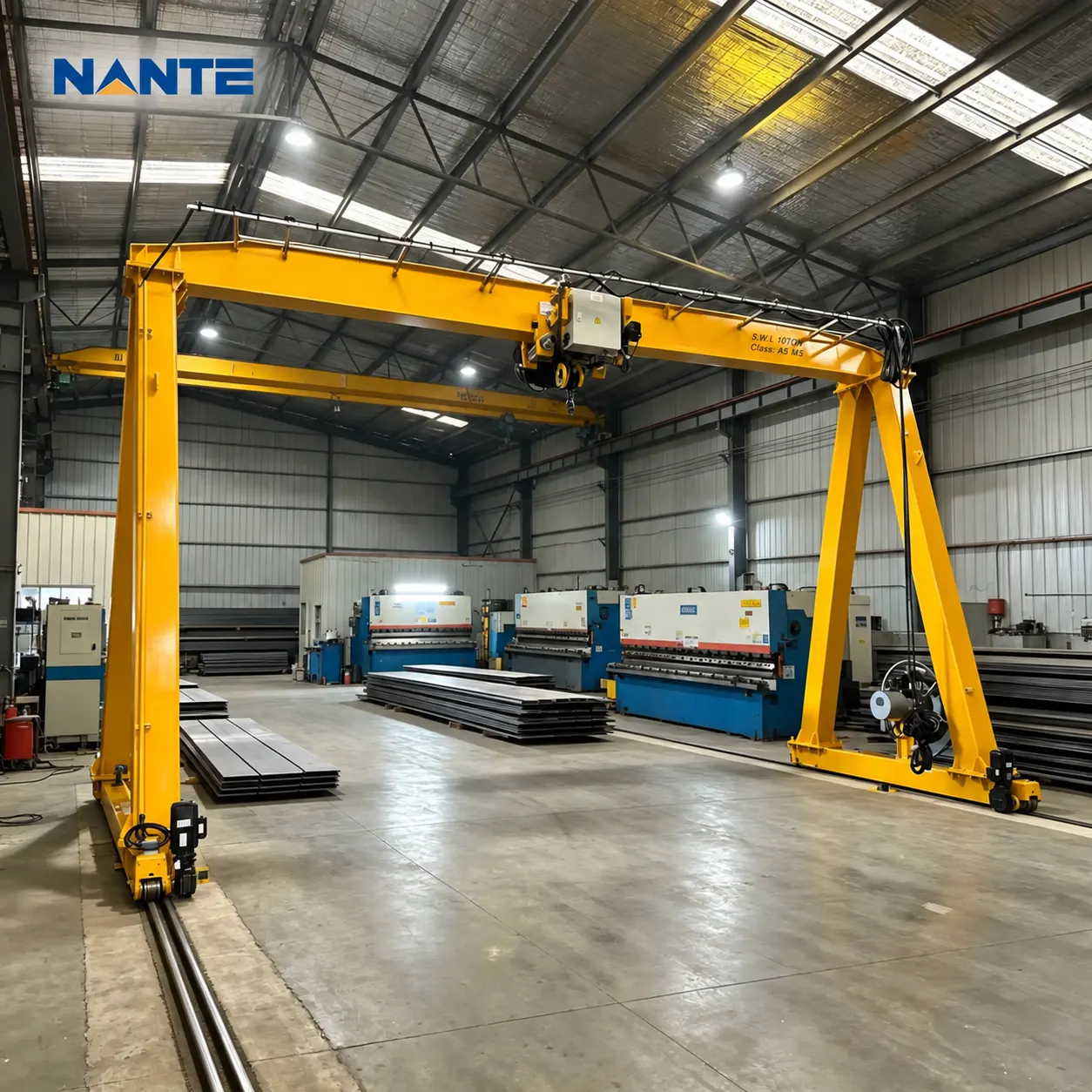
Full gantry legs run on two ground-level runways. A semi-gantry may use one elevated runway and one floor rail where a building wall already supports part of the path. Rubber-tyred equipment can avoid fixed rails for selected yards, but it introduces steering, tire, grade, and surface requirements.
The travel system should be checked for rail alignment, wheel loads, end stops, buffers, storm restraint, and access for inspection. A layout that fits the load but blocks truck turning or emergency routes is not a workable selection.
Check Site Conditions Before Pricing
Specify an outdoor gantry crane for the environment
Outdoor service adds wind, rain, temperature swings, dust, ultraviolet exposure, drainage, and corrosion to the design brief. The project should state operating wind limits, parked-crane wind conditions, altitude, temperature range, corrosivity, and whether the site is coastal, dusty, or exposed to chemicals. The outdoor storage-yard guide shows why span, wind load, and rail layout must be considered together.
Ask for wind calculations, storm parking provisions, wheel clamps or rail clamps where required, drainage details, coating system, enclosure ratings, and a maintenance plan for exposed components. Coating terminology such as C3, C4, or C5 should be tied to the actual environment and specified system, not used as a stand-alone sales label.
Confirm civil and interface responsibilities
Rail-mounted cranes require a level, aligned track and foundations capable of carrying vertical, lateral, longitudinal, and braking loads. The supply boundary should identify who designs concrete, embeds rail, installs power collectors, provides cable trenches, and verifies alignment.
For rail selection, review the crane rail component page, then request rail section, fastening method, tolerance, grounding, joint treatment, and inspection criteria. For mobile units, document pavement strength, slope, turning radius, and surface drainage instead.
Specify Controls and Power Supply
Select the power method for travel and maintenance
Power may be delivered through a festoon, conductor rail, cable reel, energy chain, or a site-specific connection. Long outdoor travel often favors a reel or protected conductor system, but the choice depends on travel length, speed, cable weight, environmental exposure, and maintenance access. The cable reel component page and long-travel reel article provide useful procurement questions.
The electrical brief should state incoming voltage and frequency, available short-circuit information, motor starting method, control voltage, grounding, cable length, and enclosure rating. Confirm whether the offer includes collectors, festoon supports, reels, junction boxes, emergency stops, isolators, and commissioning tests.
Make control and safety functions explicit
Pendant, radio, cabin, or combined control changes visibility and operating workflow. The specification should define travel and hoist speeds, acceleration limits, variable-frequency drives, anti-collision needs, limit switches, overload protection, emergency stop circuits, warning devices, and access controls. Safety functions should be mapped to the applicable local code and validated during testing.
Compare Suppliers on Evidence and Scope
Request a document and test package
A credible quotation includes a general-arrangement drawing, load and wheel-load data, motor and gearbox schedules, electrical schematics, control philosophy, paint specification, inspection and test plan, and operating and maintenance manuals. For fabricated structures, request material certificates, welding procedure and qualification records, welder qualifications, non-destructive examination records, dimensional checks, and calibration certificates.
Factory acceptance testing should define functional checks, limit devices, overload or load tests where applicable, travel alignment, emergency circuits, and the records delivered. The buyer should also confirm packing, preservation, spare-parts recommendations, warranty boundaries, training, installation supervision, commissioning, and response arrangements.
Normalize the commercial comparison
Price comparisons fail when one quotation excludes civil interfaces, rails, power distribution, freight, erection, testing, or future spares. Build a matrix with the same lines for every bidder:
- Crane, hoist or winch, trolley, legs, wheels, and controls.
- Rails, foundations, cable management, festoon or reel, and grounding interfaces.
- Engineering drawings, calculations, compliance documents, FAT, packing, and freight.
- Installation, commissioning, operator training, warranty, service, and spare parts.
- Exclusions, assumptions, lead-time basis, change-order rules, and payment milestones.
After scope is normalized, evaluate lifecycle cost: energy use, consumables, inspection access, replacement components, downtime exposure, and the cost of changing the runway later.
Build the Gantry Crane Buying Brief
Capture the inputs suppliers need
The request for quotation should include capacity and load spectrum, maximum and minimum hook positions, span, travel length, lifting height, duty class, speeds, operating hours, indoor or outdoor location, wind and temperature data, corrosivity, rail or tire arrangement, power supply, controls, standards, delivery destination, installation scope, and service expectations.
Attach a site plan, elevations, load drawings, photos, geotechnical or pavement information, and the proposed lifting sequence. A clear data pack lets suppliers identify missing interfaces before a design is frozen.
Score technical fit before price
Use a weighted review that gives priority to capacity and duty compliance, geometry, site and civil fit, safety functions, documentation, serviceability, and total cost. Record deviations line by line. A lower price should not compensate for an unpriced rail foundation, an unsuitable duty class, or missing test evidence.
In the later procurement stage, Nante Crane can be included in the same evidence-based comparison. The useful question is whether the proposed design, documents, components, and support scope match the project brief, not whether a standard catalog model appears similar.
Gantry Crane Selection FAQs
Is a single-girder crane always the economical choice?
Not necessarily. A single girder may reduce structural mass, but a double girder can provide better headroom, trolley access, or durability for a demanding duty cycle. Compare installed cost and lifecycle requirements for the specified span, capacity, and operating pattern.
What information determines gantry crane span?
The load path, rail centerlines, clearance envelope, aisle and truck interfaces, storage positions, building constraints, and future expansion determine span. A plan and elevation are more reliable than a span copied from a previous project.
What makes an outdoor gantry crane different?
Outdoor selection must account for wind in operation and while parked, storm restraint, drainage, corrosion protection, temperature, dust, ultraviolet exposure, and weatherproof electrical equipment. These conditions affect structure, rails, controls, maintenance, and civil works.
Submit a Project-Specific Selection Brief
Prepare the next technical step
Project owners, contractors, and purchasing teams can submit capacity, span, lift height, duty class, operating hours, load spectrum, site conditions, power method, standards, layout drawings, delivery destination, and installation scope. For a project-specific technical review and scope-aligned quotation, please contact the Nante Crane team.