English



Gantry Crane Capacity Calculation: Formula & Selection Guide
Gantry Crane Capacity Calculation Formula & Selection Guide
Date: 2026-09-17 Share:
Gantry crane capacity calculation starts with a clear distinction: rated capacity is the crane’s marked allowable load, while project loading is the real combination of payload, below-hook equipment, motion, environment, and support conditions. A crane can display a 10-ton rating and still be unsuitable for a lift if the hook package, load spectrum, wind, or ground reactions were not included in the design review.
The method below gives purchasing and engineering teams a screening framework. A qualified engineer must confirm the final design against governing US and site requirements, drawings, and manufacturer calculations.
What Gantry Crane Capacity Actually Means
Gantry crane rated load
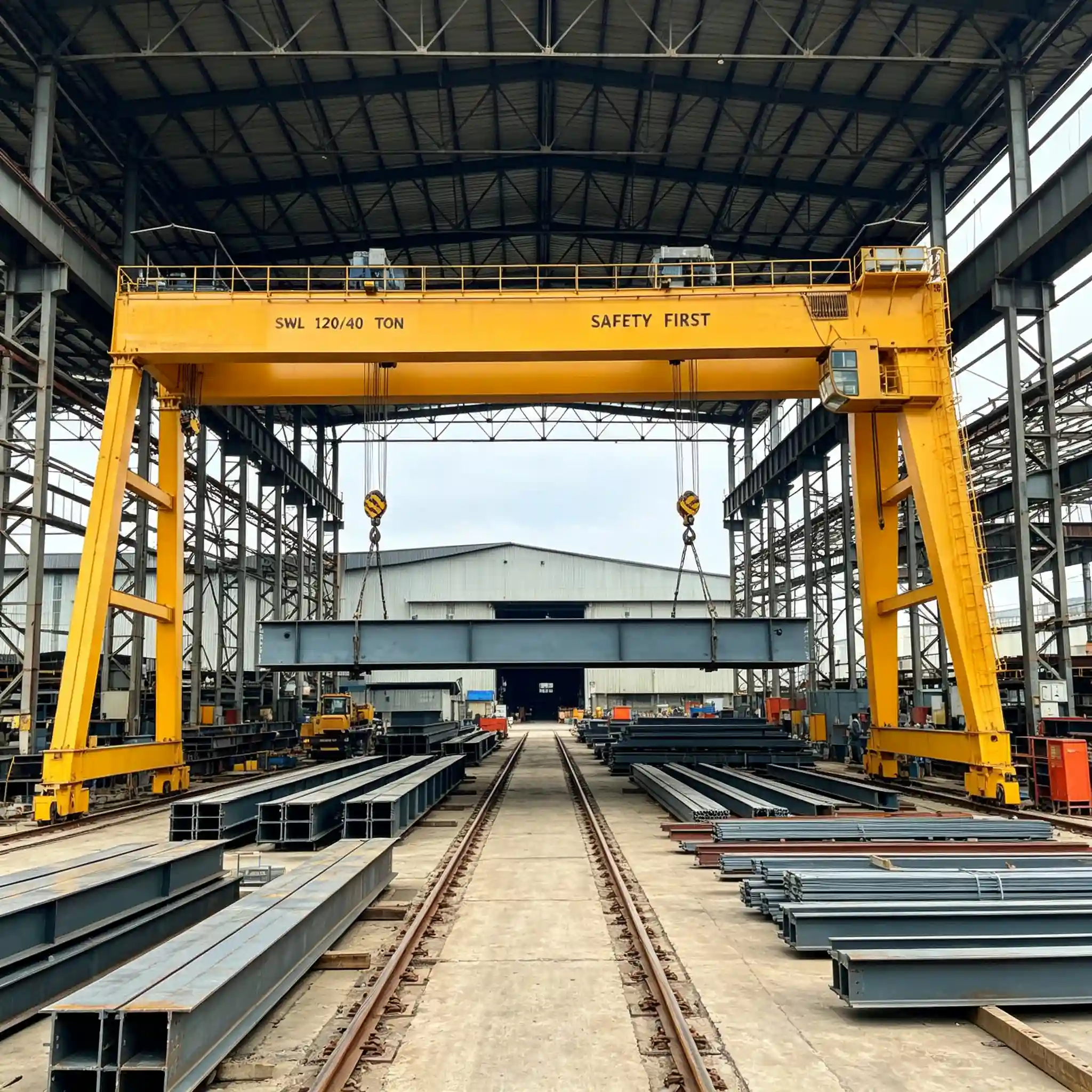
The gantry crane rated load is the maximum working load assigned to the complete crane and shown on its nameplate or technical documentation. It is not automatically the weight of every item hanging below the hook. The quotation should state whether the rating includes the hook block, lifting beam, magnets, grabs, spreader, or other below-hook devices.
Rated load applies to a defined envelope: span, trolley, hoist, travel arrangement, and duty classification. Changing span, trolley position, or attachment can alter wheel loads and structural demand even when payload is unchanged.
Gantry crane design load
Gantry crane design load is the load case used to size girders, legs, end carriages, wheels, brakes, foundations, and connections. It normally combines permanent weight with the lifted assembly and the effects required by the governing design standard.
Separate these inputs before arithmetic:
- Payload: the heaviest product, mold, coil, vessel, or container to be lifted.
- Below-hook equipment: hook block, slings, lifting beam, spreader, clamp, magnet, or process tool.
- Crane self-weight: bridge, legs, trolley, hoist, platforms, ladders, and electrical equipment.
- Motion effects: hoisting, braking, trolley acceleration, long-travel acceleration, skew, and possible impact.
- Site effects: wind, temperature, seismic demand, rail or foundation tolerances, and collision scenarios where applicable.
The governing standard determines factors and combinations. A generic percentage is not a substitute for a design load case.
Keep strength and serviceability checks separate. Girder stress, buckling, welds, bolts, and wheel contact address structural resistance; deflection, vibration, hook drift, and fatigue address performance over time. The quotation should identify the acceptance limits and load combinations used for each check.
A Step-by-Step Gantry Crane Capacity Calculation
1. Define the load envelope
Record maximum mass, dimensions, center of gravity, lifting points, and attachment geometry. Note whether the load is rigid, flexible, liquid-filled, or prone to swinging. Maintenance tools or a future product can govern selection instead of the nominal production load.
Convert all masses to one unit system. For a US project, pounds-force or short tons are common; metric tonnes should be converted consistently. Do not mix a metric-ton payload with a short-ton rating without documenting the conversion.
2. Calculate the lifted assembly
Use a transparent summation:
W_lift = W_payload + W_below-hook equipment + W_rigging
If the supplier’s rated load already includes a specific hook block or hoist accessory, do not add it twice. If the attachment is unknown, carry its estimated mass as a stated assumption and make confirmation an RFQ requirement.
Identify the design combinations required by the applicable standard. A screening expression is:
W_design = W_lift plus prescribed dynamic, horizontal, wind, and other project actions
The result is not always one vertical number. Horizontal forces can govern bracing, wheel flanges, rails, anchors, or foundations while the hoisted load remains below the nameplate rating.
3. Check capacity at the critical position
Check the trolley at midspan and positions that maximize wheel or leg reactions. Include hook approach, offset load, and any tandem operation. A centered load can pass while an off-center load creates torsion or uneven wheel loading.
Confirm compatible capacities for the hoist, wire rope, hook, brake, trolley, bridge, legs, wheels, rails, and foundation. The lowest verified limit controls lifting capacity.
For multi-point or tandem lifts, document the load-sharing assumption and communication method. Unequal stiffness, unequal line length, or timing differences can shift load to one hoist. The calculation should state whether a single crane, two cranes, or a synchronized control system is being specified.
4. Check stability and site conditions
Outdoor gantries require review of wind-on-girder and wind-on-load cases, parked conditions, storm restraints, and rail anchors. Rubber-tyred arrangements also need ground pressure, grade, tire load, and steering checks.
Verify headroom, hook height, clearances, access, power, controls, and emergency stops. These constraints can force different girder depth, leg geometry, or hoist arrangement.
Worked Gantry Crane Load Capacity Examples
Example A: 10,000-lb rated crane
A production lift has an 8,000-lb payload, a 700-lb spreader beam, and 300 lb of slings and shackles. The lifted assembly is:
8,000 + 700 + 300 = 9,000 lb
Against a 10,000-lb rated load, nominal vertical margin is 1,000 lb, not an automatic approval. Confirm rating definition, dynamic effects, hook approach, load center, duty class, and reactions. A 1,400-lb replacement spreader raises the assembly to 9,700 lb, leaving 300 lb before project actions.
Example B: 15,000-lb selection screen
A maintenance lift uses a 12,000-lb machine, a 1,200-lb lifting frame, and 300 lb of rigging:
W_lift = 12,000 + 1,200 + 300 = 13,500 lb
A 15,000-lb crane passes the basic screen with 1,500 lb nominal margin. Still test center of gravity, side loading, braking, wind, and daily cycles. A higher rating may suit future loads, but oversizing increases steel, foundation, power, and budget demands.
Match Configuration to Gantry Crane Lifting Capacity
Single girder or double girder
Single-girder designs can suit moderate loads, limited spans, and low headroom. Double-girder designs may provide more trolley capacity, hook height, stiffness, or access. Selection should follow reactions and deflection limits, not payload alone. The Gantry Crane range is a starting point for comparing configurations.
Hoist, hook, and duty class
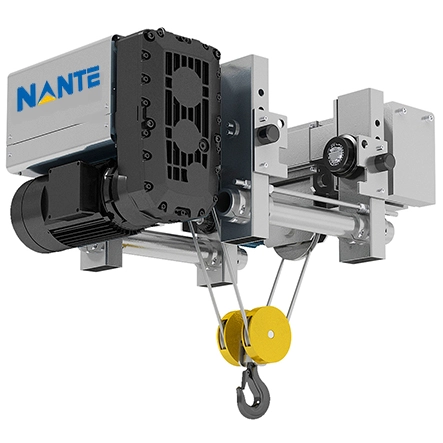
The hoist must match lift speed, reeving, starts per hour, and load spectrum. The Wire Rope Hoist page helps identify low-headroom, fixed, monorail, or double-girder arrangements.
The Crane Hook and block need a documented working load limit, inspection basis, and reeving compatibility. Specify Duty Class using hours, load spectrum, starts, and peak lifts. An underestimated class can cause wear and an invalid quotation comparison.
RFQ Checklist for a Defensible Capacity Review
Technical inputs
An RFQ should include:
- Rated load and maximum payload, with units and conversion basis.
- Spans, lift height, hook approach, rail length, and required clearances.
- Payload dimensions, center of gravity, lifting points, and attachment masses.
- Duty class inputs: hours per day, lifts per hour, load spectrum, and peak events.
- Indoor or outdoor location, wind region, temperature, corrosion, seismic, and hazardous-area requirements.
- Power supply, voltage, control method, travel speeds, braking, and anti-collision interfaces.
- Foundation, rail, wheel-load, slab, anchor, and storm-restraint responsibilities.
- Applicable standards, inspection authority, documentation language, and destination.
For US applications, identify applicable OSHA requirements and ASME B30.17 provisions, then add local structural, electrical, and site rules.
Evidence and commercial scope
Request a load list, general arrangement, wheel-load schedule, motor and brake data, deflection criteria, calculations, and marked assumptions. Ask how below-hook equipment and load combinations are treated.
Normalize quotations for steelwork, hoist and trolley, controls, conductor or cable systems, runway and foundations, freight, installation, commissioning, training, spares, warranty, testing, and exclusions. Request inspection plans, calibration records, FAT scope, material traceability, welding records, and manuals.
In the latter stage of supplier evaluation, Nante Crane can be included in the comparison set when its current product and service scope matches the project. The purchasing file should still preserve the same load assumptions and evidence requests for every bidder. A technical proposal is only comparable when capacity, duty, site actions, and supply boundaries are stated in the same format.
FAQ: Gantry Crane Rated Load and Design Load
Is rated load the same as safe working load?
Terminology varies by standard and supplier documentation. The nameplate value is the controlling marked rating for the defined crane configuration, but the quotation should clarify inclusions, exclusions, and the applicable working-load terminology.
Can a crane lift above its rated capacity for a short test?
Not as an operating practice. Proof or overload tests, when required, must be planned, controlled, documented, and performed under the governing standard and responsible engineer’s procedure. A test value must not be treated as a production rating.
Does a heavier crane always provide more usable capacity?
No. Usable capacity is limited by the weakest compatible component and by stability, deflection, wheel loads, foundation, environment, and duty class. A heavier bridge can also increase site reactions and total project cost.
Prepare a Project-Specific Capacity Request
Submit the calculation brief
The fastest path to a useful quotation is a concise project brief: required rated load, maximum payload, below-hook equipment, span, lift height, hook approach, duty class inputs, load spectrum, indoor or outdoor conditions, wind and seismic basis, power and controls, applicable standards, layout or photos, delivery location, and installation scope.
With those inputs, the engineering team can verify the governing load cases, identify the controlling component, and return a configuration and document list that can be compared across bids. For a project-specific review, submit the brief through Contact Nante Crane.