English



How to Evaluate an Overhead Crane Technical Proposal
How to Evaluate an Overhead Crane Technical Proposal
Date: 2026-09-03 Share:
An overhead crane technical proposal is the engineering and procurement bridge between a lifting requirement and a buildable machine. A low price cannot compensate for an unclear load basis, missing interfaces, or documents that cannot support inspection. A disciplined review tests whether the crane will fit the building, perform the duty, satisfy applicable rules, and arrive with evidence for acceptance.
For EPC contractors and engineering companies, the review should be structured. Apply the same baseline to every bidder, with each answer traceable to a drawing, calculation, specification clause, certificate, or test record. This method turns a crane technical proposal into an auditable decision.
What a crane technical proposal must prove
Scope and design basis
The first page should state the design basis, not only a model name. Confirm rated capacity, lifting points, span, runway length, lifting height, hook approach, headroom, speeds, operating hours, load spectrum, environment, temperature, corrosion exposure, and available power. Identify whether runway beams, rails, electrification, foundations, installation, commissioning, training, spares, and maintenance are included or excluded.
An unclear boundary creates change orders. Mark interfaces with the building designer, electrical contractor, fire-protection team, and controls integrator. A responsibility matrix should assign design, supply, installation, testing, and approval for each interface.
Proposal document control
Check revision numbers, issue dates, drawing status, and deviations. A controlled crane technical proposal distinguishes “for approval,” “for manufacture,” and “as-built” information and identifies assumptions requiring owner confirmation. Unstated assumptions become hidden scope after award.
How to review an overhead crane technical specification
GA drawings and physical interfaces
Review the general arrangement (GA) drawing against current architectural, structural, and process layouts. Verify runway centerlines, rail gauge, wheel loads, clearances, end approaches, hook paths, maintenance access, platforms, ladders, buffers, and collision zones. Check hook positions against roof steel, ducts, sprinklers, cable trays, and production equipment.
Overlay the GA drawing on the building model or coordinated plan. Record dimensions, tolerances, datum references, and loads transferred to the runway and supporting structure. A crane outline alone is not enough for structural coordination.
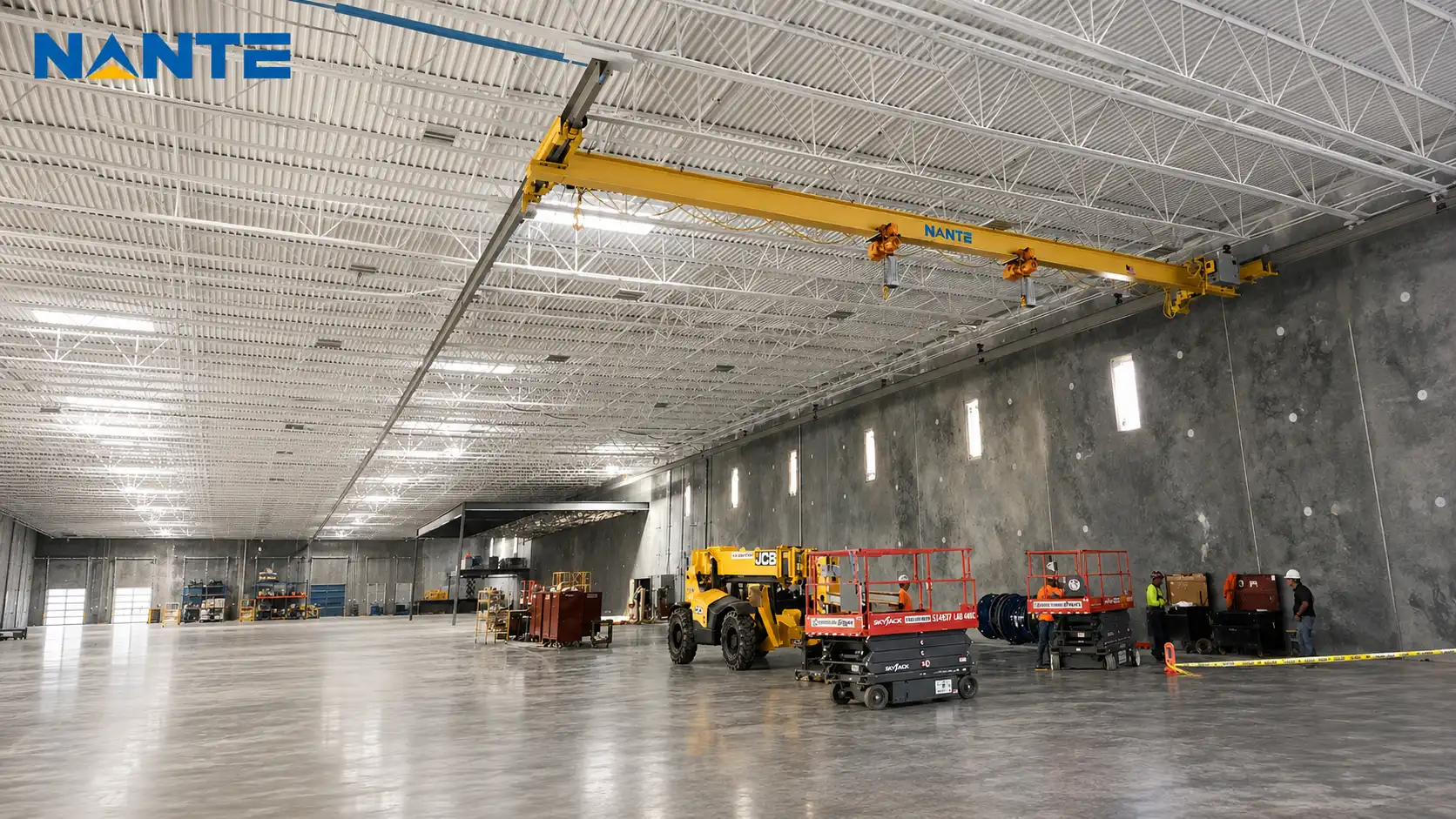
An Overhead Crane category page and a single-girder overhead crane product page can be used as product-reference points; the project GA drawing remains the controlling document.
Structural and mechanical calculations
Request calculations for bridge girders, end trucks, wheels, shafts, drums, hooks, bolted joints, welds, brakes, and runway reactions. The cover sheet should state material grades, load combinations, dynamic factors, allowable stresses or design resistance, fatigue assumptions, deflection limits, and design codes. Confirm rated load, impact, trolley position, skewing, wind, seismic effects, and exceptional loads are treated consistently.
Compare calculated wheel loads with the civil or structural engineer’s runway design. Check vertical and lateral reactions, wheel and rail compatibility, alignment tolerances, and wheel-replacement access. A Crane Design article offers a discussion point; project calculations must support the bid.
Hoist, trolley, and duty classification

The overhead crane technical specification should define hoist type, reeving, hook block, drum or chain arrangement, brakes, motor ratings, gearbox service factor, control mode, and speeds. Duty classification must match the real load spectrum and cycles, not an optimistic average. Ask for the selected FEM, ISO, CMAA, or locally required class and its assumptions.
Review overload protection, upper and lower limits, emergency stop behavior, slack-rope or over-speed protection where applicable, and inspection access. A double-girder EOT crane with hoist is a product reference, not a substitute for a project duty and interface schedule.
Electrical diagrams and controls
Power and control architecture
Trace the single-line diagram from incoming power through disconnects, protection, control supply, drives, motors, brakes, lighting, and auxiliary circuits. Confirm voltage, frequency, short-circuit rating, grounding, enclosure ratings, cable routing, festoon or conductor-bar arrangement, and isolation points. The control philosophy should explain pendant, radio, cabin, or PLC operation and command priority.
Review the schematic against the component list. Every motor, contactor, drive, limit switch, sensor, and safety relay needs a consistent tag on drawings, terminals, and the BOM. Check I/O lists, alarms, interlocks, anti-collision logic, and loss-of-power behavior.
Safety circuits and verification
For a US installation, map the proposal to site and OSHA requirements, including OSHA 1910.179. Identify the authority and edition for each requirement; a management-system certificate does not prove product compliance.
Ask for factory acceptance test (FAT) procedures covering no-load and rated-load functions, brakes, limits, emergency stop, travel, noise where specified, and calibrated instruments. State which tests are witnessed, which records are supplied, and how punch-list items close.
Component lists and traceability
Bill of materials integrity
The bill of materials (BOM) should list manufacturer, part number, quantity, rating, revision, and approved alternatives for safety-critical items. Match it to GA drawings, schematics, other diagrams, and spare-parts schedules. “Motor” or “control panel” alone is insufficient for technical bid evaluation.
Separate crane-, owner-, and site-supplied items. Confirm who provides rails, collectors, festoon cables, isolators, radio batteries, lifting lugs, anchor bolts, lubricants, and commissioning consumables. Require approval before substitutions, with evidence that rating, fit, interface, and warranty are preserved.
Quality records and technical documents
The document register should include drawings, calculations, manuals, parts lists, lubrication charts, inspection and test plans, material certificates, weld records where relevant, calibration certificates, FAT reports, coating data, packing lists, and destination certificates. A Technical Documents page is a route for available downloads; the contract register still defines project deliverables and due dates.
Crane technical bid evaluation checklist
Compliance matrix
Score each bidder against the same technical schedule. A practical matrix contains:
- Capacity, span, lift, duty, speeds, and operating environment.
- GA dimensions, clearances, wheel loads, runway interfaces, and maintenance access.
- Structural, mechanical, electrical, and control calculations.
- Safety functions, standards, certificates, inspection, and FAT scope.
- BOM completeness, approved makes, spares, manuals, and training.
- Installation, commissioning, warranty, service response, and exclusions.
Record “compliant,” “deviation,” “clarification,” or “not stated.” “Not stated” should not be treated as compliant. Require a clause-by-clause response with document references and a commercial impact for every deviation.
Normalize the commercial comparison
Compare like with like after the technical matrix is complete. Normalize crane, hoist, controls, runway or rail work, freight, packing, supervision, installation, commissioning, training, spares, taxes, testing, and warranty. Separate one-time price from lifecycle exposure: proprietary drives, special tools, consumables, inspection access, and availability of replacement parts.
The lowest evaluated price is defensible only when scope, performance, documentation, risk allocation, and acceptance criteria are equivalent. A clarification log should remain open until the purchase order captures every answer.
Crane proposal evaluation workflow
Review gates for EPC teams
Use four gates: technical completeness, interface coordination, compliance and quality evidence, and commercial recommendation. At each gate, assign an owner and a close-out date. Engineering should approve the design basis and calculations; procurement should control deviations and terms; operations and maintenance should confirm access, controls, spares, and training.
The final recommendation should cite the selected revision, unresolved risks, assumptions carried into the order, and documents required before manufacture. This record protects the project when a revised drawing or alternative component is proposed later.
Red flags requiring clarification
Pause evaluation when a proposal has mismatched capacity labels, missing wheel loads, no duty-class basis, untagged electrical components, contradictory speeds, unexplained standards, copied drawings, or “equivalent” components without approval criteria. Other warning signs include an FAT described only as “routine,” a manual promised after shipment, and exclusions that move runway or commissioning responsibility to the owner.
Supplier and the next procurement step
In the later supplier review, Nante Crane’s published portfolio includes overhead and gantry crane products, crane components, and service resources. Relevant product pages can help an engineering team frame questions about configuration; the project proposal and controlled document register must establish the actual commitments. For standards context, review the Crane Standards article and welding-quality guidance alongside the governing project codes.
Request a project-specific review
An EPC contractor, engineering company, plant owner, or distributor can send the capacity, span, lift, duty class, operating hours, load spectrum, environment, power supply, control method, applicable standards, layout or GA drawing, delivery destination, and installation scope to sales@nantecrane.com. Nante Crane can then review the design inputs and prepare the appropriate technical response or quotation package. Supplying the comparison matrix and bidder deviations at the same time makes the review more useful and reduces clarification cycles.
FAQ: crane technical proposal review
What is the most important document in a crane technical proposal?
There is no single substitute for a coordinated package. The design basis, GA drawing, calculations, electrical diagrams, BOM, compliance matrix, and test plan should agree. Any conflict between these documents is a hold point until resolved in writing.
How should a crane technical bid evaluation handle missing data?
Classify missing data as “not stated,” issue a clarification, and assign a commercial and schedule impact. Do not fill gaps with assumptions during scoring. The final order should convert every accepted clarification into a controlled requirement.
Which standards belong in the review?
The governing standards depend on location, industry, building interface, and purchaser specification. The review should identify the applicable crane, electrical, structural, welding, lifting-device, and workplace-safety requirements, verify edition and scope, and request evidence for each claimed compliance item.
When is a technical proposal ready for purchase-order release?
Release is appropriate when scope boundaries, design basis, interfaces, deviations, acceptance tests, documentation, warranty, and change control are approved. “Price received” is not the same as technical readiness.
Submit the project brief through the Nante Crane contact page.