English


Regenerative Braking for Overhead Cranes: Energy Savings, Heat Reduction, and ROI
Regenerative Braking for Overhead Cranes: Energy Savings, Heat Reduction, and ROI
Date: 2026-08-07 Share:
Regenerative braking for overhead cranes captures electrical energy when a loaded hoist descends. The right design can also address crane braking resistor overheating and improve overhead crane regenerative braking ROI by reducing wasted electricity and cabinet heat. This article compares braking resistors, regenerative drives, and active front ends and provides a payback example.
How Regenerative Braking for Overhead Cranes Works
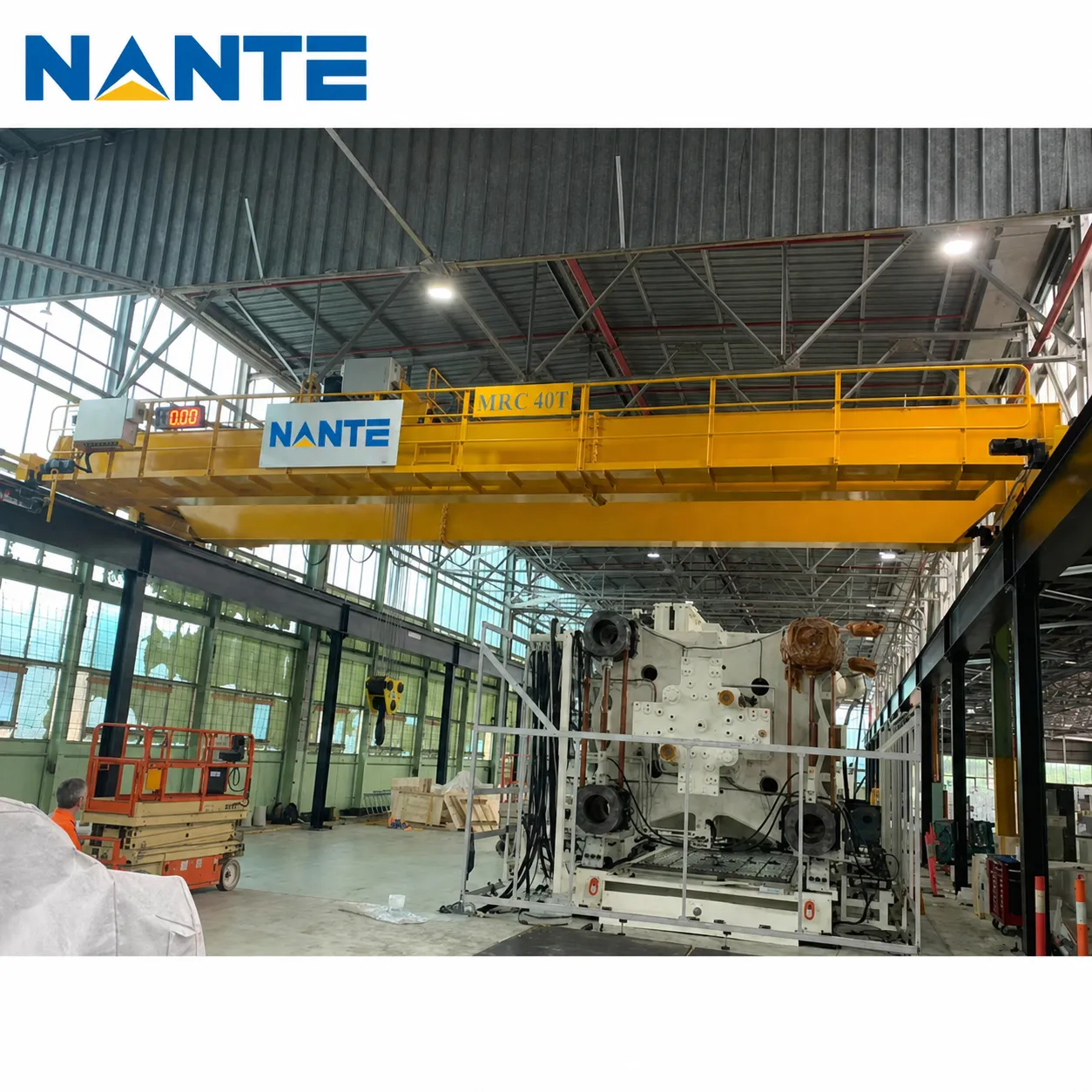
A crane consumes power while lifting because the hoist motor increases gravitational potential energy. A descending load can reverse that flow because gravity drives the drum, gearbox, and motor.
How a Descending Load Generates Electricity
The hoist motor operates as a generator when the suspended load drives the mechanism while the motor supplies controlled counter-torque. The generated power then flows into the drive.
The theoretical energy from one descent is:
Energy (kWh) = mass (kg) × 9.81 × lowering height (m) ÷ 3,600,000
The total mass should include the payload, hook block, spreader, grab, magnet, and other suspended equipment. Lowering speed mainly changes instantaneous power, while mass and vertical distance determine theoretical energy per cycle.
Research verified on a real overhead crane found that the hoisting mechanism created the main recovery opportunity during payload lowering. Actual recovery depended on load and duty cycle.
What Happens on the DC Bus
Generated current raises the drive’s DC-bus voltage. The DC-link capacitors store little energy, so the system needs a resistor, shared DC bus, or regenerative converter during substantial lowering regeneration.
Where the Braking Energy Can Go
The architecture determines whether energy becomes heat, supports another motor, or returns to the plant network.
A Braking Resistor Produces Heat
A brake chopper connects the resistor when DC-bus voltage reaches a threshold. The resistor then converts braking energy into heat.
This simple solution suits occasional braking. Repeated braking can require larger resistors, extra space, and more cooling capacity.
A Regenerative Drive Returns Power
A regenerative drive creates a controlled path from the DC bus to the AC side. Other facility loads can consume the returned electricity.
The plant should confirm that power’s value through its metering arrangement and internal demand. The facility should not automatically assume that every returned kilowatt-hour has the same value as purchased electricity.
An Active Front End Controls Bidirectional Flow
An active front end is the controlled line-side converter within many regenerative drive systems. It supplies DC power during lifting and returns surplus power during lowering.
The converter can also control input current and power factor. Harmonic performance depends on the converter, filter, network impedance, and load.
A Common DC Bus Shares Energy
A common DC bus can connect hoist, trolley, and bridge drives. A descending hoist can support another crane motor that is consuming power.
The system still needs a resistor or regenerative converter when generated power exceeds simultaneous motor demand.
Why Crane Braking Resistor Overheating Occurs
Crane braking resistor overheating occurs when the resistor receives energy faster than it releases heat.
Peak and Average Power Create Different Limits
Peak power determines whether the resistor and brake chopper can absorb one event. Average power determines whether the resistor remains within its thermal rating across repeated cycles.
A high-cycle crane may begin another loaded descent before the resistor cools. Chopper current, minimum resistance, ventilation, enclosure space, and permissible surface temperature all limit the design.
Resistor Heat Raises Cabinet Temperature
An internal resistor releases heat inside the control cabinet. An external resistor can release the same heat into an electrical room.
The heat reduces the available thermal margin for drives, power supplies, contactors, and controllers. The cabinet may consequently require forced ventilation, a larger enclosure, or air conditioning.
Braking Resistor vs Regenerative Drive vs Active Front End
The best choice depends on duty cycle, lowering energy, power-quality requirements, and installed cost.
When a Braking Resistor Is Practical
A resistor can be economical when the crane completes few loaded descents, uses a short lowering distance, and performs mostly empty-hook movements.
The solution can also remain practical when the resistor releases heat outside a conditioned area. Occasional braking with a small amount of energy generally provides less financial justification for a regenerative system.
When Regeneration Provides More Value
A regenerative system deserves evaluation when the crane operates for several shifts, lowers heavy loads frequently, uses long vertical travel, or creates a major cooling burden.
An active front end becomes relevant when the system requires frequent high-power regeneration or one controlled supply for several drives. Regularly repeated braking and high braking energy generally strengthen the case for energy recovery.
Overhead Crane Regenerative Braking ROI Calculation
A credible calculation should use measured operating data rather than maximum crane ratings.
Energy-Savings Example
Assume that a crane lowers 30,000 kg through 15 metres for 500 cycles per day and 300 days per year.
The theoretical energy per descent is:
30,000 × 9.81 × 15 ÷ 3,600,000 = 1.226 kWh
Assume that combined mechanical and electrical efficiencies deliver 85% of this energy to the DC bus. The available DC-bus energy becomes:
1.226 × 0.85 = 1.042 kWh per cycle
Assume that the regenerative stage returns 95% of the DC-bus energy. The returned energy becomes:
1.042 × 0.95 = 0.990 kWh per cycle
The annual returned energy becomes:
0.990 × 500 × 300 = 148,500 kWh per year
An electricity value of $0.12 per kWh produces a direct annual saving of approximately $17,820.
Heat Reduction and Payback
A resistor-based system would convert about 1.042 kWh into heat during each representative cycle. Annual resistor heat would reach approximately 156,300 kWh of thermal energy.
Assume that 60% of this heat affects a conditioned area and that the cooling system has a coefficient of performance of 3.0. Avoided cooling electricity would equal about 31,260 kWh, or $3,750 per year.
The combined illustrative saving would equal $21,570 per year. An incremental installed cost of $60,000 would produce a simple payback of approximately:
$60,000 ÷ $21,570 = 2.8 years
The final analysis should test conservative, expected, and high-utilization scenarios. Actual load, cycle count, lowering height, electricity price, system efficiency, and resistor location can change the result substantially.
Electrical and Control Requirements
The project team should verify that the plant network can accept reverse power flow. The team should also evaluate transformer capacity, protective devices, metering boundaries, filtering, harmonics, and maximum regenerative power.
The design should define crane operation during an AC supply loss. The system may require controlled stopping, a backup resistor, and coordinated mechanical brake control because a regenerative converter cannot return energy to an unavailable network.
Regenerative braking does not replace the mechanical holding brake. Electrical braking controls lowering speed, while the holding brake secures the suspended load under stationary and defined stopping conditions. Crane requirements distinguish between holding brakes and regenerative or other control-braking methods.
Information Buyers Should Confirm
A useful inquiry should contain confirmed project data:
- The buyer should provide the crane capacity, average suspended mass, lifting height, lowering speed, and cycle frequency.
- The buyer should provide the motor ratings, supply voltage, existing drive architecture, and braking resistor data.
- The buyer should provide the resistor location, cabinet cooling conditions, electricity price, and power-loss requirements.
- The buyer should provide measured DC-bus voltage, peak regenerative power, or operating-cycle records when those measurements are available.
FAQ
Can an Overhead Crane Generate Electricity?
A descending load can drive the hoist motor as a generator while the drive controls lowering speed. The system must then dissipate, share, or return the generated energy.
Can a Regenerative Drive Eliminate the Braking Resistor?
A regenerative drive can remove the resistor from normal braking duty. The final design may retain a smaller resistor for backup conditions or operation during a supply interruption.
Is an Active Front End the Same as a Regenerative Drive?
A regenerative drive describes the complete energy-return system. An active front end describes the bidirectional line-side converter within that system.
Which Cranes Usually Provide the Best Payback?
Cranes with frequent heavy-load lowering, long lifting heights, high annual cycle counts, and significant cooling demand usually provide the strongest opportunity.
Does Regenerative Braking Replace the Mechanical Brake?
Regenerative braking manages motion and electrical energy. The mechanical brake holds the load and supports the required stopping conditions.
Discuss Your Confirmed Crane Requirements
Nante Crane designs and manufactures industrial cranes and crane components, including single-girder, double-girder, and underhung overhead cranes, electric hoists, hoisting mechanisms, and crane control panels. Its control-panel options can cover hoisting, long travel, cross travel, or complete crane control.
Contact Nante Crane to discuss your confirmed crane specifications, operating cycle, electrical requirements, and energy-recovery objectives with its engineering team.
The reader can submit confirmed capacity, average load, lifting height, cycle data, motor ratings, supply voltage, drive architecture, resistor rating, and project schedule to Nante Crane. The engineering team can then review the braking architecture and prepare a focused proposal without pressure for an immediate purchase.