English



What Types of Crane End Carriages Are Used in Different Crane Designs?
What Types of Crane End Carriages Are Used in Different Crane Designs
Date: 2026-03-13 Share:
Crane end carriages, often called end trucks, act as basic parts in the travelling setup of cranes. They link the crane bridge or girder to the runway rails or the floor. These components carry vertical loads, allow accurate side-to-side movement, spread out forces in an even way, and keep everything lined up properly. This reduces wear on rails and helps keep operations safe. Picking the right kind of crane end carriage matters a lot. It improves how well overhead cranes, gantry cranes, workstation cranes, jib cranes, and special setups work.
Nante Crane offers a full selection: HSE Hollow Shaft, OGE Open Gear, SCE Underhung, and RTE Rubber Tyre series. These fit nicely with lifting gear and moving systems. They work for different duty classes (M3–M8) and places, from light assembly tasks to tough industrial jobs.
Crane End Carriage Overview — Types & Functions
Crane end carriages make up the moving base for bridge-style cranes. They usually come from strong steel box sections or frames that resist twisting. They include wheel sets with flanges to guide along rails, drive parts like motors and gearboxes, brakes, buffers, limit switches, and devices to stop derailing.
Their main jobs include:
Holding loads and sharing them across several wheels. This avoids too much stress in one spot.
Providing smooth and steady travel. Speeds can reach up to 100 m/min in better designs.
Keeping the girder straight and connected with bolted or welded plates for solid support.
Working together with safety features to manage sudden loads and quick stops.
Nante’s series meet various requirements:
HSE Hollow Shaft — Compact and very efficient in a European style.
OGE Open Gear — Strong and focused on high torque in a classic setup.
SCE Underhung — Saves space in low-headroom areas.
RTE Rubber Tyre — Gives flexibility without rails for free movement.
These options work well for top-running overhead cranes, underhung systems, gantry structures, and mobile arrangements.
Hollow Shaft End Carriage (HSE Series)
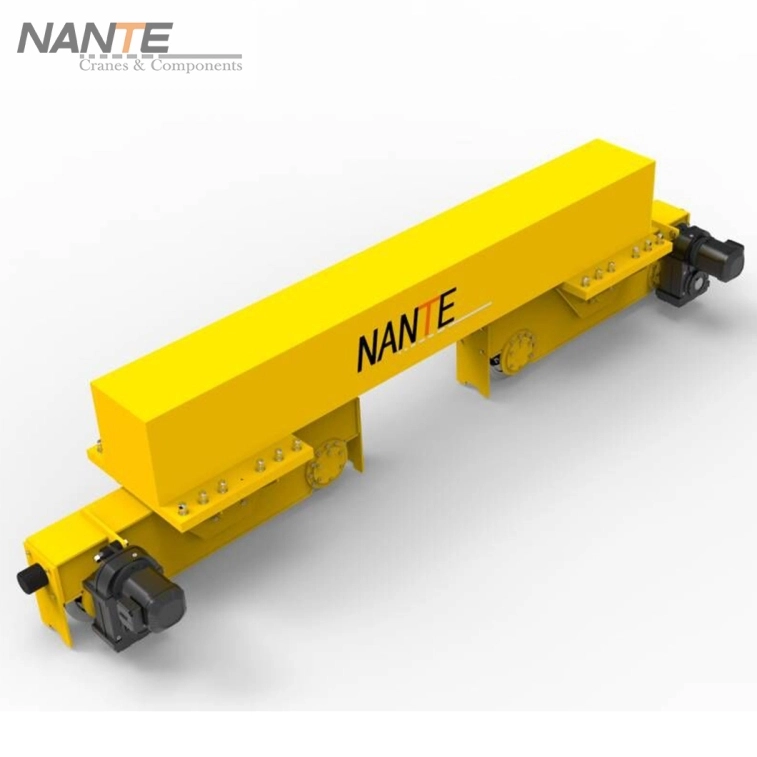
What Is a Hollow Shaft End Carriage?
The Hollow Shaft End Carriage features a hollow output shaft. This allows the motor and reducer to mount directly. It removes the need for extra couplings and creates a simpler drive system.
Key Design Features of Hollow Shaft End Carriages
The torsion-resistant open-frame box gives a strong yet light build. It supports modular wheel setups with diameters from 125–630 mm. Options cover single-girder types (125–400 mm wheels, wheelbase 1–5 m), double-girder types (200–630 mm, wheelbase 2.5–8 m), and bogie versions (8–16 wheels). They come with IP55 geared motors, electromagnetic brakes with F-class insulation, and accurate bearings.
Hollow Shaft End Carriage Benefits
This design brings better power transfer, less noise, and energy savings. Wheel changes happen easily. It also cuts down vibration more than older styles. The smaller size fits well in today’s factory spaces.
Common Applications and When to Choose It
Hollow Shaft End Carriage works mainly in single- and double-girder overhead cranes. Use it in manufacturing plants, warehouses, assembly lines, and medium-duty tasks (M3–M7). It suits places that need quiet and efficient movement, especially where space is tight or cycles run high.
Open Gear End Carriage (OGE Series)
How Does an Open Gear End Carriage Work?
Open Gear End Carriage uses exposed gears to send power. The pinion connects straight to the wheel. This gives direct high-torque force from the motor to the wheels through open gearing.
Design Advantages of Open Gear End Carriages
Open Gear End Carriage have tough builds for very heavy loads. Gears stay easy to check and fix. Costs run lower than fully closed systems. They hold up well in rough settings. Wheel sizes go from 125–500 mm to handle different spans.
Typical Industrial Uses
Heavy-duty double-girder overhead cranes often use them. Common spots include steel mills, foundries, mining sites, and plants with big capacity needs. They deliver steady torque during frequent heavy lifts.
When Is Open Gear the Right Choice?
Pick Open Gear End Carriage for tough duty cycles (M5–M8). It shines where strength and easy repairs matter more than small size. This holds true in dusty, hot, or shock-heavy places.
Underhung End Carriage (SCE Series)
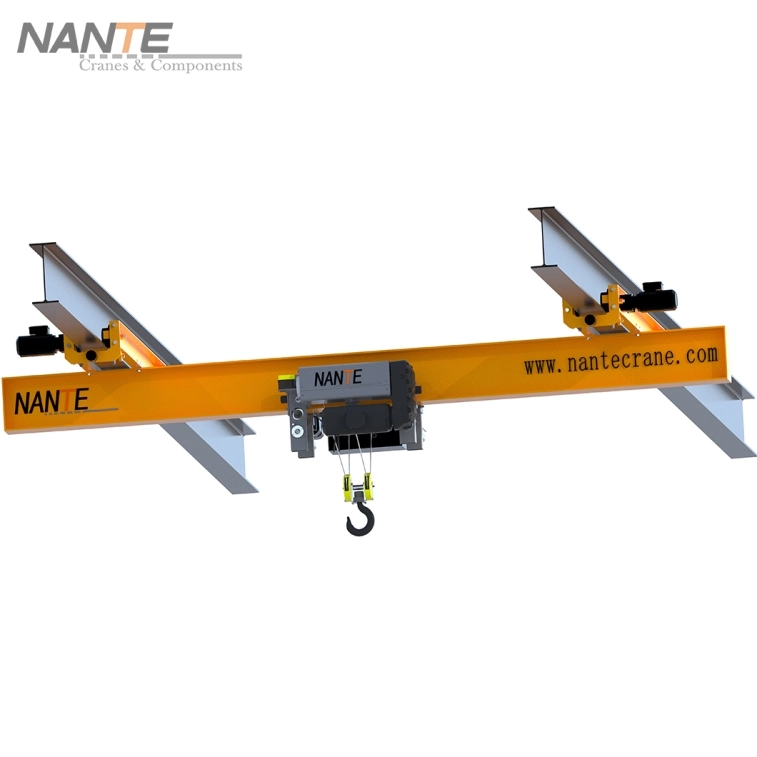
What Makes Underhung End Carriages Unique?
Underhung End Carriages wheels roll on the bottom side of runway beams (100–200 mm diameters). This flips the usual top-running style. It gives the most hook height and loses very little headroom.
Underhung vs Top-Running End Carriages
Underhung End Carriages saves vertical space in buildings with low ceilings. It can add 100–300 mm to lift height. Yet it usually manages lighter loads. Top-running End Carriages sits on top of rails. It supports bigger weights and heavier work because the rail provides strong backing.
Design Features and Advantages
Guidance rollers keep things precise. Safety anti-drop parts and small frames hold stable positions. This cuts the need for tall buildings and lowers setup costs.
Best Applications for Underhung End Carriages
Workstation cranes and light-duty overhead systems use Underhung End Carriages a lot (up to 10–20 tons). They fit assembly lines, machining shops, and buildings with height limits or full floor use needs.
Rubber Tyre End Carriage (RTE Series)
How Rubber Tyre End Carriages Operate
Rubber Tyre End Carriage relies on big rubber tires (500–2000 mm) for grip right on the floor. No rails needed. This allows movement in many directions or along flexible paths.
Key Benefits of Rubber Tyre Design
The tires absorb shocks and vibrations well. They protect floors since no rails dig in. Noise drops, relocation happens fast, and they adjust to bumpy or short-term surfaces.
Applications in Mobile and Heavy-Duty Cranes
Rubber tyre gantry cranes (RTG) use this often. Construction sites, shipyards, ports, maintenance areas, and outdoor heavy lifts rely on it when fixed rails do not make sense.
When to Select Rubber Tyre End Carriages
Go with Rubber Tyre End Carriage for mobile or partly mobile work. It helps on uneven ground, when moving often, or when avoiding permanent runways.
Additional Considerations for Crane End Carriage Selection
Factors Influencing End Carriage Performance
Look at duty class, span length, travel speed, and surroundings (indoor or outdoor, corrosive areas). Pairing with variable frequency drives helps smooth starts and stops.
Safety and Compliance Features
Every Nante design includes buffers, limit switches, overload guards, and anti-derailment parts. They follow international rules like FEM/ISO.
Integration with Crane Systems
End carriages connect with hoisting setups for full travelling power. This keeps motion in sync and cuts down on sway.
Comparison — Best Crane End Carriage for Each Crane Type
Side-by-Side Performance Comparison
Load Capacity: OGE handles the most (heavy industrial use); HSE covers medium to high; SCE stays lighter; RTE varies for mobile needs.
Travel Speed: HSE and OGE reach up to 100 m/min; SCE and RTE depend on the job.
Noise/Energy Efficiency: HSE stays the quietest and most efficient; OGE focuses on torque but needs more upkeep.
Durability/Impact: OGE stands out in rough conditions; RTE guards floors and dampens hits.
Space/Headroom: SCE wins here; others depend on rails.
Cost, Installation, and Long-Term Factors
HSE brings lower energy and upkeep costs over time. OGE allows simple fixes on site. SCE and RTE cut building or rail expenses. Installation requires careful alignment so wheels touch rails just right.
Recommended Choices by Crane Design
Top-running overhead: HSE for better efficiency or OGE for heavy-duty tasks.
Underhung/workstation: SCE.
Gantry/construction/mobile: RTE.
Heavy industrial: OGE.
Conclusion — Choosing the Right Crane End Carriage
Think about the crane type, load and duty needs, space limits, surroundings, and budget. Make sure it matches well with travelling and hoisting parts for safety and long life.
How to choose crane end carriage: Check details like wheelbase and load ratings. Look at the duty cycle. Pick modular types when possible. Crane end carriage buying guide: Pay attention to good materials, careful engineering, and trusted suppliers for steady results.
Contact Nante Crane for Crane End Carriages
Nante Crane specializes in high-quality crane components, including a full range of crane end carriages such as HSE Hollow Shaft, OGE Open Gear, SCE Underhung, and RTE Rubber Tyre series, alongside complete cranes like overhead cranes, gantry cranes, jib cranes, and workstation cranes. With over 30 years of expertise, Nante delivers safe, efficient, modular solutions tailored to diverse industries worldwide. Contact Nante Crane today to explore the best crane end carriage options for your project.
FAQ
What is the difference between underhung and top-running crane end carriages?
Underhung (SCE) runs wheels on the underside of the runway beam. This saves headroom and boosts lift height. But it usually handles lighter loads. Top-running moves on top of the rails. It supports higher capacities and heavier duties. Yet it needs more building height.
Which crane end carriage is best for heavy loads in overhead cranes?
Open Gear (OGE series) usually works best for heavy loads in overhead cranes. Its high-torque exposed gear design, strong build, and fit for M5–M8 duty cycles make it great for steel mills, foundries, and similar spots.
How do hollow shaft crane end carriages improve efficiency?
The hollow shaft (HSE) setup lets the motor and reducer connect straight away. No couplings needed. This raises transmission efficiency, cuts energy use, lowers noise and vibration, simplifies upkeep, and keeps the overall size small.
When should I choose a rubber tyre end carriage for my crane design?
Choose RTE Rubber Tyre when fixed rails do not work. It suits construction sites, shipyards, ports, outdoor yards, or uneven and temporary surfaces. It offers floor protection plus good shock absorption.
What size ranges does Nante offer for hollow shaft end carriages?
Nante HSE series wheel diameters range from 125 mm to 630 mm. Single-girder versions typically 125–400 mm, double-girder 200–630 mm, with wheelbases from 1 m to 8 m depending on the model.