English



What Is a Jib Crane, Where Can We Use the Jib Crane
What Is a Jib Crane, Where Can We Use the Jib Crane
Date: 2026-03-12 Share:
A jib crane is a flexible and handy lifting tool. It sees wide use in factories and workshops for handling materials in one spot. People often look up what is a jib crane. It is an overhead crane with a horizontal arm called the jib or boom. This arm turns around a steady upright support. The support can be a pillar on the floor or a bracket on a wall or column. Such setup lets it lift, place, and shift loads in a round or half-round space. That makes it great for repeated jobs in small areas.
Jib cranes improve work speed. They cut down on hand lifting, make things safer, and help flow better at certain spots. They usually manage weights from 250kg to 5000kg, or even higher in special builds. Also, they cost less than big overhead bridge cranes. This guide explains the main points, build, uses, kinds, and a clear way to pick a jib crane. It helps decide if one fits the place.
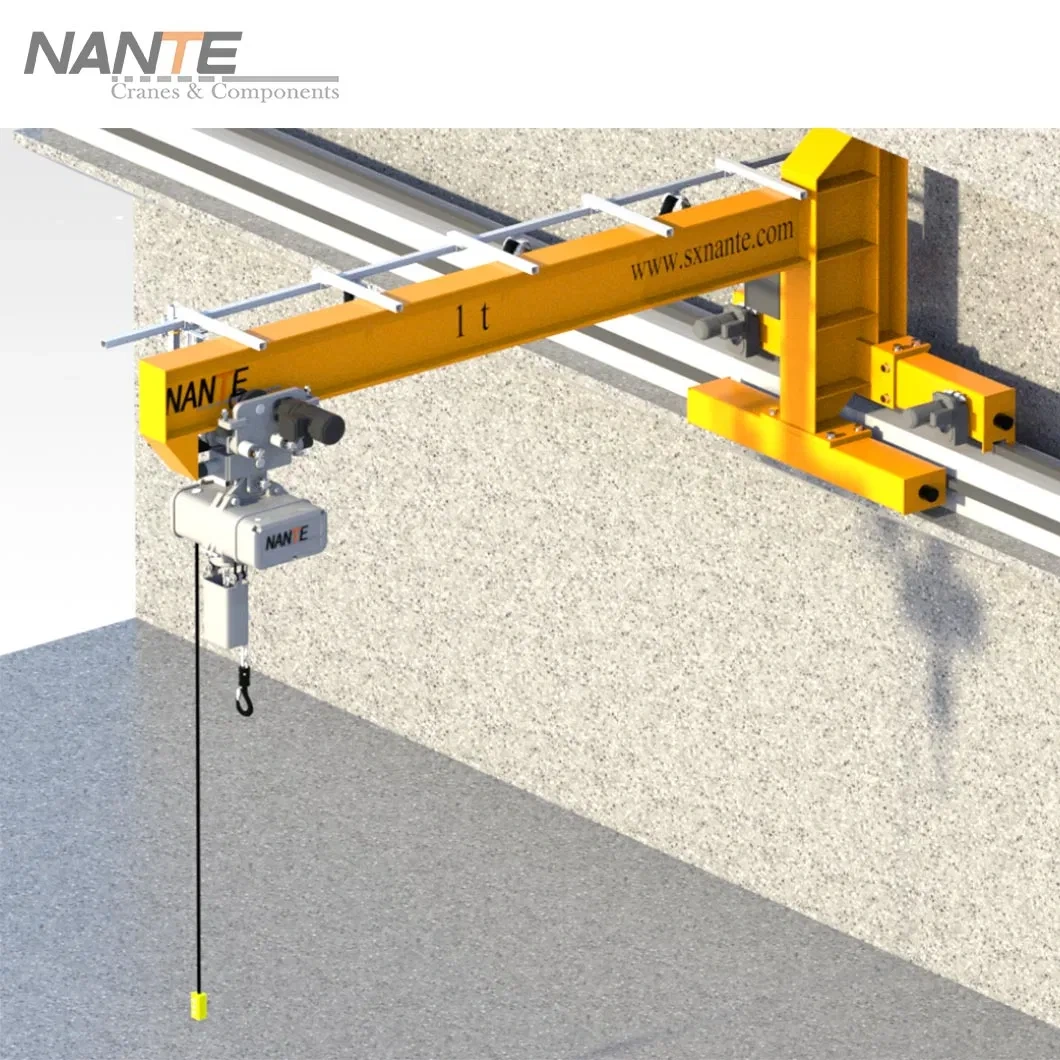
What Is a Jib Crane
A jib crane is a fixed overhead lifting tool made for work in one area. It differs from big gantry or bridge cranes. It centers on a certain zone. It uses a turning boom to reach out in a circle well.
The main plus is the small space it takes and how simple it is for regular, exact lifts. These cranes appear often in making things, putting parts together, and storing goods. They raise output and lower tiredness or hurt risks for workers. They meet global rules such as FEM, CMAA, ISO, and more for safe work and good results.
Structure and Main Components of a Jib Crane
Jib cranes have several important parts. These parts join to give steady work.
Jib crane arm (boom): This is the side beam that sticks out from the support. It is often an I-beam, box girder for bigger loads, or a closed track shape. It holds the hoist and trolley. It lets loads move along its path.
Pillar or wall support: The upright post (pillar for floor types) or bracket (for wall types). Pillars use smooth pipe or steel posts fixed to the floor. Wall supports fix to current building parts like columns.
Hoist and trolley system: The hoist (electric chain, wire rope, or hand type) lifts and lowers loads up and down. The trolley rolls side to side on the boom. It comes as push style, powered, or low-headroom for extra space.
Other crane parts cover the turning setup (hand or powered bearing for spin), base plate or anchor for pillar kinds, and safe items like limit switches.
How a Jib Crane Operates
The jib crane working principle uses three linked actions: turning, side movement, and up-down lift.
The boom spins around the support with a slewing bearing. Wall-mounted kinds give 180°–200°. Pillar-mounted kinds reach up to 360°. Turning happens by hand push or with power for even motion.
The jib crane lifting mechanism uses the hoist. It raises or drops loads with chain or wire rope. The trolley sets the hoist spot along the boom for exact placement.
This mix allows fast and right handling in tight spots. Safety parts stop too much weight or wild swings.
Where Can a Jib Crane Be Used: Common Jib Crane Applications
Jib crane applications cover many fields that need good local lifting. They do well when big overhead setups feel too much or hard to fit.
Fields with jib cranes cover manufacturing, assembly, warehousing, logistics, metalworking, automotive, food processing, pharmaceuticals, and repair shops. They help with repeated jobs, better comfort, and links to work lines.
Workstation Jib Crane Applications
In plant work spots, workstation jib crane applications work great on assembly lines and machine care. They place tools, pieces, or items right at benches. This cuts strain and makes work faster.
For instance, they manage lifts in machining spots, comfort areas, or making zones. Operators shift loads with little effort in a round space.
Jib Crane for Warehouse Loading
Warehouse material handling crane setups use jib cranes to load or unload trucks. They also set pallets and manage stock. At loading docks or pick zones, they make moving boxes, crates, or big loads easy in narrow paths.
Wall-mounted kinds save floor room. Pillar kinds cover open spots well.
Jib Crane for Small Workshops
Small shop lifting crane options stay small and bendy for garages, build shops, or fix areas. They give tight lifting gear for now-and-then heavy lifts. They take little room.
They suit tool placement, part putting-together, or fixes in small places.
Other useful jib crane applications add support to bigger cranes in machining, packing, or load spots. This gives quicker local handling.
Types of Jib Cranes
Jib cranes change by mount style and build to match needs.
Main groups cover pillar-mounted (floor-mounted), wall-mounted, movable, and wall-travelling kinds.
Pillar Mounted Jib Crane
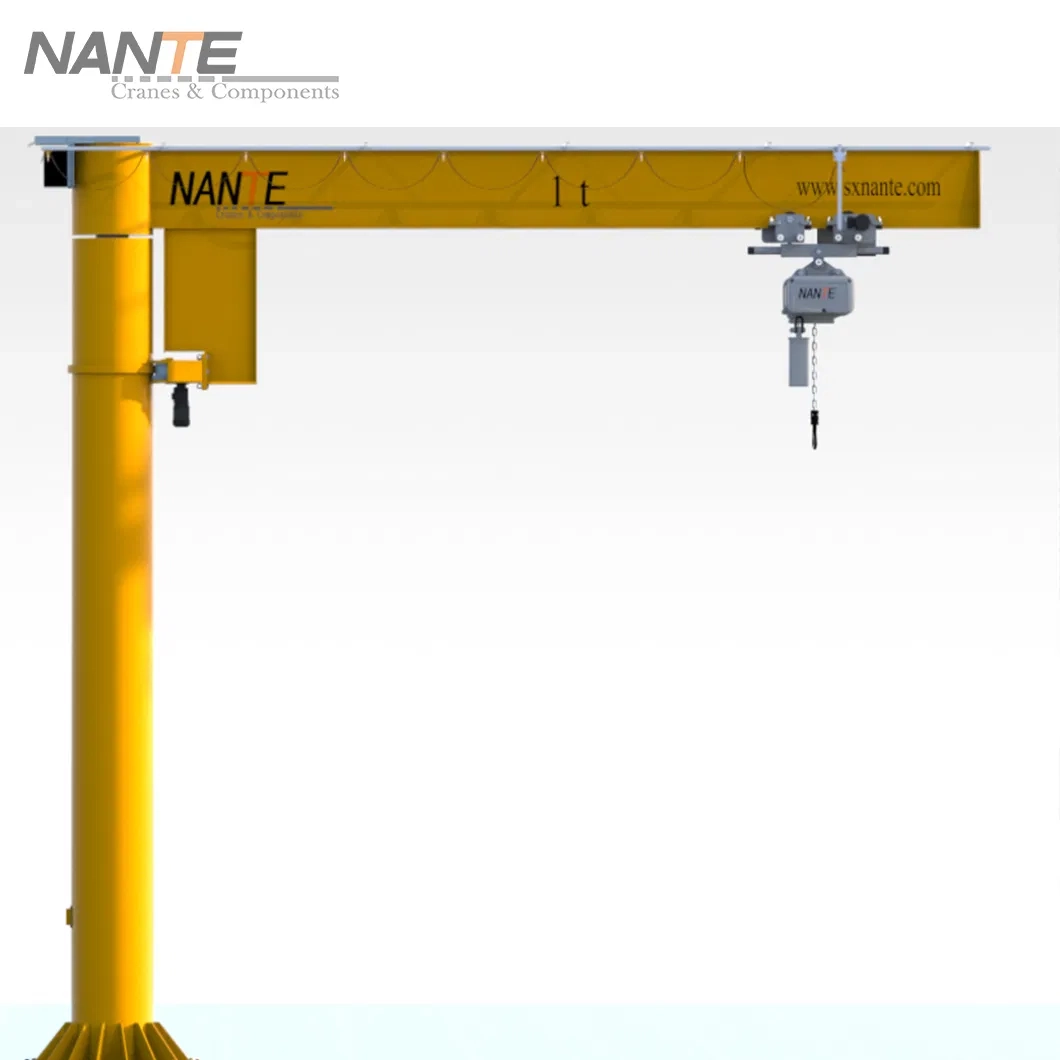
Also known as floor mounted jib crane, this free-standing kind fixes to a concrete base. It gives full 360° turn without need for building parts.
Floor mounted jib crane advantages cover round reach, bigger loads (up to 5000kg+), and fit for open spots. It lasts long and works well for tough jobs or changing setups.
Wall Mounted Jib Crane
Wall bracket jib crane fixes to walls or columns. It keeps floor clear. Turn stays at 180°–200° usually.
Wall bracket jib crane benefits include lower setup cost, no base needed, and good fit for tight zones like next to lines or near walls.
Other kinds cover movable (on wheels for short-term use) and wall-travelling (on tracks for more reach).
How to Choose the Right Jib Crane: Selection Guide
Picking the best jib crane means checking exact needs for top work and safety.
Key Factors to Consider Before Buying
Lifting capacity of jib crane: Find max load (with hoist/trolley weight and extra force). Common ranges: 250kg–5000kg. Make sure it fits the heaviest usual lift.
Jib crane rotation range: Pick 360° for pillar kinds (full reach) or 180°–200° for wall kinds (enough for straight work).
Installation space requirements: Pillar needs strong floor/base. Wall-mounted uses wall strength but frees floor.
Boom length (reach): Check needed stretch (2m–7m usual). Longer arms lower load at end from bend.
Height and under-boom clearance: Check enough lift height (2m–7m usual) and space above for safe moves.
Power source and features: Hand or electric hoist/turn. Think about place (inside/outside, work amount).
Other considerations: Meet rules, turn type, and fit with current gear.
Steps to Select a Jib Crane
Check load kinds and how often → Draw work layout → Figure needed load/reach → Look at mount choices → Check details and ask experts → Put safety and smooth work first.
Ready to Find the Perfect Jib Crane Solution?
Nante Crane specializes in high-quality overhead cranes, gantry cranes, construction cranes, workstation cranes, and crane components, including reliable jib cranes designed for industrial efficiency and durability. With expertise across applications like factories, warehouses, and workshops, Nante Crane delivers tailored lifting solutions backed by professional service. Contact us today to discuss your requirements and get expert guidance on the right jib crane for your operations.
FAQ
What is a jib crane used for?
It handles local lifting in workstations, warehouses, and workshops. This manages repeated material moves well.
What is the difference between pillar mounted and wall mounted jib crane?
Pillar-mounted gives 360° turn and bigger loads but takes floor room. Wall-mounted saves space with 180°–200° turn and lower price.
How much weight can a jib crane lift?
Typically 250kg to 5000kg, based on type, boom length, and model. Always look at rated capacity charts.
Can a jib crane be installed in a small space?
Yes. Wall-mounted kinds skip floor use and fit tight spots well.
What factors matter most when choosing a jib crane?
Load capacity, turn needs, open space, boom reach, and setup ease stand out for the best match.