English


What Determines the Required Crane Travel Speed?
What Determines the Required Crane Travel Speed
Date: 2026-09-18 Share:
Crane travel speed is determined by route distance, cycle time, placement accuracy, duty, and risk created by moving mass. A larger data-sheet number is not automatically better. The specification must balance throughput with controlled starts, stops, visibility, and component life.
Separate the three motions first: bridge travel moves the crane along the runway, trolley travel moves the hoist across the bridge, and hoisting changes elevation. Each has a different motor, brake, control profile, and safety consequence.
Start with the Three Crane Motions
Bridge travel speed
Bridge travel, also called crane long travel, determines how quickly the crane reaches another bay or workstation. The useful measure is not maximum speed alone; it is the time from a safe departure point to a stable arrival, including acceleration and braking. Runway length, rail condition, wheel loads, and the presence of other cranes set practical limits.
When stations are widely spaced, higher Overhead Crane travel speed can reduce empty movement. In a compact shop, it may create braking and clearance risk. End stops, buffers, interlocks, and travel limits must suit the profile.
Crane trolley speed
Crane trolley speed controls lateral positioning on the bridge. It affects how quickly a load can move from an aisle to a machine, fixture, or staging point. Trolley motion is especially sensitive to suspended-load swing because the load often travels across people, equipment, or open containers.
The specification should state whether a single speed, two-step speed, or variable-speed range is required. A slow final approach may produce better placement than a high nominal speed followed by abrupt braking. Wheel diameter, gearbox ratio, and load geometry also influence the result.
Hoisting speed is a separate decision
Hoisting speed should not compensate for slow horizontal travel. It determines exposure time while a load is suspended, hook positioning near obstructions, and time to confirm secure attachments.
Fast hoisting may help repetitive work, while a slower precision mode suits dies, molds, or fixtures. Specify hoist duty, brake response, reeving, load spectrum, and inching resolution independently from horizontal speeds.
Workshop Size and Material Flow
Convert the layout into a travel requirement
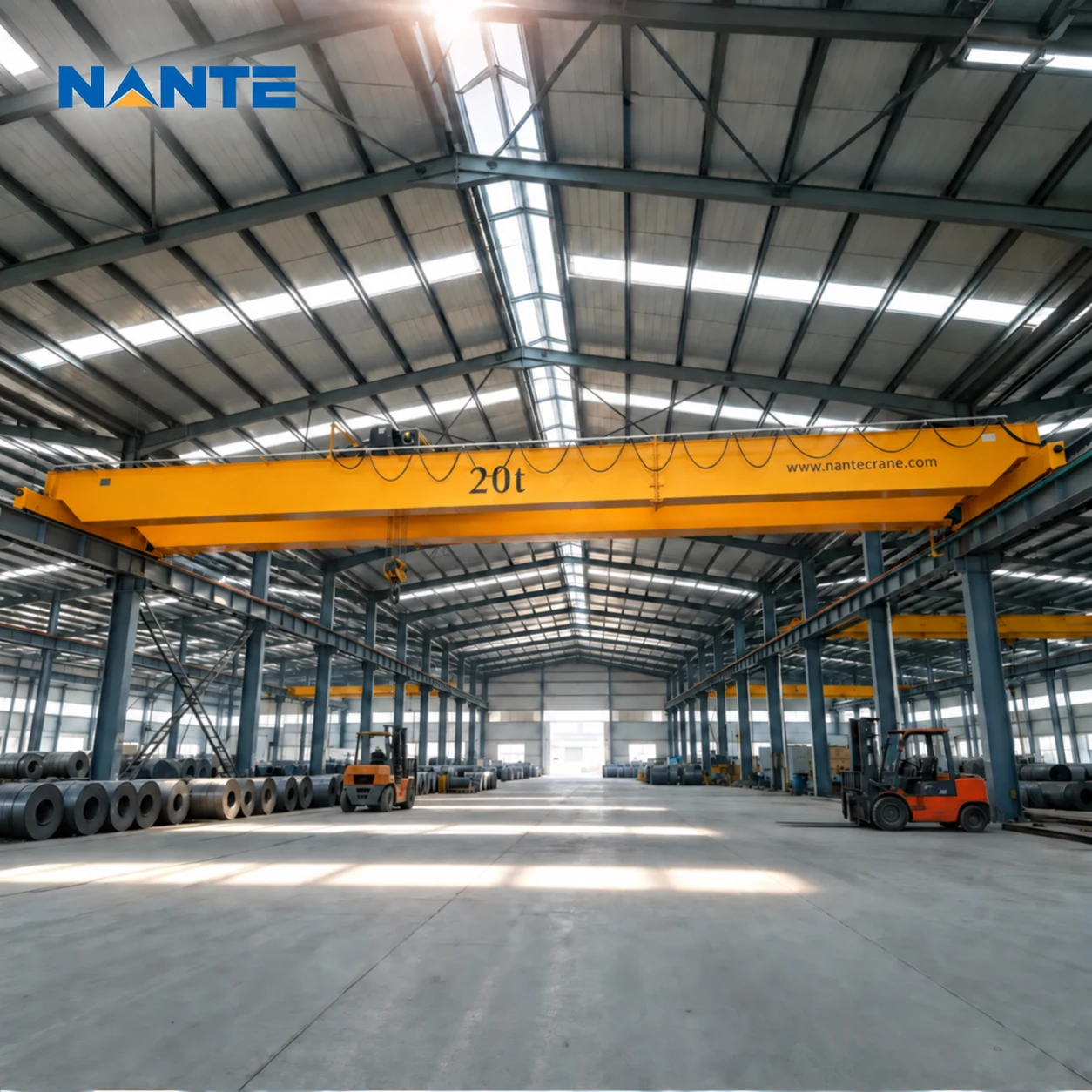
Workshop size matters only when translated into routes. Record runway length, span, pickup and drop-off points, average one-way distance, and the share of cycles using the full envelope. A short route repeated all shift may need more speed capacity than a long route used twice daily.
Cycle-time modeling should separate pickup, lift, bridge travel, trolley travel, placement, lowering, and return. Add acceleration and deceleration rather than multiplying distance by nameplate speed. This reveals the bottleneck.
Match speed to material flow
A process with fixed stations benefits from predictable point-to-point movement. A job shop with changing destinations benefits from a wider controllable range. Where multiple cranes share a runway, traffic rules and priority logic may matter more than maximum travel speed.
A material-flow review asks:
- Does the crane repeat the same route, or does each lift have a different path?
- Are pedestrians, forklifts, doors, or maintenance zones near the runway?
- Can loads be staged to reduce empty-hook travel?
- Is the crane feeding production or supporting occasional maintenance lifts?
These answers define normal speed, reduced-speed zones, and restricted areas before motor or gearbox selection. See the guide to the crane travelling mechanism.
Positioning Accuracy and Load Behavior
Why maximum speed is not working speed
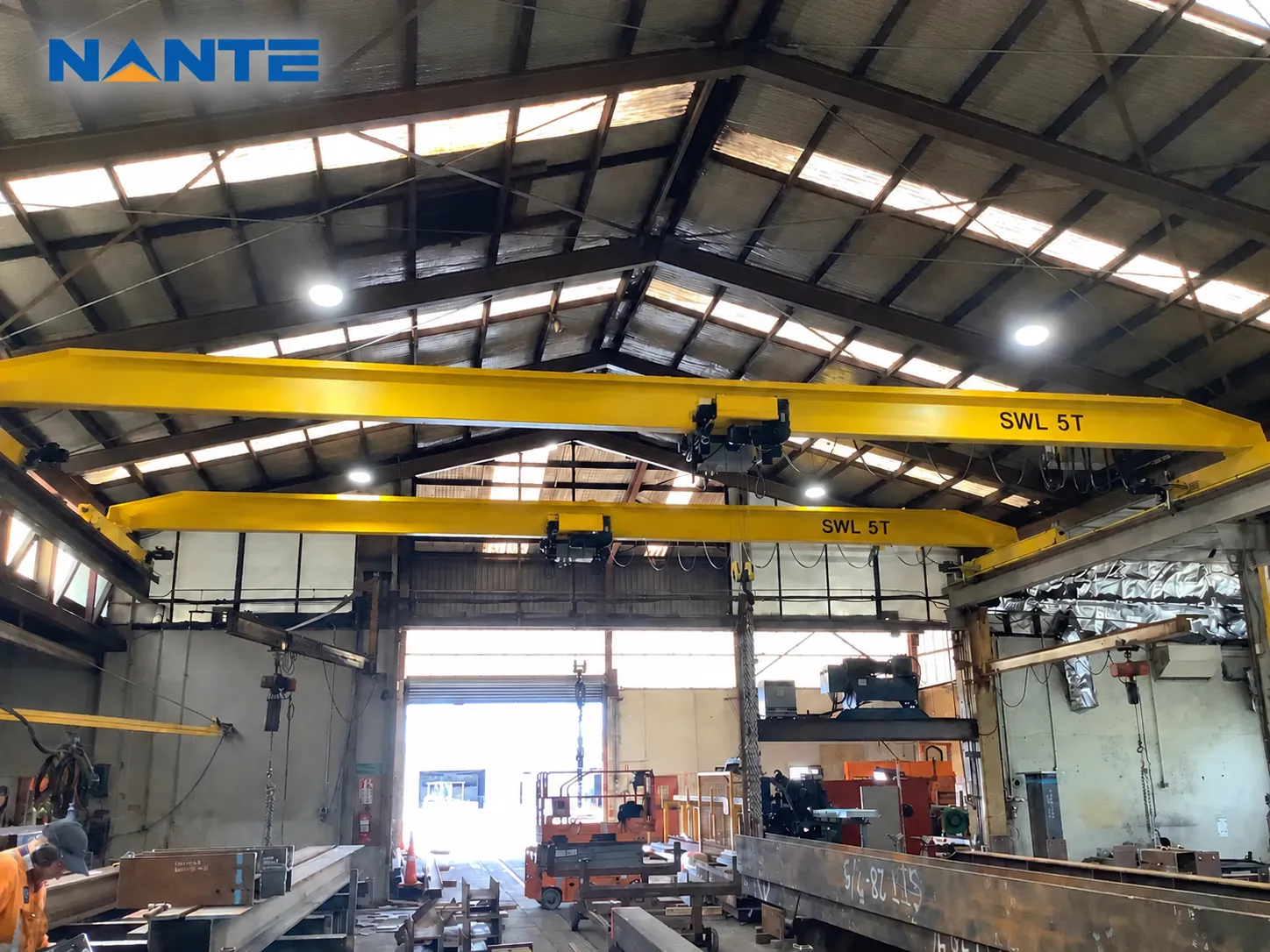
Positioning accuracy depends on stopping distance, brake timing, wheel slip, flexibility, swing, and operator response. High speed can work when controls provide smooth ramping and a low-speed approach; abrupt braking is a poor fit.
The load changes the answer. A rigid spreader may settle quickly; a long beam, liquid container, or flexible sling can continue moving after the bridge stops. The speed schedule should leave distance for settling before final placement.
Use acceleration and deceleration as design variables
Acceleration affects wheel-rail forces, torque, and swing; deceleration affects stopping distance and buffer forces. Record ramp times, braking method, allowable jerk, and load condition, not only top speed.
For precision work, an inching or creep setting may be more valuable than a higher maximum speed. Anti-sway can assist, but it does not replace a layout review, correct rigging, or line of sight. State the target as repeatable placement within a defined area and condition.
Operating Frequency and Duty Class
Cycle count and load spectrum
Operating frequency determines thermal loading and wear. Record starts per hour, average and peak load, travel distance, idle time, and low-speed share. A motor sized for occasional movement may overheat in production.
Duty classification should align with the project standard and load spectrum. Request the calculation basis, not just a duty label. The Crane Motor specification should identify rated power, enclosure, brake arrangement, gearbox service factor, and permissible starts.
Select a controllable speed range
Variable-frequency control allows the same motion to use a faster transit setting and a slower approach setting. The selected VFD must be compatible with motor cooling, braking energy, harmonics, electromagnetic compatibility, and the required low-speed torque.
VFD control still requires checks for braking resistors, regeneration, cable length, earthing, and fault recovery. State whether speed presets, ramps, limits, and parameter backups are included.
Safety, Controls, and Compliance
Design for visibility and separation
Safety considerations often reduce usable speed. Review blind corners, columns, doors, pedestrian crossings, suspended obstructions, and adjacent cranes. Select warning devices, barriers, and access controls for the actual environment.
In the United States, OSHA 1910.179 addresses overhead and gantry crane operation, inspection, and handling. Identify local rules, site procedures, and applicable consensus standards such as ASME B30.2. A speed setting alone cannot make an unsafe route acceptable.
Verify the control architecture
The Crane Control System should coordinate commands, interlocks, limits, overload protection, emergency stopping, and fault indication. Radio, pendant, cabin, and automated control each change visibility and response time.
The control narrative should define behavior after power or communication loss, overspeed detection, and a travel-limit trip. State how reduced-speed zones activate and how reset is confirmed. A cause-and-effect matrix is more useful than a generic “safe controls” claim.
A Practical Crane Speed Selection Method
Freeze the inputs in the request for quotation
Before requesting prices, record:
- Runway length, bridge span, clearances, rail and support conditions.
- Capacity, hook approach, lifting height, load dimensions, and center of gravity.
- Pickup and delivery coordinates, cycle time, starts per hour, and load spectrum.
- Required placement tolerance, creep mode, anti-sway expectation, and automation interface.
- Ambient temperature, dust, humidity, hazardous-area classification, power supply, and control method.
- Applicable standards, inspection hold points, testing, installation scope, training, spares, and warranty terms.
This lets an engineer calculate travel time and stopping distance realistically, preventing a speed quote without the motor, brake, wheel, rail, and control details needed to achieve it.
Compare bids on normalized performance
Normalize bids for drive assemblies, VFDs, brakes, cabinets, cables, limits, buffers, testing, documentation, commissioning, and support. Request a motion table showing maximum, creep, ramping, and rated-load conditions for each axis.
Request drawings, motor and gearbox data, brake calculations, control schematics, FAT procedures, calibration records, and a commissioning checklist. A supplier that cannot explain the quoted speed creates lifecycle risk.
From Specification to Commissioning
Test the actual operating envelope
Factory acceptance testing should verify direction, speed presets, ramping, brakes, limits, emergency stop behavior, and fault recovery. Site commissioning should repeat critical checks with the installed runway, control distance, representative loads, and traffic rules.
Record no-load and rated-load travel, steady-state speed, and stopping distance, with any approved parameter changes.
Maintain the speed capability
Travel speed depends on wheel condition, rail alignment, lubrication, gearbox backlash, brake wear, sensors, and VFD parameters. Preventive maintenance should define inspection intervals and wear limits. Spare planning should cover motors, brakes, wheels, drives, sensors, and control components according to criticality.
Request parameter backups, wiring diagrams, recommended spares, troubleshooting codes, and training records so speed changes remain controlled.
Supplier Review for a Project-Specific Decision
What Nante Crane can review
With the engineering inputs assembled, Nante Crane can be included in a comparable review of crane arrangement, motions, components, controls, and documentation. Compare the same layout, duty, speed profile, safety functions, testing, and delivery responsibilities.
The procurement package should ask for bridge travel speed, crane long travel speed, crane trolley speed, hoisting speed, ramp settings, motor and brake data, control philosophy, and test records.
Questions for the quotation package
Is a higher speed always better?
No. Higher speed can shorten transit time, but it can increase stopping distance, swing, wheel forces, and interaction risk. The correct value is the fastest controlled setting that meets cycle-time and placement requirements on the route.
FAQ About Crane Travel Speed
What is crane travel speed?
Crane travel speed is the speed of the complete bridge moving along the runway. It is different from crane trolley speed and hoisting speed.
How does workshop size affect overhead crane travel speed?
Large workshops may need higher overhead crane travel speed to reduce transfer time. Smaller workshops often require slower movement for safer stopping and positioning.
How is crane long travel speed selected?
Crane long travel speed depends on runway length, load movement distance, operating frequency, stopping space, and positioning accuracy.
When is VFD control recommended?
VFD control is useful when smooth acceleration, controlled deceleration, frequent start-stop operation, or accurate load positioning is required.
Request a Project-Specific Crane Speed Proposal
For a comparable RFQ, submit the layout, runway length, span, capacity, lifting height, load dimensions, travel distance, cycle time, duty class, positioning tolerance, operating environment, control method, applicable standards, and installation scope. The brief should separate bridge or crane long travel speed, trolley speed, and hoisting speed. Based on these inputs, Nante Crane can review the motion profile and prepare a project-specific response covering speed ranges, drive, brake, VFD, controls, testing, and quotation assumptions. Send the project brief and drawings through the Contact page.