English



Jib Crane Basics: Structure, Rotation Angle, and Lifting Mechanism
Jib Crane Basics Structure, Rotation Angle, and Lifting Mechanism
Date: 2026-03-05 Share:
A jib crane ranks as one of the most space-saving and budget-friendly material handling options for small to medium-sized workshops and factories. Unlike big overhead bridge crane setups that need long runway beams and column supports, a jib crane features a single turning horizontal arm (often named the crane jib or jib arm). This arm attaches either to a vertical post or straight to a building wall or column. Such a setup allows exact, local lifting in a round or half-round work zone.
Key technical parts cover a sturdy frame, a managed jib crane rotation angle (from 180° to full 360° based on the type), and a dependable lifting setup usually powered by an electric chain hoist or wire rope hoist that moves along the arm.
For workshop planners and factory owners with little floor space and strict budgets, small workshop jib cranes bring solid workstation-level output. At the same time, they keep main paths and central spots open for other tasks. But does one jib crane meet the needs of a given workflow? This detailed guide looks at the main technical points. It also shows how jib cranes work well with bridge cranes instead of going against them.
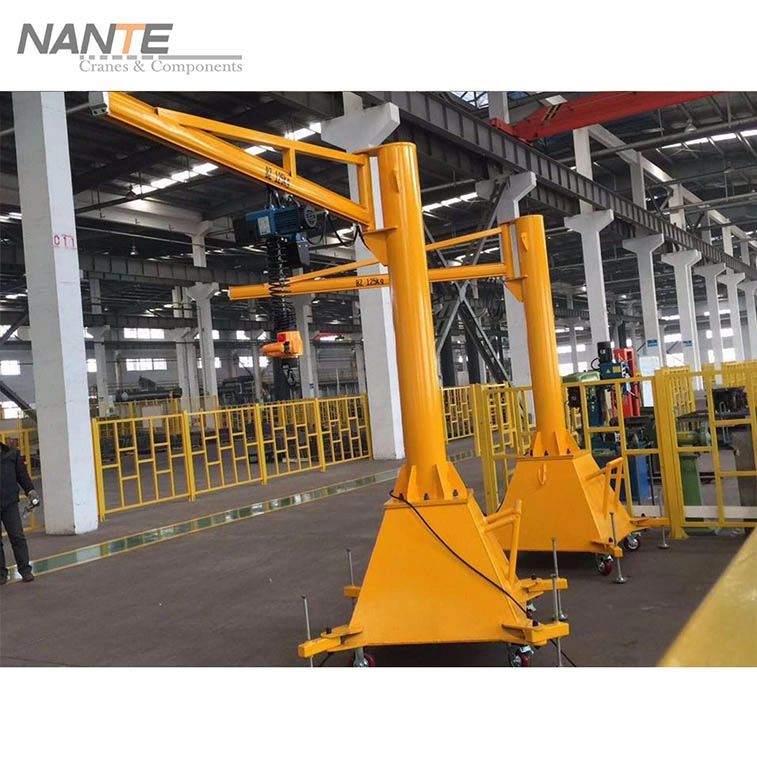
What is a Jib Crane?
A jib crane is a fixed or partly fixed turning crane built for moving loads within a set distance from a steady pivot spot.
It has a level arm that turns around a vertical line. This lets the hoist cover a fan-like or full-round work area.
In small and medium workshops, jib cranes see the most use for repeated moving jobs at single workstations, machine tools, assembly tables, or repair spots.
Their chief benefits cover small floor use, fast setup next to overhead systems, and much lower setup cost.
Is a jib crane the right choice for your small workshop? It often fits when most lifting jobs focus within 3–6 meters of a main point or near a wall.
Jib Crane Structure
The frame strength and work dependability of a jib crane rely on well-planned crane parts that act together under weight and wear conditions.
Main frame parts include:
- Pillar / mast — a strong tube or box steel column (often Q235B or Q355B steel) that passes all up and down and twist loads to the base or wall.
- Crane jib (boom) — the level weight-holding part, usually made as an I-beam, H-beam, or closed box beam to get the best strength-to-weight balance and cut bending.
- Hoist and trolley system — an electric chain hoist or wire rope hoist set on a low-height trolley that runs along the crane jib length.
- Rotation / slewing mechanism — good slewing bearing (one or two row ball type) linked with either hand chain drive, wheel, or electric motor plus gear box plus gear wheel for powered turning.
- Mounting base — big base plate with hold-down bolts for ground units, or strong wall holder with extra plates for wall or column units.
All weight-holding steel parts get sand-blasted and covered with thick epoxy base coat plus poly top coat. This gives lasting rust protection in work settings.
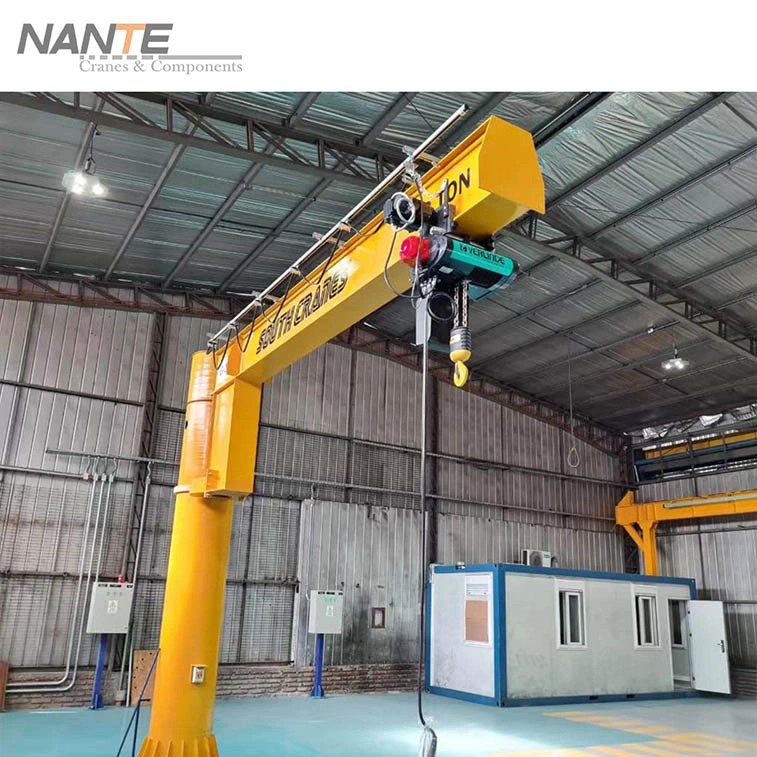
Jib Crane Working Principle
The working principle of a jib crane joins three separate but linked movement types:
- Vertical lifting/lowering — done by the hoist drum rolling up or down the lifting chain or wire rope.
- Horizontal rotation — reached by turning the whole crane jib around the main pivot line with the slewing bearing and drive setup.
- Radial positioning — finished by shifting the hoist trolley along the crane jib, which lets exact hook placement under the load.
Most small workshop setups use electric hoists with two-speed lift and trolley move. Rotation can stay hand-operated or get motor power for heavy or often-used cases.
New designs add electric-mechanical stop switches, overload guards, stop buttons, and phase guards to match world safety rules.
Jib Crane Rotation Angle
The jib crane rotation angle stands as one of the key measures that set the useful work area.
- Floor-mounted (freestanding) jib cranes often give full 360° steady rotation. This allows open reach around the whole post circle.
- Wall-mounted or column-mounted jib cranes usually limit to 180°–200° of turn to keep the arm from hitting the hold wall, column, or nearby gear.
The real possible angle rests on:
- Slewing bearing plan and build
- Spot of mechanical turn stops
- Space to nearby blocks
- Use of inside or outside limit switches
A bigger jib crane rotation angle right away raises the count of workstations served from one attach point. This makes it very useful in tight workshops.
- 360° rotation — favored for island machine setups or main workstation groups
- 180°–200° rotation — best for wall-near or straight production lines
What jib crane rotation angle best matches your workshop layout?
Wall-Mounted vs Floor-Mounted Jib Crane
Right pick between wall-mounted and floor-mounted kinds has a big effect on workshop space use and lasting work.
Wall-Mounted Jib Crane
- Advantages: No floor space taken, no concrete base needed, perfect for setup near machine tools, assembly tables, or set columns.
- Limitations: Lower safe work load (often 0.25–3 tons), limited turn angle, more bend at full reach from overhang setup.
Floor-Mounted Jib Crane
- Advantages: Full 360° rotation, much higher lift power (up to 10 tons in some plans), less bend, simpler move later if wanted.
- Limitations: Needs lots of floor space around the post, calls for well-made strong concrete base to fight tip-over force.
In real use, wall-mounted types win in very close workshops. Floor-mounted ones get picked when higher power or full round cover is needed.
Jib Crane Lifting Capacity
Rated lifting power of a jib crane is not a set figure. It changes a lot with load distance (space from pivot to hook).
Main effect factors cover:
- Length of the crane jib (longer reach means lower power at end from more bend force)
- Frame section strength of the arm
- Type and hold strength of the slewing bearing
- Hoist and trolley own weight
- Move load factors (hit, speed-up)
Usual power spans for small workshop jobs run from 250 kg to 5 tons. Most common models sit between 500 kg and 2 tons.
Key work rules:
- Always check the manufacturer’s load-distance chart
- Never go over the rated power at any hook spot
- Add hoist, trolley, and any lift tools to load counts
- Plan regular weight tests and frame checks
Jib Crane Applications in Workshops
Small workshop jib cranes find wide use in these cases:
- Exact load and unload of CNC lathes, milling machines, and machining centers
- Part move along straight assembly lines
- Tool and die handle in tool rooms
- Engine, gearbox, and heavy part placement in upkeep
- Local material feed in welding, painting, or packing spots
Their skill at placing loads just right in a small space cuts hand moving and truck paths inside the workshop.
Why Jib Cranes Complement Bridge Cranes in Small Workshops
Bridge cranes (overhead moving cranes) aim to cover big square floor areas with heavy, rare lifts over many sections.
Jib cranes, on the other hand, do well at quick, repeated, short-move handling at single workstations.
When both setups work together in a small-to-medium factory:
- The bridge crane does cross-section transport and heavy rare lifts
- Many jib cranes take care of 70–90% of daily workstation moves
This split of tasks cuts bridge crane move time, lessens worker wait, drops power use, and greatly boosts full output flow.
One jib crane enough? Or pair it with a bridge crane? In most small workshops, the mix gives the best match of bend, speed, and space use.
Is One Jib Crane Enough for Your Small Workshop?
A single small workshop jib crane often works fine when:
- Lifting jobs focus in one main area
- Daily lift count stays average
- Load weights stay in a tight span
More units turn needed when the workshop has many separate workstations, high output, or varied load kinds and distances.
A close plan study on lift routes, count, growth plans, and safe zones sets the best number and spot.
Ready to Optimize Your Workshop Lifting?
Nante Crane focuses on solid jib cranes, overhead cranes, gantry cranes, and crane parts made for workshops and industrial jobs. Check our strong jib crane options, expert service, and custom choices at nantecrane.com to boost space use now. Contact for a talk.
FAQ
What is the typical jib crane rotation angle?
Floor-mounted models usually offer 360° continuous rotation, while wall-mounted versions provide 180°–200° to avoid structural interference.
How does a small workshop jib crane save space?
It requires only a small mounting footprint (especially wall-mounted models) and eliminates the need for long runway beams and large column supports.
What’s the difference between wall-mounted and floor-mounted jib cranes?
Wall-mounted units save floor space but offer lower capacity and rotation; floor-mounted models provide full 360° rotation and higher load ratings but require foundation work.
Can a jib crane replace a bridge crane?
No — it complements rather than replaces bridge cranes by efficiently handling localized, repetitive tasks while the bridge crane covers larger areas.
What factors determine jib crane lifting capacity?
Boom length, structural section, slewing bearing capacity, hoist specification, and load radius are the primary factors; always consult the load chart.