English


How Span Affects Overhead Crane Design: Single or Double Girder Guide
How Span Affects Overhead Crane Design Single or Double Girder Guide
Date: 2026-04-29 Share:
The overhead crane span vs girder design plays a central role in every lifting system. Engineers measure the crane span as the center-to-center distance between the runway rails. This dimension directly determines whether a single girder or double girder structure works best.
What Is Bridge Span in Overhead Crane Design
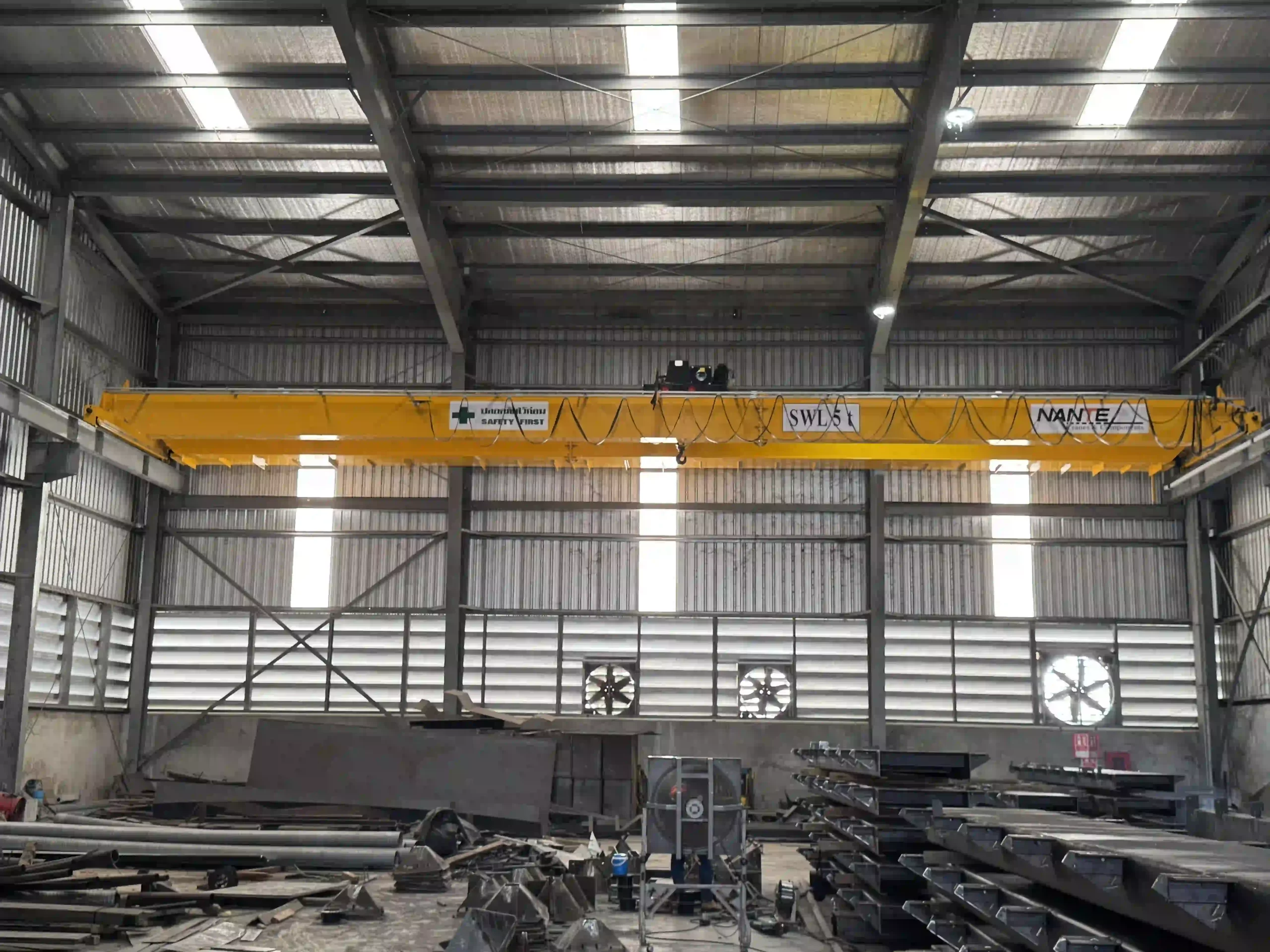
The bridge span in an overhead crane equals the horizontal distance measured center-to-center between the two runway rails. This measurement defines the clear width the crane bridge covers while traveling along the runway. Runway distance refers to the parallel supporting beams or rails that carry the entire crane load. Designers always specify span in meters because it sets the foundation for all other crane dimensions. Nante Crane single girder overhead cranes support spans from 5m to 30m, while double girder models reach up to 40m.
Why Span Length Directly Affects Crane Structure
Span vs structural stress and load distribution
As span length grows, the bending moment on the girder increases significantly. The load distributes across a greater distance. This raises stress at the center of the bridge. Double girder designs often handle this stress better because two parallel beams share the forces. Single girder cranes experience higher concentrated loading on one beam. So designers must reinforce the structure accordingly. Longer spans place more pressure on the supporting runway and building columns.
Beam deflection problems in long-span cranes
Longer spans cause greater vertical deflection under load. Excessive deflection reduces lifting precision and may lead to trolley movement issues. Industry standards limit deflection to ratios such as L/700 or L/1000. Engineers calculate deflection carefully to keep the crane within safe operating limits. Deflection escalates cubically with span length in some calculations. This makes control critical beyond 20 meters.
Impact on girder size, weight, and materials
Larger spans require deeper or thicker girders made from high-strength steel like S355. The increased material raises the crane’s self-weight. This affects runway loading and energy consumption. Designers balance girder size against total weight to maintain efficiency while meeting deflection criteria. Proper material selection ensures the crane remains durable without unnecessary cost. Nante Crane uses S355 steel with precise welding standards (ISO 15614, AWS D14.1) and non-destructive testing to achieve light self-weight and high rigidity.
Typical Span Range for Single Girder Overhead Cranes
Recommended span (6–18m / up to ~20m)
Single girder overhead cranes perform best in spans from 6 meters to approximately 18–20 meters. Many models handle up to 30 meters in lighter applications. But efficiency drops beyond 20 meters. Nante Crane single girder overhead cranes offer spans from 5m to 30m with lifting capacities from 1t to 20t and lifting heights from 3m to 30m.
Advantages for short and medium spans
Single girder overhead crane has an advantage in terms of low cost and reduced self-weight for short-to-medium span applications. This type of crane is compact in nature and requires less headroom and also reduces the load on structure construction. It is easier to install and maintain because it has fewer parts to align.
Limitations when span increases
As span exceeds 18–20 meters, beam deflection grows and reduces operational precision. The single girder carries the full load. This limits maximum capacity and stability. Higher spans also increase the need for stronger materials. These changes raise costs and may offset the original economic advantage.
Typical Span Range for Double Girder Overhead Cranes
Recommended span (20m+ and large workshops)
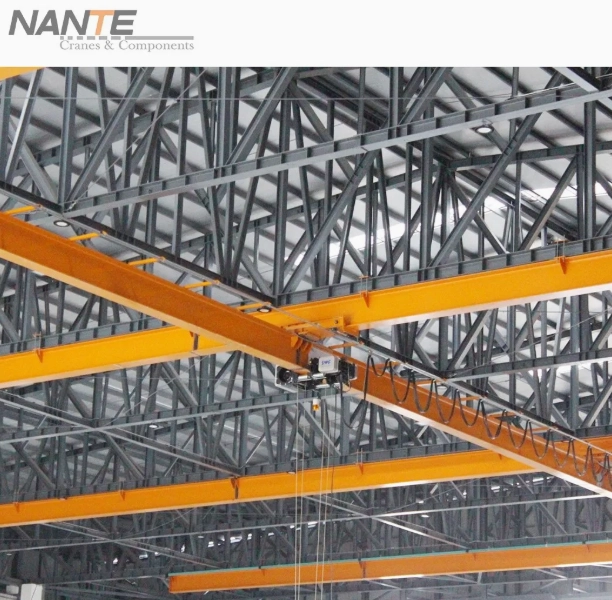
Double girder overhead cranes excel in spans of 20 meters and above. Many models reach 30–40 meters or more. These cranes support heavy-duty operations in large production halls and warehouses. Nante Crane double girder EOT cranes with hoist provide spans from 5m to 40m, capacities from 5t to 63t, and duty classifications from M4 to M6.
Structural advantages for long spans
Two parallel girders distribute load evenly and deliver higher rigidity. The design minimizes deflection even at extended spans. This improves trolley travel smoothness and lifting accuracy. Walkways and handrails attach easily to the girders for safe maintenance access. Bogie end carriages on larger models ensure smooth running with short wheel bases.
Suitability for heavy-duty operations
Double girder cranes handle higher lifting capacities and frequent use without excessive wear. The hoist travels on rails mounted on top of the girders. This provides better hook height and stability. These features make the cranes ideal for demanding environments that require reliable performance over long spans. Inverter-controlled motors and IE3 energy-efficient features further support heavy-duty cycles.
Single vs Double Girder: Span-Based Comparison
Cost vs performance trade-offs
Single girder cranes cost less for spans under 18–20 meters because they use fewer materials. Double girder cranes require higher upfront investment but deliver better long-term performance in larger spans. Buyers weigh initial cost against reduced maintenance and higher reliability over the crane’s service life. Single girder designs often prove more economical for light to medium applications.
Lifting height and headroom differences
Single girder designs often provide more usable headroom in buildings with height restrictions because the hoist runs under the girder. Double girder cranes offer greater hook height since the hoist sits between or on top of the two girders. The choice depends on available vertical clearance in the workshop. Low headroom hoist options on single girder models enhance flexibility in constrained spaces.
Stability and precision under different spans
Single girder cranes maintain good stability in shorter spans but may lose precision as span increases. Double girder cranes keep excellent stability and precision across long spans due to their rigid structure. Precision matters most in applications that require accurate load positioning. Reduced deflection in double girder models supports smoother operation and longer service life.
Key Factors Beyond Span That Influence Girder Choice
Available headroom and building constraints
Limited headroom may favor single girder cranes even when span suggests a double girder option. Building column strength and foundation capacity also affect the final decision. Designers review the entire facility layout before finalizing girder type. Runway rail alignment and existing steel structures play important roles in the evaluation.
Lifting frequency and duty cycle
High-frequency operations with heavy loads benefit from the durability of double girder cranes. Light or occasional use allows single girder cranes to perform adequately. Duty cycle classification (A1–A8 or M4–M6) helps match the crane to operational demands. Nante Crane models incorporate inverter controls for smooth, energy-efficient performance across various duty levels.
Future expansion and automation needs
Plans for increased capacity or automated systems often point toward double girder cranes. These designs accommodate future upgrades such as service walkways or higher speeds more easily. Span remains the starting point. But long-term growth influences the complete selection. Modular crane components from Nante Crane support customization for evolving workshop requirements.
Span-Based Crane Selection Guide (Quick Reference)
Span < 18m → Single Girder recommendation For spans below 18 meters, single girder overhead cranes usually provide the most economical and practical solution. These cranes deliver sufficient capacity and performance for most standard workshops. A 5-ton single girder crane works well in this range with compact design and low self-weight.
Span 18–20m → Hybrid decision zone Spans between 18 and 20 meters create a decision zone where both types may work. Engineers compare headroom, duty cycle, and budget to choose the best option. Factors such as lifting frequency and building constraints guide the final choice in this transitional range.
Span > 20m → Double Girder preferred For spans over 20 meters, double girder cranes become the preferred choice. Their superior rigidity and load distribution ensure safe and efficient operation across large distances. Nante Crane double girder models handle these spans with minimal deflection and high stability.
Span vs Girder Type Comparison Table
| Span Range | Recommended Girder Type | Key Advantages | Typical Applications |
|---|---|---|---|
| < 18m | Single Girder | Lower cost, lighter weight, simpler installation, better headroom options | Small workshops, warehouses, light-medium duty |
| 18–20m | Hybrid Decision | Balance of cost and performance | Medium factories with variable needs |
| > 20m | Double Girder | Higher rigidity, lower deflection, greater capacity and stability | Large production halls, heavy-duty operations |
Discover Reliable Overhead Crane Solutions with Nante Crane
Nante Crane is one of the major crane manufacturers that has been operating in the market for over 30 years. It specializes in providing customized single and double girder overhead cranes following standards set out by international organizations like FEM, CMAA, and EN ISO. The company emphasizes efficient, compact, and robust design features to provide solutions to different applications ranging from workshops to warehouses and heavy-duty plants. Contact Nante Crane today.
FAQ
What is the typical maximum span for a single girder overhead crane?
Single girder overhead cranes usually perform best up to 18–20 meters, though some models reach 30 meters in lighter duties. Beyond this range, deflection and stability concerns increase.
How does span influence beam deflection in crane design?
Longer spans increase bending under load. Engineers limit deflection through girder design, material selection (such as S355 steel), and sometimes by switching to a double girder structure. Limits typically follow L/700 to L/1000 ratios.