English


Festoon Cable System Selection Guide: What Engineers Need Before Purchasing
Festoon Cable System Selection Guide: What Engineers Need Before Purchasing
Date: 2026-09-04 Share:
When a crane trolley moves, power and control cables must move with it without snagging, twisting, or exceeding bending limits. A festoon cable system organizes that motion on trolleys and a supporting track or rope. The purchase decision affects uptime, electrical safety, maintenance access, and future change cost.
The right specification starts with the complete travel path and operating environment, not with a catalog model. This guide sets out the festoon system selection criteria engineers and purchasing teams should verify before requesting comparable quotations.
1. Define the operating duty before comparing systems
Travel, speed, and cycle data
Record crane or hoist type, cross-travel and short-distance long-travel, speed, acceleration, braking profile, and cycles per hour. An occasional indoor bridge-crane duty may not suit a continuously moving process crane.
Measure the usable track length, parking position, cable outlet points, and any dead zones where the trolley must not accumulate. Include the maximum number of moving trolleys and the required spacing between them. These dimensions determine cable loop geometry and the reserve needed at the ends.
Load spectrum and service life
List the conductors required for motor power, control, brakes, sensors, Ethernet, and safety circuits. Note the voltage, current, starting method, variable-frequency-drive output, shielding needs, and allowable voltage drop. Separate continuously loaded conductors from intermittent control cores.
Ask the supplier to state assumptions behind trolley capacity and service life. A credible quotation shows how cable weight, loop spacing, acceleration, and duty class were considered.
2. Select the cable and verify crane festoon cable size
Flat cable, round cable, or mixed circuits
Flat festoon cable can pack efficiently in a controlled loop and is often selected where many parallel cores share a compact track. Round cable may simplify mixed power, control, and data bundles, but the carrier and clamp arrangement must prevent twisting. A hybrid arrangement can separate high-current power from sensitive communication circuits.
Cable construction matters as much as conductor area. Confirm conductor material, insulation and jacket compounds, flexibility class, shield, oil resistance, flame behavior, UV/ozone resistance, and temperature range. The maker’s minimum dynamic bending radius must be respected during installation.
Sizing current, voltage drop, and mechanics together
The required crane festoon cable size is a combined electrical and mechanical decision. Check ampacity for the actual grouping and ambient temperature, then calculate voltage drop over the moving length and the starting or braking condition. For VFD-driven motors, verify compatibility with the drive’s insulation stress and EMC requirements.
Calculate cable mass per meter, loop length, and load per trolley. Include connectors, strain reliefs, and hoses or fiber elements sharing the carrier. Request a cable schedule identifying every core and termination so control or protective-earth conductors are not omitted.
Bend radius and separation controls
Use the largest practical bend radius when space allows. Maintain separation between power and data circuits where the control system requires it, and specify shielding termination at the correct points. The quotation should identify the fixed end, moving end, intermediate clamps, and strain-relief method so that cable forces are not transferred into terminals.
For replacement planning, record the exact cable part number, outside diameter, mass, and approved substitutes. A generic “crane cable” description is not enough for a controlled maintenance program.
3. Match the support architecture to the runway
C-track systems
C-track systems provide a defined path with hangers, joints, and cable trolleys. They suit many indoor crane layouts where the track can be aligned to the runway and protected from incidental contact. Check track gauge, hanger spacing, joint tolerances, end stops, collector or power-feed interfaces, and the space required for trolley parking.
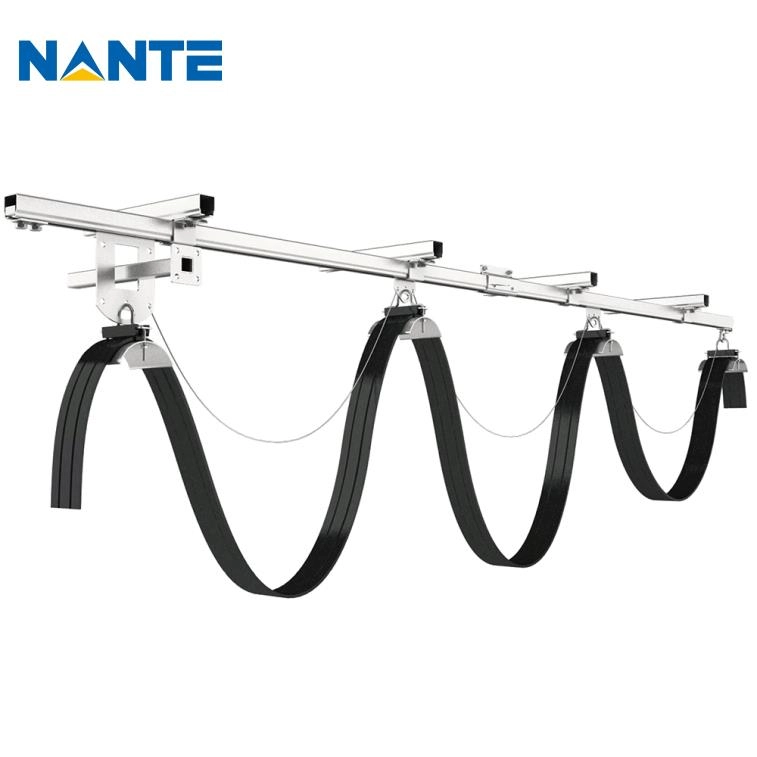
The track should be straight and level within the supplier’s stated installation tolerance. Burrs, misaligned joints, or a damaged galvanized surface can increase rolling resistance and shorten trolley life. Specify inspection of cut ends, joint hardware, and fastener torque during installation.
I-beam, wire-rope, and angle-bar options
An I-beam festoon arrangement can use the crane structure or a dedicated beam where a heavier carrier is appropriate. A wire-rope system can be useful for outdoor or irregular supports when the rope, clamps, and trolley wheels are designed as one assembly. Angle-bar systems may fit applications with a suitable structural edge and clear trolley path.
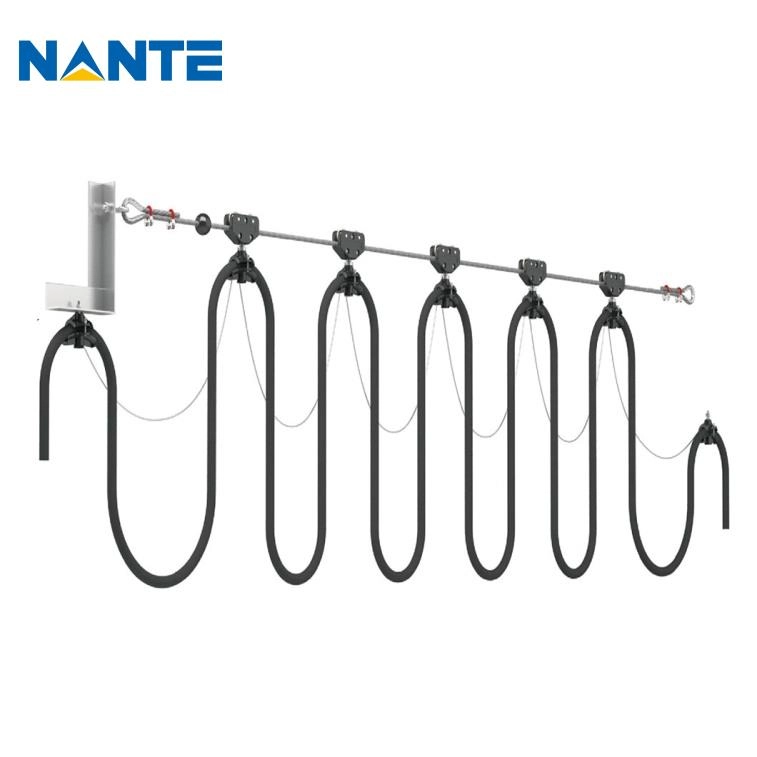
Compare each architecture against structural loads, deflection, corrosion exposure, access for maintenance, and future cable additions. The lowest component price may become expensive if the runway needs unplanned steelwork or if the cable cannot be removed without dismantling adjacent equipment.
4. Account for environment and installation constraints
Corrosion, temperature, and contamination
Classify the site as indoor, outdoor, washdown, coastal, chemical, dusty, high-temperature, or low-temperature. Identify salt, acids, alkalis, welding spatter, abrasive dust, ice, and standing water. Select track, trolley, hanger, and fastener materials and coatings for the actual exposure.
The verified product page for the festoon system product range states that galvanized steel, 304/316 stainless steel, plastic-coated track, and curved-track customization are available for different site conditions. These are options to evaluate against a project corrosion specification, not automatic proof of suitability.
Layout, access, and safe installation
Provide a dimensioned plan, runway elevations, obstructions, expansion joints, and the location of control panels. Confirm whether installation occurs during a shutdown, at height, or around live production. Define isolation, lifting equipment, temporary supports, and the responsibility for field drilling or welding.
The installation method should cover track alignment, hanger spacing, trolley sequencing, loop formation, cable clamping, end allowances, and electrical tests. Include access for replacing one trolley or cable section without removing the entire system. A commissioning checklist should record free travel, clearances, insulation resistance, phase identification, protective-earth continuity, and control-signal operation.
5. Build a supplier comparison that can be audited
Documents and evidence to request
Ask every festoon system supplier for the same evidence package:
- General arrangement drawing with track length, supports, trolley spacing, end positions, and clearances.
- Cable schedule with conductor data, outside diameter, mass, bending radius, and termination details.
- Load and duty calculation covering cable weight, trolley capacity, acceleration, and environmental factors.
- Material and coating information for track, trolleys, hangers, joints, clamps, and fasteners.
- Inspection and test plan, factory-acceptance-test format, calibration records, and certificates where specified.
- Installation, operation, maintenance, spare-parts, and troubleshooting instructions.
Evidence should be traceable to the quoted configuration. A management-system certificate does not by itself prove product compliance; the purchasing team should check certificate scope, legal entity, site, issuer, validity, and expiry.
Normalize the commercial scope
Compare like with like. Put equipment, cables, supports, runway interface work, controls, packaging, freight, installation, commissioning, training, spares, warranty, exclusions, and change terms into one comparison sheet. Record delivery destination, taxes, currency, and validity separately.
Clarify who owns design responsibility for structural interfaces and final cable terminations. Confirm the response time and process for warranty claims, technical questions, replacement trolleys, and discontinued cable types. These details often matter more than a small difference in the initial equipment price.
6. Use a practical pre-purchase checklist
Information to include in the request for quotation
The project brief should state:
- Crane type, runway length, cross-travel and long-travel distances
- Rated load, duty classification, speed, acceleration, and cycles
- Power, control, communication, grounding, and emergency-stop circuits
- Cable type, core count, current, voltage, shielding, and allowable drop
- Indoor or outdoor environment, temperature, contamination, and corrosion class
- Track or support preference, structural drawings, clearances, and access limits
- Required standards, inspection points, documentation, spares, and schedule
Attach photographs and marked-up drawings, but do not rely on photos for dimensions or ratings. Ask for a clarification list before bid closing so that all suppliers price the same assumptions.
Questions for technical review
During bid evaluation, ask how the proposed system handles minimum bend radius, cable mass, trolley overload, parking compression, and end-travel impact. Ask what happens if one trolley wheel binds, a cable clamp loosens, or a new control cable is added later. Require the supplier to identify inspection intervals and wear limits for wheels, bearings, joints, and cable jackets.
7. When to involve a festoon system supplier
Engineering review before order placement
Early supplier review is valuable when the crane has high cycle rates, curved travel, outdoor exposure, VFD power, mixed data networks, restricted shutdown windows, or a nonstandard runway. The supplier can validate the arrangement, identify missing interface data, and issue a project-specific bill of materials before procurement approval.
Nante Crane‘s official product page lists multiple festoon architectures and customized curved or corrosion-resistant track options. Its crane component resources can help the purchasing team place the festoon scope alongside other crane interfaces. For cable-specific selection context, the related festoon cable selection guide provides a useful technical cross-check, while the Nante Crane company page confirms the official source for current product and service information.
Final decision rule
Approve the system when the drawing, cable schedule, load calculation, environmental materials, installation method, test plan, and after-sales scope all match the project brief. Hold the order when a supplier cannot explain cable sizing, trolley loading, structural interfaces, or replacement strategy. A complete, reviewable proposal reduces commissioning surprises and gives maintenance teams a controlled basis for future changes.
Project-specific festoon cable system inquiry
For a technical proposal or comparable quotation review, submit the crane type, travel distances, load and duty, speeds and cycles, cable circuits, operating environment, runway drawings, standards, delivery location, and installation scope. Nante Crane can review those inputs against the selected festoon architecture, cable arrangement, materials, documentation, and testing requirements. Send the project brief through Contact Nante Crane.