English


Crane Anti-Sway Technology in Modern Overhead Cranes
Crane Anti-Sway Technology in Modern Overhead Cranes
Date: 2026-06-11 Share:
Crane Anti-Sway Technology is turning into an important part of modern overhead crane design. It helps manage one common issue in material handling: load swing. In factories, warehouses, steel processing lines, logistics centers, and smart factory workshops, overhead crane sway control influences safety, cycle time, load positioning, and equipment life.
These systems combine intelligent crane positioning, VFD anti-sway control, PLC logic, and load swing reduction systems. As a result, modern overhead cranes can move loads more smoothly and stop closer to the target point.
A typical overhead crane works through bridge travel, trolley travel, and hoisting movement. When a load hangs by wire rope or chain, it acts like a pendulum. This happens during acceleration, deceleration, or direction changes. Therefore, sway control becomes a technical challenge rather than only an operator skill issue.
What Causes Load Sway in Overhead Cranes?
Load sway begins when crane motion and suspended load motion do not match each other.
When the bridge or trolley starts moving, the load does not follow immediately. It lags behind because of inertia. When the crane slows down or stops, the load keeps moving forward. This creates swing. The pendulum effect becomes stronger with high hook height, long travel distance, or higher operating speed.
Common Causes of Overhead Crane Sway
- Sudden trolley acceleration
- Hard braking or emergency stopping
- Long hook height
- Heavy or irregular loads
- Fast bridge travel
- Poor speed transition
- Operator overcorrection
- Repetitive start-stop movement
- Unstable load center of gravity
- Limited visibility in the working area
For production managers, sway creates real operational problems. It can delay unloading, increase collision risk, damage materials, and make precise placement difficult.
The Pendulum Effect Behind Crane Load Swing
A suspended load acts like a moving pendulum.
When the trolley moves forward, the hook point moves first. The load follows after a short delay. After the trolley stops, the load may continue swinging around the target position. This residual swing is one reason operators often wait several seconds before lowering or placing the load.
Key Motion Elements in Load Swing
In a motion control diagram, the following elements are important:
- Bridge travel direction
- Trolley movement path
- Rope angle
- Load swing angle
- Acceleration point
- Deceleration point
- Target stopping position
These visual elements help explain why load swing reduction systems must control both movement speed and movement timing.
Why Manual Operation Alone Cannot Fully Eliminate Sway
Experienced operators can reduce sway through careful timing. However, manual operation is not always repeatable.
In high-frequency lifting operations, operators must simultaneously control bridge travel, trolley travel, hoisting, braking, positioning, and site safety. Under production pressure, overcorrection may create secondary swing.
If the load is large, the hook height is high, or the placement area is narrow, manual correction becomes even more difficult.
Modern crane automation technology solves this problem by turning motion control into a programmed process. The system calculates smoother acceleration, deceleration, and stopping behavior instead of relying only on human reaction.
How Anti-Sway Crane Systems Work
Anti-sway crane systems reduce load swing by controlling how the crane accelerates, travels, slows down, and stops.
The system may use open-loop control, sensor-based feedback, mathematical algorithms, VFD control, PLC logic, or a combination of these methods.
Research on anti-sway positioning control shows that the key goal is not only to suppress swing but also to position the load accurately.
In practical terms, anti-sway control works by shaping the motion curve. The control system manages crane movement while avoiding abrupt speed changes. This approach reduces pendulum excitation.
VFD Anti-Sway Control for Smooth Acceleration and Braking
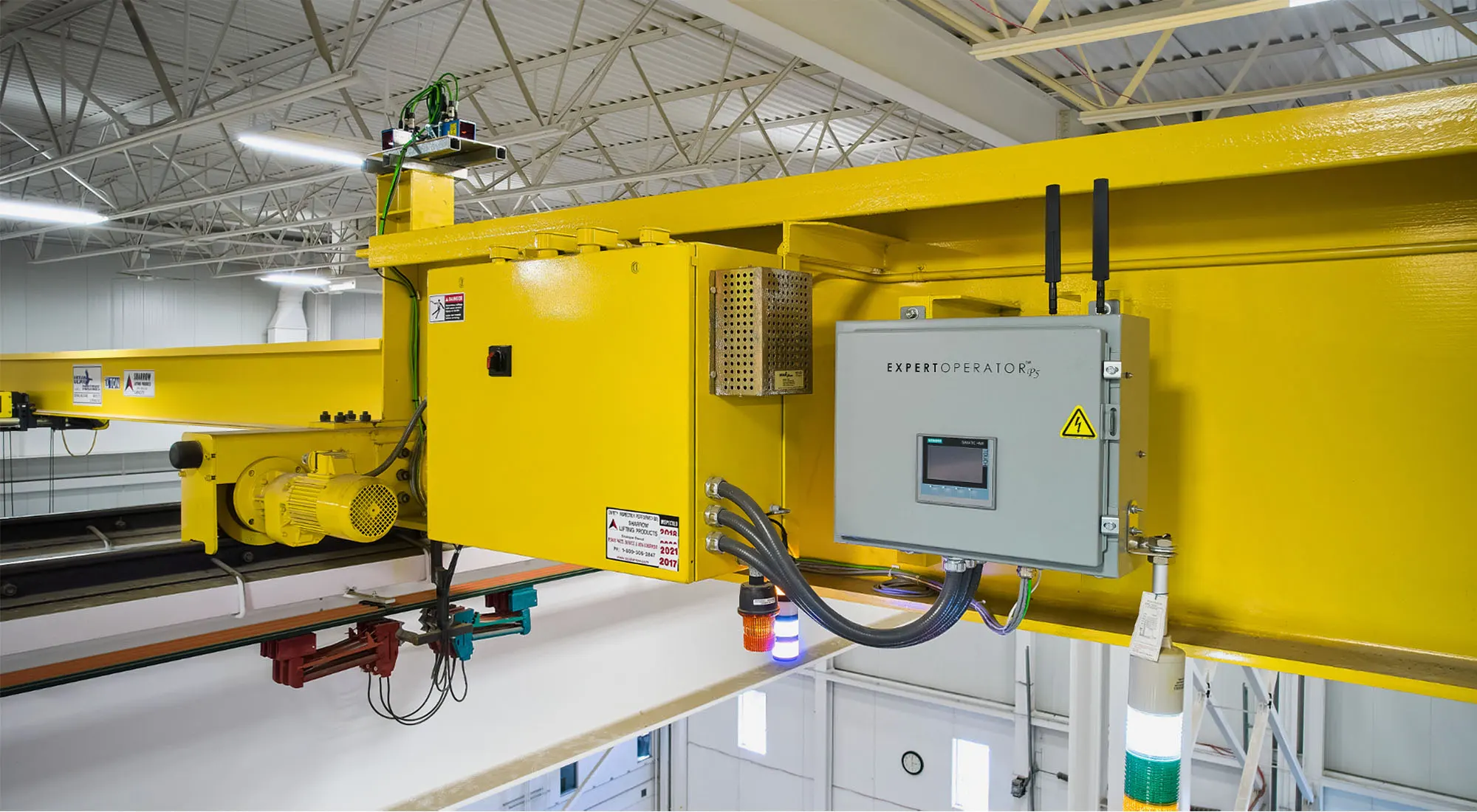
VFD anti-sway control is widely used because it gives the crane drive system better speed regulation.
A variable frequency drive can adjust motor speed, torque response, acceleration time, and deceleration time. Compared with older speed control methods, VFD-based upgrading provides better control over travel motion and braking stages.
For overhead cranes, the practical benefits include:
- Smoother starting
- More stable trolley travel
- Controlled braking
- Less load overshoot
- Lower mechanical shock
- Better final positioning
A useful comparison often shows that sharp acceleration and braking create larger swing, while controlled VFD acceleration and deceleration produce lower residual swing.
PLC-Based Crane Automation Technology
PLC-based crane automation technology connects motion commands with control logic.
The PLC receives input from operators, remote controls, sensors, limit switches, or automation systems. It then sends instructions to the VFD, hoist, bridge travel drive, trolley drive, and safety devices.
Functions Controlled by PLC Systems
A PLC-based system can manage:
- Speed transition
- Travel sequence
- Positioning logic
- Safety interlocks
- Anti-collision rules
- Load movement limits
- Repetitive routes
- Automatic stopping points
This is why anti-sway crane systems are increasingly connected with smart factory crane control, digital material flow, and automated production lines.
Sensor-Based and Sensorless Load Swing Reduction Systems
Load swing reduction systems can be sensor-based or sensorless.
Sensor-Based Systems
Sensor-based systems may use:
- Angle sensors
- Encoders
- Cameras
- Load monitoring devices
- Position feedback systems
These systems detect load behavior and adjust movement in real time.
Sensorless Systems
Sensorless systems use mathematical models, travel speed, acceleration data, hook height, and control algorithms to estimate swing and adjust crane motion.
Both methods can be effective. The right choice depends on crane capacity, hook height, load type, required positioning accuracy, installation conditions, and maintenance expectations.
 Intelligent Crane Positioning for Smart Factory Material Handling
Intelligent crane positioning goes beyond basic sway reduction.
The goal is to move the load to a target point with minimal swing and minimal waiting time. In automated workshops, cranes may transfer materials between storage zones, processing machines, assembly stations, and loading areas.
Accurate positioning helps maintain stable production flow.
Recent research on automated crane control continues to focus on both position precision and sway suppression, especially in demanding industrial environments.
From Operator Control to Automated Crane Movement
Traditional crane control depends heavily on operator skill.
Automated crane movement uses programmed logic to manage the travel route, speed profile, stopping point, and safety response. This does not eliminate the need for safe operation, but it reduces variation between operators and converts repetitive movement into a controlled process.
Applications Suitable for Automated Crane Movement
Automated systems are especially valuable for:
- Fixed production routes
- Repeated loading and unloading
- High-volume material transfer
- Smart factory logistics
- Heavy component handling
- Narrow placement areas
Position Accuracy, Cycle Time, and Residual Swing
Three indicators matter most when evaluating intelligent crane positioning:
- Position accuracy — how close the load stops to the target
- Cycle time — how quickly the crane completes one handling cycle
- Residual swing — how much the load continues moving after stopping
Poor sway control forces workers to wait before lowering or releasing the load. Better control allows the crane to move efficiently without sacrificing safety.
Key Benefits of Crane Anti-Sway Technology
Crane Anti-Sway Technology supports safer, faster, and more repeatable lifting operations.
Main Benefits
- Reduced load swing
- Better load placement accuracy
- Shorter waiting time after travel
- Lower collision risk
- Less operator fatigue
- Reduced mechanical stress
- Lower risk of product damage
- Better support for automation
- More stable production rhythm
Safer Lifting in High-Density Work Areas
In many workshops, cranes operate above machines, racks, molds, vehicles, steel plates, or assembly fixtures. A swinging load can create serious safety risks.
Overhead crane sway control helps keep the load path more predictable. This is especially important in:
- Metal processing
- Machinery manufacturing
- Logistics centers
- Paper production
- Shipbuilding
- Energy facilities
- Advanced manufacturing plants
Better Throughput in Automated Material Handling
Speed alone does not improve productivity.
If a crane moves quickly but the load swings heavily after stopping, operators still lose time waiting for stabilization. Anti-sway crane systems help cranes travel at practical speeds while keeping loads stable.
This improves throughput because the load can be positioned sooner and requires fewer corrections.
Less Wear on Crane Components
Uncontrolled sway often leads to repeated braking, correction movement, and impact loading.
Over time, this may increase stress on:
- Motors
- Brakes
- Ropes
- Hooks
- Reducers
- Wheels
- Structural components
Smooth motion control reduces unnecessary shock and supports more stable long-term operation.
FAQ About Crane Anti-Sway Technology
What is Crane Anti-Sway Technology?
Crane Anti-Sway Technology is a motion control method that reduces load swing during overhead crane travel. It controls acceleration, speed, braking, and positioning to make load movement more stable.
Why Does an Overhead Crane Load Swing?
A suspended load swings because it behaves like a pendulum. When the crane accelerates, stops, or changes direction, the load continues moving due to inertia.
Work With Nante Crane for Intelligent Crane Control Solutions
Nante Crane is a crane and crane component designer and manufacturer. Its products cover overhead cranes, gantry cranes, workstation cranes, offshore cranes, electric hoists, crane travel units, mobile power supply systems, crane control panels, and crane safety components.
The company’s product range includes:
- Single girder overhead cranes
- Double girder overhead cranes
- Underhung overhead cranes
- Gantry cranes
- Electric hoists
- Open winches
- Crane control panels
Nante Crane’s technology direction includes crane intelligence, lightweight design, energy saving, big data, and the Internet of Things.
For buyers planning overhead crane upgrades, VFD-based control panels, automation crane systems, or intelligent material handling solutions, Nante Crane can provide customized lifting equipment and crane control solutions for industrial applications.