English



Single Girder vs Double Girder Gantry Crane: Which Is Better?
Date: 2026-11-20 Share:
A single girder gantry crane is often the better buy when a compact hoist can reach every pickup and set-down point, meet the required duty, and keep installed cost low. A double girder gantry crane is worth pricing when a heavier load, wider span, higher hook position, or more demanding trolley makes the single-girder option impractical.
Two cranes with the same rated capacity can produce very different results at a truck bay. One may have enough vertical travel but fall short of the required hook elevation. The other may complete the lift but require rail or foundation upgrades. Compare both on the same route before comparing price.
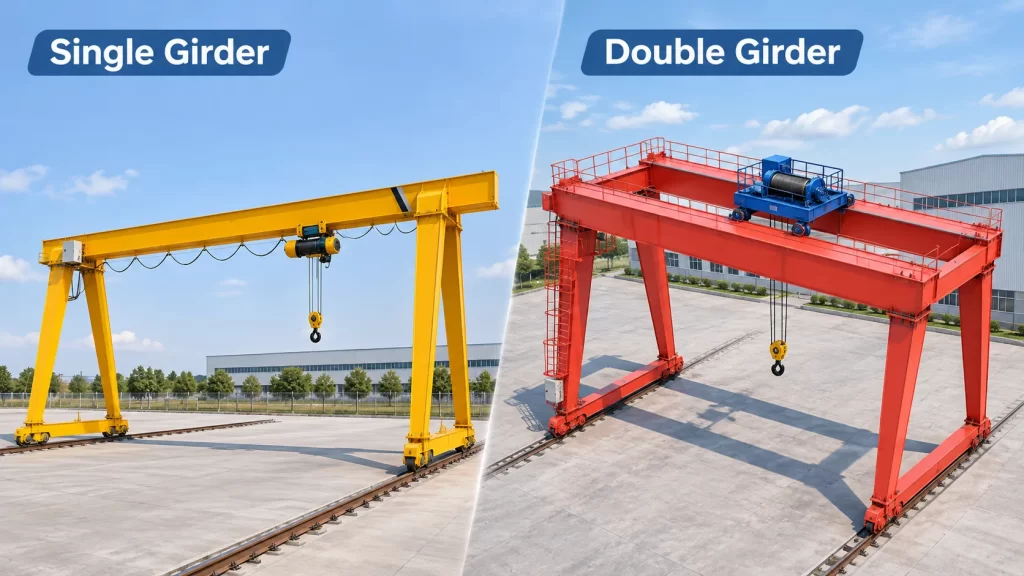
Gantry Crane Comparison by Specification
Both configurations use a bridge supported by legs. On a full rail-mounted gantry, the trolley crosses the bridge while the legs travel along ground-level rails. The hoist lifts the load, and the bridge, legs, and wheels transfer the forces into the rails and foundations.
| Factor | Single girder gantry crane | Double girder gantry crane |
| Structure | One main girder, commonly with an underhung hoist | Two parallel girders, commonly carrying a top-running trolley |
| Capacity | Often economical for moderate loads with a compatible hoist | Accommodates larger hoists or open-winch trolleys for demanding lifts |
| Span | Often economical at moderate rail spacing | Worth evaluating as the span and stiffness requirements increase |
| Lifting height | A low-headroom hoist can improve the upper hook position | A hook block that rises between the girders can gain usable hook height |
| Duty class | Must match the specified workload and mechanism duty | Offers more trolley options for intensive service. Duty still requires verification. |
| Crane weight | Often lower with a compact hoist and bridge | Often higher once trolley, bridge steel, and access platforms are included |
| Cost | Often lower equipment and erection cost for a straightforward lift | May cost more up front and can justify the premium through better coverage or service access |
Compare Rated Capacity at the Required Span
Add the heaviest payload to the weight of slings, shackles, and any spreader or lifting beam carried by the hook. State the total in pounds or US short tons. If a quote uses metric tonnes, have the supplier confirm the units and rated capacity on the same basis.
Specify span between the ground-rail centerlines. As span increases, the girder must resist bending and limit deflection under the moving trolley. Ask each supplier to confirm rated capacity, span, and deflection for the proposed assembly on a single drawing or data sheet. Separate catalog maxima may describe different builds.
Check Hook Elevation and Approach at Each Station
Lifting height is the distance between the hook’s upper and lower positions. For truck loading, the deciding dimension can be the highest usable hook elevation above the pavement. It must accommodate the deck height, the load, the rigging stack, and clearance needed to move the load into place.
Compare both drawings from the same pavement or top-of-rail reference. Mark the upper and lower hook positions, the highest point of the crane and trolley, and the hook approach on both sides. Hook approach is how close the hook centerline can get to a specified end or side of the working area. Check the load’s edges against the legs as well.
Worked Example for a Covered Truck Bay
Suppose the loaded hook must reach 15 ft above the pavement to clear a trailer and its side stakes. A single-girder bid shows an upper hook elevation of 14 ft 8 in. A double-girder bid shows 15 ft 4 in. Both quote the same capacity and nominal vertical hook travel.
The double-girder bid clears the hook-height requirement. Before accepting it, check the trolley against the lowest overhead obstruction and verify hook approach over the trailer. If the single-girder supplier can close the 4-in. gap with a low-headroom hoist, request a revised drawing and price. That revision could keep both designs in contention without changing the truck route.
Where Each Gantry Crane Configuration Fits
Single Girder Gantry Crane for Maintenance and Fabrication
Typical jobs include setting motors on repair stands, transferring fabricated frames between workstations, and loading finished parts in a modest yard. A compact single-girder arrangement can keep the structure light when the hoist fits below the girder and the work stays comfortably between the legs.
Consider a fabrication bay with a truck lane beside the rails. A single-girder proposal may cover every lift if the truck can stop where the trolley reaches the pick point. Confirm truck alignment and access on the site plan before pricing a cantilever or a taller crane.
Double Girder Gantry Crane for Heavy Production and Yard Handling
Common applications include moving large weldments in heavy manufacturing, transferring steel products across wide bays, and handling precast sections in production yards. A top-running trolley can provide room for a larger hoist or winch and may let the hook rise farther within the available height.
Consider a precast yard that regularly loads tall sections onto trailers. If the rigging and load clear the trailer only with a higher hook position, price the double-girder layout with that dimension stated in the quote and shown on the drawing. Check the trolley’s upper clearance and confirm that the hook can reach the trailer’s loading position.
What Makes a Heavy Duty Gantry Crane Suitable for Repeated Lifts?
A maintenance lift and a production lift can have the same peak weight and very different duty requirements. Record lifts per shift, the share of lifts near rated load, typical hoisting and travel distances, and peak starts per hour. Repeated starts affect motor heating and brake wear. Repeated load cycles also affect fatigue in the structure.
Use the duty class guide to organize the workload for the request for quotation. Ask suppliers to state the classification basis for the crane and the hoisting mechanism, along with the assumed load spectrum and operating pattern. If a production schedule has bursts of closely spaced lifts, include the busiest period.
Compare Installed Cost on the Same Site Plan
Check Wheel Loads and Erection Costs
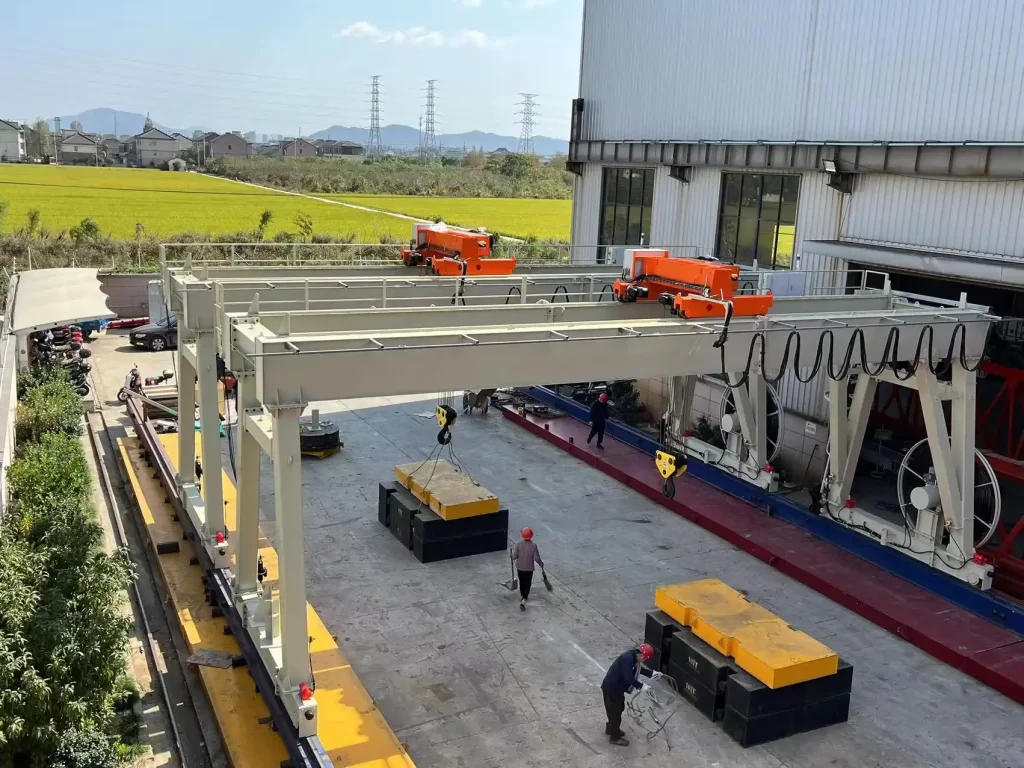
Request the total crane weight, the heaviest shipping and erection pieces, and the maximum loads at individual wheels. The loaded trolley can concentrate reactions on one side as it approaches a leg. Wheel spacing and wheel count also affect the demands on the rail support.
Give both sets of reactions to the civil or structural engineer. For an outdoor crane, include the specified operating and parked wind cases and the forces from any storm restraints. The engineer can identify whether either design changes the rail, anchorage, or foundation scope before bids are ranked.
Price the Same Supply and Service Scope
The gantry crane range includes both configurations. Nante Crane lists design, fabrication, transport, installation and commissioning support, training, and maintenance among its services. Ask for the scope of each in the quotation, including work assigned to the buyer or local contractor.
- Equipment and interfaces.Price rails and fasteners, power feed, controls, access platforms, and any civil or electrical work the crane requires.
- Delivery and handover.Compare packing, freight, unloading, erection, commissioning, training, and which party supplies test weights. Request the inspection and test plan and identify the drawings and test records due at handover. For the truck bay, agree on how the installer will demonstrate hook reach at the actual loading station. Ask which checks will be completed at the factory and which depend on the installed rails, site power, and final travel limits.
- Service and downtime.Ask how the site will reach the hoist and brakes, how large components can be removed, which spares are recommended, and what the warranty covers. Include any recurring lift rental or production stoppage needed for service.
A lower crane price can lose its advantage if the design requires a new trailer position, rail strengthening, or rented access equipment for routine maintenance. Conversely, a double-girder premium is hard to justify if both designs clear the same route, meet the same duty, and have similar service costs.
Frequently Asked Questions
Can Two Cranes With the Same Capacity Have Different Hook Heights?
Yes. The trolley layout and hook block determine the upper hook position. Compare the top hook elevation and the height of the tallest crane component on dimensioned drawings. Use the same reference level and check the result with the specified rigging.
Is There a Tonnage Where a Double Girder Becomes Mandatory?
The practical cutoff varies with the span, hoist, duty, and site. Where both ratings are feasible, compare a single girder gantry crane with a double girder gantry crane on the same operating requirements and ask each supplier to confirm the proposed configuration.
Request a Gantry Crane Configuration Review and Quote
Purchasing teams can submit the maximum suspended weight, rail span, required hook elevations, lifting frequency, and a sketch of the pickup and set-down points. Include the site location and preferred installation scope. Nante Crane can review the layout and workload and prepare a project-specific quotation through a gantry crane configuration inquiry.