English



Jib Crane vs Gantry Crane: Which Is Better for Material Handling?
Date: 2026-11-13 Share:
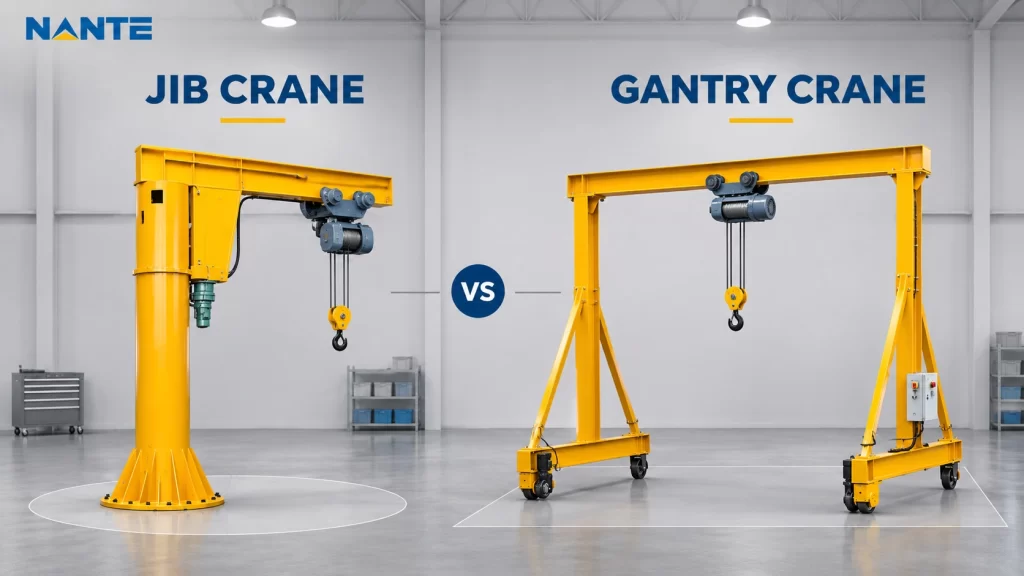
A jib crane generally suits repeated lifting around one machine or work cell. A gantry crane deserves consideration when loads must move beneath a spanning beam, along a defined travel corridor, or between occasional lifting locations.
The choice depends on how the load moves through the operation. Capacity matters, but a crane must also reach every transfer point, clear surrounding equipment, and work within the site’s structural limits.
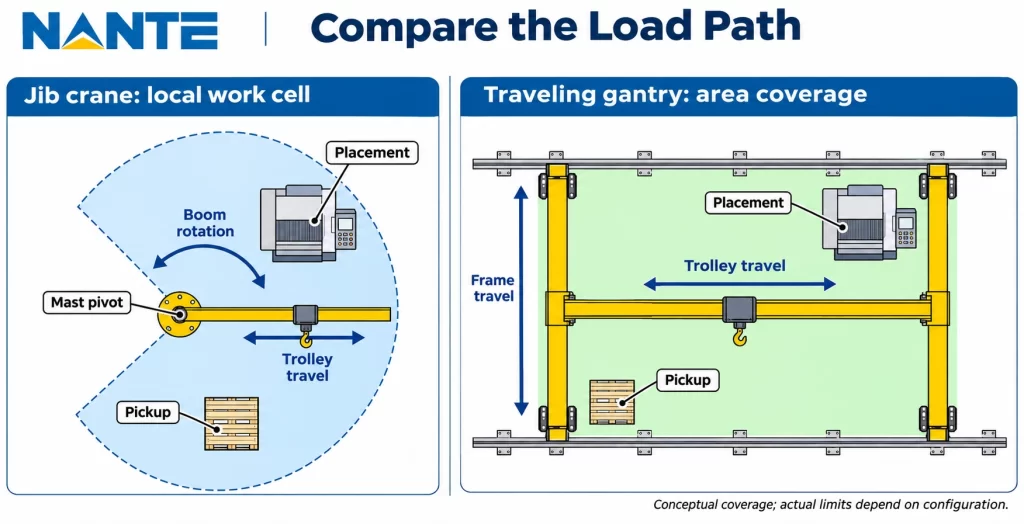
The practical comparison starts with the load path, then connects coverage, capacity, mobility, and installation to the actual handling task.
Jib Crane vs Gantry Crane: How They Work
Jib Cranes Combine Rotation with Trolley Travel
A typical industrial jib crane has a horizontal arm supported by a mast or structural mounting. A hoist raises the load, while trolley travel and arm rotation position it within the permitted working envelope.
The load passes through the hoist and arm into the supporting structure. Because the load acts at a distance from that support, it creates a bending effect. Reach therefore matters alongside lifting capacity when assessing mounting and foundation requirements.
This explains why an available wall or concrete floor cannot automatically be treated as a suitable installation point.
Gantry Cranes Transfer Loads Through Supporting Legs
A gantry crane carries its beam on legs. The trolley moves across the beam; where provided, frame travel adds movement along the operating route.
Loads transfer through the beam and legs into wheels, rails, or foundations. Buyers must therefore consider concentrated support loads and travel conditions as well as lifting capacity.
A stationary gantry provides trolley movement across its beam. Rectangular area coverage requires an appropriate traveling arrangement; it should not be assumed from the gantry shape alone.
Compare Coverage, Capacity, Mobility, and Installation
Coverage Means Usable Hook Positions
A jib’s nominal radius does not establish whether the hook can reach a machine fixture. Trolley approach limits, rotation stops, columns, and machine enclosures can reduce usable coverage.
Similarly, gantry span is not identical to usable hook travel. Legs, end approaches, and surrounding equipment affect the accessible area.
Mark pickup, transfer, and placement positions on a layout. Then check the complete suspended load and attachment through the proposed route.
Capacity Must Include the Handling Attachment
The suspended weight includes the component and below-the-hook equipment, such as a spreader or lifting fixture.
Provide the maximum and typical loads, lifting frequency, operating hours, and travel distances. These inputs help the supplier select suitable hoisting and travel mechanisms for the operating pattern.
Neither crane family always has the higher capacity. Comparing a portable maintenance gantry with a substantial fixed jib can produce a different result from comparing industrial traveling systems.
Mobility Depends on the Supplied Configuration
Fixed jibs, movable jibs, stationary gantries, portable gantries, and rail-traveling gantries have different operating boundaries.
For portable equipment, distinguish relocation without a load from travel with a suspended load. Loaded travel must be expressly permitted by the manufacturer under the stated conditions.
Doorways, floor joints, gradients, turning space, and overhead services can determine whether relocation is practical.
Installation Determines More Than Initial Cost
| Selection factor | Jib crane | Gantry crane |
| Support interface | Mast foundation or verified mounting structure | Floor, wheels, rails, or foundations |
| Space constraint | Arm sweep, base, and suspended-load clearance | Legs, frame clearance, and travel route |
| Height check | Usable hook height beneath the arm and hoist | Usable hook height beneath the beam and hoist |
| Installation evidence | Support reactions and anchorage requirements | Support or wheel loads and travel requirements |
| Cost boundary | Equipment plus structural and installation work | Equipment plus floor, rail, power, and installation work |
Overall equipment height is not usable lifting height. Confirm hook height with the actual hoist, attachment, and load arrangement.
Jib Crane Applications: Fixed Workstation Handling
Example: Loading a Machine from an Adjacent Pallet
Consider an illustrative machining cell where blanks move from a pallet into a fixture, then finished components move to an inspection bench.
A jib is a candidate when all three positions lie within its usable envelope and the suspended component clears the machine enclosure. Repeated transfers can then follow one defined local route.
The choice changes if the pallet must remain outside the swing area or the arm cannot pass a structural column. A longer arm alone may not resolve the obstruction or supporting-structure limits.
Assembly Work Requires Controlled Positioning
Other jib crane applications include positioning components at assembly benches and handling tooling within a dedicated work cell.
For alignment tasks, controllable movement may matter more than maximum speed. The specification should describe the positioning task, operator access, and lifting attachment.
If components routinely leave the cell, assess the handoff. Repeated transfers between lifting systems can add handling steps and waiting time.
Gantry Crane Applications: Maintenance and Area Handling
Example: Maintenance at Several Machines
Consider an illustrative maintenance department that occasionally removes components from machines in different locations.
A portable gantry may be appropriate if it can be relocated, positioned over the equipment, and used on a suitable floor. Check the route before selecting its dimensions.
If the frame cannot pass a doorway or straddle the machine, mobility provides little practical benefit. Any required loaded movement needs separate confirmation against the manufacturer’s instructions.
Traveling Gantries Serve Defined Material Routes
Industrial gantry crane applications include moving fabricated assemblies between work positions or handling stock along a designated corridor.
The route must accommodate the complete frame and suspended load. Forklift crossings, stored material, power supply arrangements, and maintenance access need consideration.
Outdoor operation adds wind exposure, corrosion, drainage, electrical protection, and parking requirements. Indoor equipment should not be assumed suitable for outdoor service.
Workstation Crane vs Gantry Crane: Define the Alternative
Compare Specific Systems
For a useful workstation crane vs gantry crane comparison, define “workstation crane.” Here, it means a light bridge or track system serving a production area.
A light bridge system may merit evaluation when parts move repeatedly between adjacent assembly positions. A jib can serve one local cell, while a portable gantry may suit occasional maintenance.
The appropriate arrangement follows the handling route and frequency. Sharing movable equipment between busy stations may introduce delays even when its lifting capacity is adequate.
Match Product Categories to the Task
Nante Crane lists jib cranes, light crane systems, movable mini gantries, and industrial gantry configurations.
The Jib Crane and workstation options provide a starting point for local handling. The Gantry Crane range supports evaluation of spanning and traveling arrangements.
These categories establish a shortlist. A project layout and operating specification are still needed before selecting a configuration.
How Buyers Should Compare Technical Proposals
Apply the Selection Checks in Order
A practical procurement sequence is:
- Confirm coverage:Can the hook reach every required position with the load clear?
- Verify support and headroom:Are structural interfaces, floor conditions, and lifting height suitable?
- Define load and duty:Does the configuration match suspended weight and operating frequency?
- Confirm mobility:Are relocation and any loaded travel expressly addressed?
- Compare installed scope:Are site work, testing, documentation, and support included?
This order helps eliminate unsuitable arrangements before price comparisons.
Request Evidence Against Each Site Risk
Request a general arrangement drawing showing usable hook coverage, clearances, and installation interfaces.
Ask for support reactions or wheel loads, foundation requirements, mechanism specifications, control details, and inspection and commissioning scope.
For US projects, agree applicable requirements with the project owner and qualified engineering team. A general management-system certificate does not establish project-specific product compliance.
Normalize the Commercial Boundary
Compare equipment, attachments, power supply, foundations, rails, freight, installation, testing, training, warranty, and spare-parts arrangements.
Clarify exclusions and responsibility for site modifications. The related workshop crane selection guide supports broader evaluation when overhead systems also remain candidates.
Frequently Asked Questions
Is a Jib Crane Always Better in a Small Workshop?
No. Its mounting, arm sweep, and load path must fit. A compact gantry may suit a task requiring a beam across equipment or occasional relocation.
Can a Gantry Move with a Suspended Load?
Only where the supplied design and manufacturer’s instructions permit it. Wheels alone do not establish permission for loaded travel.
Which Design Is Better for Frequent Production?
The arrangement that covers the required route with suitable duty capability and minimal additional handling. A dedicated local jib and a traveling gantry solve different movement patterns.
Request a Project-Specific Crane Selection Review
Submit the Layout and Operating Requirements
Purchasing teams should provide maximum suspended weight, attachment details, pickup and placement positions, required hook height, lifting frequency, environment, and installation scope.
Nante Crane can review these inputs for a suitable equipment proposal. Include a marked layout, available support information, and delivery destination when submitting a jib or gantry crane project brief.