English


How to Choose Between Top Running and Underhung Overhead Cranes
How to Choose Between Top Running and Underhung Overhead Cranes
Date: 2026-09-10 Share:
For a plant replacing a crane or designing a new bay, the top running vs underhung crane decision is primarily a building-interface decision. Runway position changes hook height, wheel loads, maintenance access and structural work. A low purchase price can become expensive if the arrangement needs roof reinforcement or leaves too little process clearance.
Select the arrangement that meets the load spectrum and travel envelope with minimal building work. The comparison below gives engineers and purchasing teams a basis for design review and comparable quotations.
What the Two Runway Configurations Mean
Top running overhead crane
A top running overhead crane travels on rails mounted on top of runway beams. The crane bridge wheels run on the upper rail surface, and the bridge structure sits above the runway. Runway columns may be freestanding or connected to the building, subject to the structural design.
Underhung overhead crane
An underhung overhead crane is suspended from the lower flange of runway beams or the building roof structure. Its end trucks grip or roll along the lower flange, allowing the bridge to operate below the runway. The arrangement can use existing roof framing when that framing is verified for crane loads and repeated wheel travel.
The underhung layout can follow a building bay without freestanding columns and place the hook closer to the roof. Flange width, beam stiffness, connections, local reinforcement and installation access still require engineering review.
For a project reference, see the underhung overhead crane guide.
Top Running vs Underhung: Best-Fit Comparison
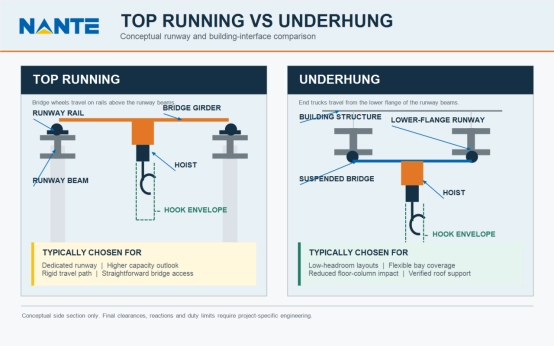
Best for each crane type
| Decision factor | Top running overhead crane | Underhung overhead crane |
|---|---|---|
| Runway interface | Rails on top of runway beams; clear wheel path | Wheels or end trucks suspended from lower flanges |
| Building structure | Suits new runway columns or substantial runway beams | Can suit verified roof or runway framing; connection design is critical |
| Capacity outlook | Common choice when higher wheel loads and larger bridge equipment are acceptable | Often selected for lighter to moderate loads; confirm the specific design limit |
| Span and bay coverage | Good for dedicated, rigid runways and long travel paths | Useful where the bridge must pass between existing bays or use curved/branching paths, if engineered |
| Headroom | Bridge and hoist occupy space above the rail level | Can improve hook approach in low buildings, depending on beam depth and hoist geometry |
| Maintenance access | Top-side rail and bridge access can be straightforward with a service platform | Roof-level access may be difficult; plan inspection points and safe isolation |
| Typical buyer priority | Capacity, rigidity, repeatability and service access | Low headroom, flexible coverage and reduced floor-column impact |
Use the table to screen options; confirm wheel loads, rail reactions, deflection, clearances and duty from the design basis.
Building Structure, Span and Headroom
Verify the load path before selecting the crane
The load path runs from the hoist through the bridge, end trucks, rails, runway beams and connections into the building or foundations. A survey should record column locations, roof members, flange dimensions, connections and corrosion or modifications.
For underhung systems, the lower flange is both running surface and structural interface, so local bending, torsion, lateral restraint and connection fatigue need explicit calculations. Top running systems require equivalent review of rail seats, alignment and column reactions.
Treat headroom as a measured envelope
“Low headroom” should describe a verified dimension, not a marketing label. The design drawing should show floor-to-hook distance, top-of-rail elevation, beam depth, hoist headroom, hook block travel, building obstructions and the required approach to the end walls.
Compare span and usable coverage
Span is the distance between runway rails; usable coverage also depends on end approach, hook offset, aisle obstructions and neighboring cranes. Underhung systems can be attractive in buildings with multiple light runways, but switches, transfers or unusual geometry add engineering and maintenance interfaces.
Capacity, Duty and Controls
Specify the real load spectrum
Rated capacity is only one input. The specification should state maximum lifted load, typical load, lift frequency, average travel distance, starts per hour, operating hours, load distribution and whether loads are static, swinging, hot, corrosive or outdoors.
The same bridge can require different brakes, motors, wheels, controls and inspection intervals under different duty conditions. Separate rated load from impact, skew, wind and other application loads rather than hiding them in one “safety factor.”
Match the hoist and controls to the process
The hoist selection affects headroom, lifting speed, reeving, hook approach and service access. A wire rope hoist may be suitable for a particular bridge, but the final model and duty must be confirmed against the design calculations.
Specify controls by function: pendant, radio, cabin or combination; variable-speed travel; anti-collision interfaces; overload protection; limit switches; emergency stop; and control voltage. State who supplies power distribution and field testing.
Maintenance Access and Lifecycle Risk
Design for inspection, not just installation
Top-side rails can make wheel and rail inspection visible from a runway platform, while underhung components may sit close to roof steel and process services. Either arrangement needs safe access to brakes, gearboxes, rope drums, electrical panels, wheels, buffers and limit devices.
The maintenance plan should identify isolation points, access equipment, inspection frequencies, lubrication points, wear limits and replacement methods, including how wheels, ropes or brakes can be changed without removing building members.
Normalize the commercial scope
When comparing offers, place equipment and interfaces in one matrix: bridge, end trucks, hoist, controls, electrification, rails, runway steel, structural modifications, engineering calculations, drawings, factory tests, packing, freight, installation, commissioning, operator training, spares and warranty. List exclusions and change-order assumptions beside each item.
An offer that excludes runway alignment or roof reinforcement is not comparable with a turnkey offer; the lower initial number may move risk to the project owner.
Underhung Crane Advantages and Trade-Offs
Where underhung can add value
Underhung crane advantages may include a lower bridge position, less interference with floor traffic and the ability to use a building’s upper structure when a dedicated column line is undesirable. Multiple cranes can sometimes share runway space or be arranged around production zones, subject to engineering.
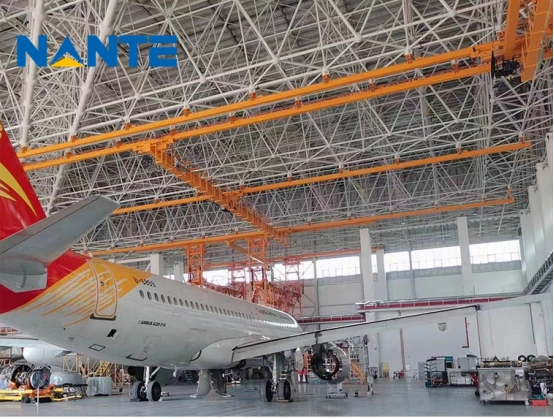
These benefits are strongest when a survey confirms adequate framing and the process needs hook height more than very high capacity. A concept drawing should prove clearance from roof bracing, ducts, lights and sprinklers.
Where top running remains the safer fit
Top running is often the conservative choice for a new heavy-duty bay, long dedicated runway or application needing generous bridge access, because the runway can be designed as a known structural system.
Neither type should be selected from a catalog image. The final choice depends on calculated reactions, deflection, fatigue, rail alignment, environment, controls and the installation method.
Supplier Evidence to Request
Technical review package
From the midpoint of procurement, the buyer should expect a design basis, general arrangement, clearance drawing, load and reaction schedule, component list, control narrative and interface matrix. Request material certificates, welding and inspection records, calibration records and a factory acceptance test plan when risk justifies them.
For buyers reviewing a complete overhead crane system, Nante Crane can be included in the same evidence-based comparison. The review should focus on the offered configuration, documented scope and response to the project’s drawings rather than on generic claims.
Components and site interfaces
Check that the offer names the underhung end carriage where applicable, identifies wheel and bearing access, and states how alignment will be verified. Confirm rail profile, fastening, end stops and tolerance records for the proposed crane rail.
Ask for commissioning records covering unloaded and loaded travel, hoist limits, emergency stop, overload function where supplied, braking and direction. Handover should include manuals, parts lists, inspection forms and recommended spares.
A Practical Selection Checklist
Inputs for a comparable quotation
- State maximum and typical loads, lifting height, hook approach and load spectrum.
- Provide a dimensioned building plan, sections, roof or runway member details and surveyed obstructions.
- Mark rail centerlines, runway length, end approaches, process zones and existing lifting equipment.
- Define duty, environment, power supply, control method, operating temperature and applicable US site requirements.
- Separate supply, structural modification, installation, commissioning, training, spares and warranty responsibilities.
- Require a clearance drawing, reaction schedule, inspection plan and deviations list before order release.
FAQ: Top Running vs Underhung Crane Selection
Is an underhung crane always a low headroom overhead crane?
No. It can improve hook position, but beam depth, end-truck geometry, hoist dimensions and roof obstructions determine the final headroom. Only a dimensioned general arrangement can confirm the result.
Does top running always provide greater capacity?
Not as a universal rule. Top running often suits heavier runway reactions, but capacity is governed by the complete bridge, hoist, runway, structure and duty design. The supplier should issue calculated ratings for the specific project.
Which option is easier to maintain?
Maintenance access depends on platforms, isolation, roof access and component layout. A top running crane may offer simpler rail-side access, while an underhung crane can reduce floor-level obstructions. The inspection and replacement method should be compared during design review.
Submit the Project Brief for a Technical Comparison
The fastest route to a defensible selection is a shared project brief: capacity, span, lift, duty, operating hours, building drawings, clearances, environment, power, controls, standards and installation scope. Nante Crane can review those inputs and return a configuration, interface list and quotation basis for a top running or underhung arrangement. Send the brief through Contact Nante Crane.