English



Single Girder vs Double Girder Overhead Crane: How to Choose the Right One
Single Girder vs Double Girder Overhead Crane: How to Choose the Right One
Date: 2026-08-27 Share:
A single girder vs double girder overhead crane comparison should look beyond lifting capacity. Span, lifting height, headroom, duty class, crane weight, runway loads, price, and operating requirements can all change the best choice. In general, a single girder overhead crane suits light-to-medium handling, while a double girder overhead crane is often preferred for more demanding loads, spans, duty cycles, or hook-height requirements.
Single Girder vs Double Girder Overhead Crane at a Glance
| Factor | Single Girder | Double Girder |
| Bridge | One main girder | Two parallel girders |
| Hoist/trolley | Usually below the girder | Commonly on or between girders |
| Capacity | Light to medium applications | Higher capacities and demanding service |
| Span | Short to moderate spans | Often preferred as span demands increase |
| Lifting height | Good with low-headroom hoists | Often allows a higher hook position |
| Duty | Light-to-moderate service | Frequent or heavy-duty service |
| Crane weight | Generally lower | Generally higher |
| Price | Generally lower | Generally higher |
| Typical use | Workshops, warehouses, assembly | Heavy fabrication and process production |
These are general selection tendencies, not fixed limits. Crane classification depends on actual service conditions, including working cycles, load spectrum, and average load displacement.
What Is a Single Girder Overhead Crane?
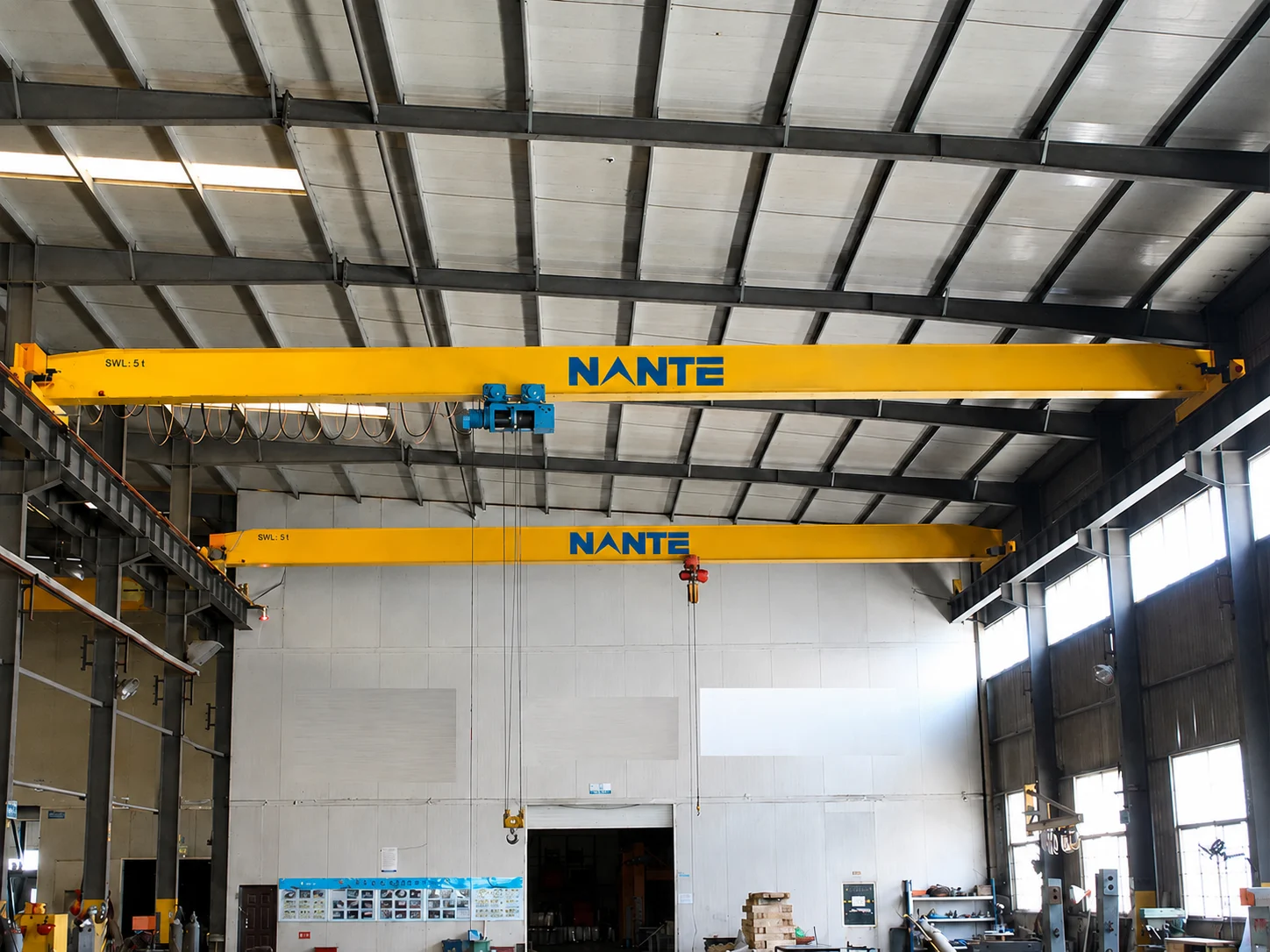
A single girder overhead crane uses one bridge girder supported by end trucks or end carriages. The electric hoist usually travels beneath the bridge.
Main Advantages of a Single Girder Overhead Crane
Typical benefits include lower bridge weight, lower wheel loads in comparable applications, lower initial cost, compact construction, and simpler installation.
It is suitable whenever one girder can meet the required capacity, span, deflection, duty, lifting height, and safety requirements economically.
Main Limitations
As capacity, span, operating frequency, or special equipment needs increase, a single girder can become less practical. Its hoist arrangement may also reduce maximum hook elevation.
What Is a Double Girder Overhead Crane?
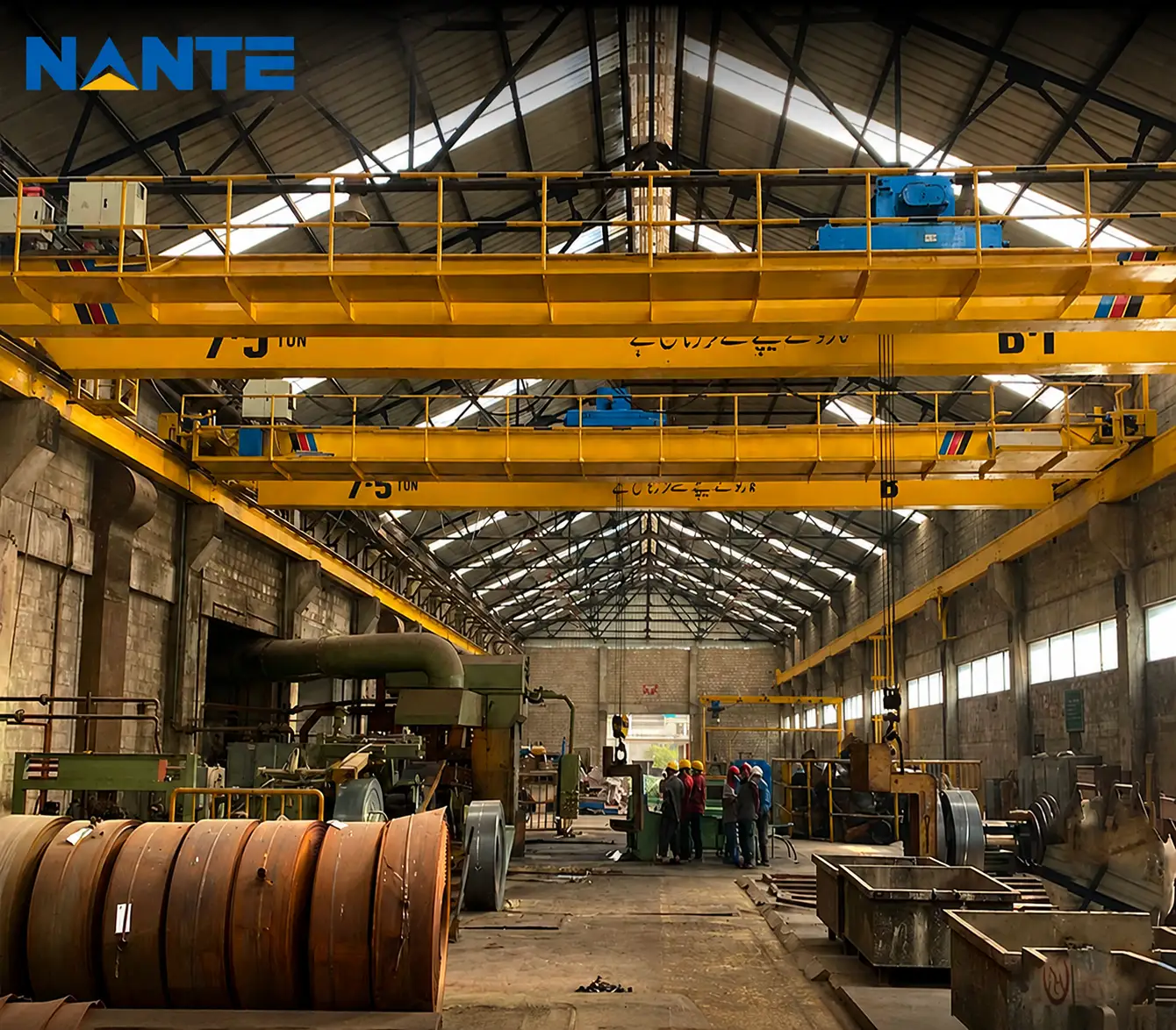
A double girder overhead crane uses two parallel bridge girders supporting a trolley that normally travels on rails mounted on the bridge. It offers more structural flexibility for demanding lifting, longer spans, and frequent operation.
Double Girder Crane Advantages
The important features of double girder cranes are flexibility to cater to high capacities and long spans, availability of space for large hoist mechanisms, simplicity of using additional hoists, ease of installing platforms for servicing and more flexibility in incorporating automation features.
But this is relevant only if the application demands them, otherwise the extra weight and cost might not be warranted.
Single vs Double Girder Crane: 8 Factors to Compare
1. Lifting Capacity
Capacity does play a role, but it shouldn’t be the sole criteria for selecting. Think about maximum capacity, below the hook devices, attachments, and practical future needs.
Single girders tend to be cost-effective for medium capacities; double girders offer more flexibility in both structure and trolleys with increased load capacity.
2. Crane Span
Span affects girder bending, deflection, crane weight, wheel loads, and building cost. Single girder cranes are often economical for shorter or moderate spans, while double girder cranes become more attractive as span and structural demands increase.
Capacity and span should always be evaluated together. A moderate load carried across a long span may impose significant structural demands.
3. Lifting Height
Lifting height is the vertical travel between the lowest and highest useful hook positions.
A single girder hoist generally hangs below the bridge, although low-headroom designs reduce lost vertical space. A double girder trolley can often sit higher relative to the bridge, helping the hook reach a higher elevation.
This difference can be important when lifting tall machinery, molds, vessels, or fabricated components.
4. Headroom and Building Clearance
Headroom is not the same as lifting height. Compare bridge depth, trolley height, top clearance, highest hook position, and end approaches on actual crane drawings.
Safe clearance between the crane and surrounding building obstructions must also be maintained.
For an existing factory, the most suitable solution is therefore the crane configuration that provides the required hook position without exceeding available roof clearance.
5. Duty Class and Operating Frequency
Duty class describes how hard the crane works throughout its design life. Working cycles, load spectrum, and average displacement are core classification factors.
A heavy duty overhead crane should therefore be selected from real operating data: lifts per hour, shifts per day, average load, percentage of lifts near rated capacity, lifting distance, and travel distance.
A crane lifting moderate loads continuously can experience more demanding service than a higher-capacity crane used only occasionally.
6. Crane Weight and Runway Loads
Crane dead weight affects wheel loads, runway beams, columns, and foundations. A single girder bridge is generally lighter, which can benefit existing buildings.
A double girder crane is usually heavier. Buyers should therefore consider any required runway reinforcement or structural modification in addition to the crane purchase price.
This is particularly important in retrofit projects where the existing runway structure has limited reserve capacity.
7. Price and Total Cost of Ownership
Single girder cranes generally cost less initially because the bridge structure is simpler and lighter. Double girder cranes normally require more structural material and a more substantial trolley.
However, purchase price should not be the only commercial factor.
Compare total cost of ownership, including:
- Installation
- Runway or building modifications
- Maintenance
- Spare parts
- Production downtime
- Energy use
- Service access
- Expected service life
The lowest quotation is not always the lowest-cost crane over its working life.
8. Applications and Future Requirements
The single girder cranes may be found in warehouses, assembling lines, maintenance workshops, manufacturing, and light fabrications.
Double girder cranes can be used for heavy fabrications, machines making, material handling, lifting processes, big molds, and where auxiliary lifting systems will be required.
Future productions must be considered too. But if there is an unnecessary oversized crane, then there will be a lot of weight and more wheel load, so future production must be realistic.
When Should You Choose a Single Girder Overhead Crane?
Select one girder where capacity and span are moderate, duty is not heavy, the hook height requirement is achievable, and light crane weight is desirable.
One girder is especially suited to warehouse facilities, workshops, repair shops, and retrofits.
When the one girder satisfies the requirements of capacity, span, duty, deflection, clearances, and lifting heights, the choice will usually be the economical one.
When Should You Choose a Double Girder Overhead Crane?
Choose a double girder design when loads are heavy, spans are long, production is frequent, maximum hook height is critical, or the crane requires auxiliary hoists, service platforms, specialized trolleys, or advanced process functions.
When It Becomes the Better Heavy Duty Overhead Crane
A double girder structure is especially attractive when several demanding factors occur together, such as:
- High capacity plus long span
- High duty plus frequent travel
- Limited hook-height margin plus large loads
- Continuous multi-shift operation
- Specialized lifting equipment plus demanding production cycles
This is why girder selection should be based on the complete operating envelope rather than capacity alone.
A Practical Selection Process
Before requesting quotations:
- Define the maximum load, including lifting attachments.
- Measure the required runway span.
- Confirm lifting height and highest hook position.
- Check roof clearance and nearby obstructions.
- Record lifts per hour, shifts, average load, and load spectrum.
- Verify runway beams, columns, and foundations.
- Compare quotations using the same speeds, duty, controls, and supply scope.
- Identify future auxiliary-hoist, automation, anti-sway, or monitoring requirements.
The goal is to choose the simplest crane configuration that safely satisfies the actual production requirement.
Common Mistakes to Avoid
Do not choose a crane by tonnage alone or assume a double girder crane is automatically better.
Do not compare quotations without checking whether capacity, duty class, speeds, controls, lifting height, and installation scope are equivalent.
Also avoid ignoring crane dead weight, confusing headroom with lifting height, underestimating operating frequency, or oversizing the crane for an undefined future requirement.
Information to Send a Crane Supplier
The following should be provided to the supplier along with any auxiliary hoist or automation requirements: capacity, span, lifting height, runway elevation, building clear height, load size, lifts per hour, operation time, lifting speed and travel speed, indoor/outdoor environment, power supply, control type, duty cycle, environmental factors.
Building drawings of an existing workshop will assist the engineers in evaluating wheel loading and clearance availability.
FAQ About Single Girder vs Double Girder Overhead Cranes
Which Crane Is Better: Single Girder or Double Girder?
Neither is universally better. Single girder cranes are often more economical for moderate loads, spans, and duty. Double girder cranes are generally preferred when capacity, span, operating frequency, hook height, or special equipment requirements are more demanding.
Is a Double Girder Crane Always Stronger?
A double girder arrangement offers greater structural flexibility for demanding applications, but girder count alone does not determine whether a crane is suitable. A correctly engineered single girder crane can be the better solution within its intended capacity, span, and duty range.
Which Crane Provides More Lifting Height?
A double girder crane often provides a higher maximum hook position because the trolley can operate higher relative to the bridge. However, low-headroom single girder designs can also use available building height efficiently.
Actual crane dimension drawings should always be compared.
Is a Double Girder Crane More Expensive?
Generally, yes. It normally requires more structural material and a more substantial trolley arrangement.
However, buyers should compare lifecycle cost, productivity, building modifications, service access, and maintenance—not purchase price alone.
Is a Double Girder Crane Better for Heavy-Duty Operation?
Often, but girder count alone does not define crane duty. Heavy-duty selection should consider working cycles, load spectrum, travel distances, lifting distances, operating frequency, and expected design life.
Need Help Choosing the Right Crane?
Send Nante Crane your capacity, span, lifting height, duty class, workshop dimensions, and application details. With experience serving industrial lifting projects worldwide, Nante Crane can recommend a suitable single girder or double girder overhead crane and provide a tailored technical proposal and quotation.
Contact Nante Crane to discuss your project and request a quote.