English


High Temperature Overhead Crane Design Guide for Steel Mills
High Temperature Overhead Crane Design Guide for Steel Mills
Date: 2026-07-31 Share:
A high temperature overhead crane must operate safely when radiant heat, hot dust, heavy-duty cycles, and molten loads push ordinary components beyond normal limits. In a steel mill overhead crane, the structure, heat resistant motor, brakes, cables, controls, and operator station must be engineered as one thermal system. A molten metal crane needs additional redundancy because uncontrolled lowering can have severe consequences.
This guide covers the principal design requirements for steel mills, foundries, forging plants, casting bays, and other high-temperature facilities.
What Is a High Temperature Overhead Crane?
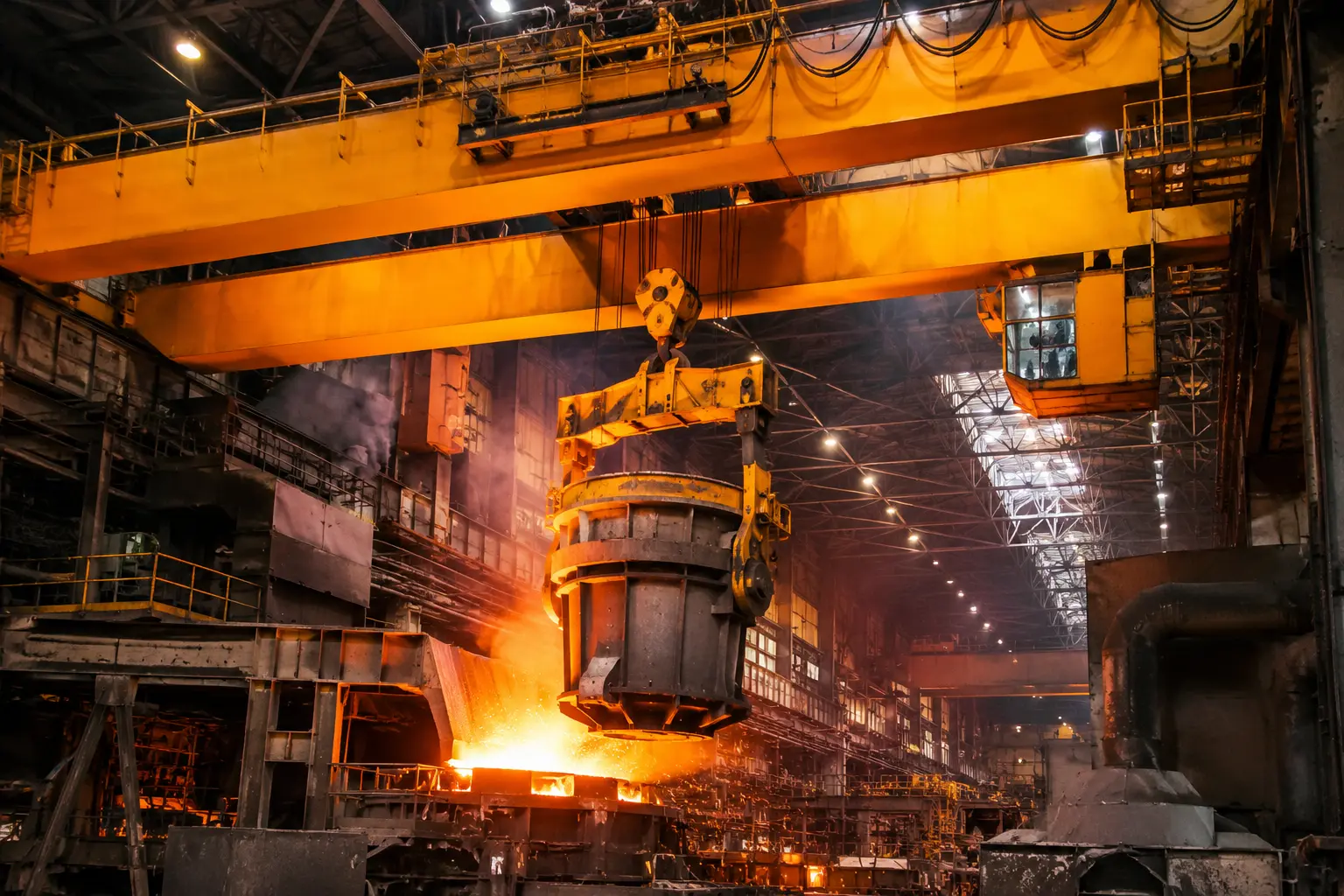
A high temperature overhead crane is an overhead travelling crane configured for elevated ambient temperature, radiant heat, hot materials, sparks, scale, fumes, or repeated thermal cycling.
The bridge, hook, motor, brake, and control cabinet may experience very different temperatures. Design should therefore use measured or calculated temperatures at each critical component, not only the workshop’s average air temperature.
Heat can shorten insulation life, reduce motor cooling, degrade lubricants, damage cables, change mechanical clearances, and accelerate wear in bearings, seals, brakes, and wire rope. A reliable design treats these effects as connected risks.
Steel Mill Overhead Crane Operating Conditions
Overhead cranes in a steel mill are frequently in areas where there is high heat, metallic dust, smoke, vibration, frequent starting and long hours of plant operation.
Ambient Temperature, Radiant Heat, and Duty
The specification should distinguish air temperature from radiant heat emitted by furnaces, ladles, billets, and slabs, while recording exposure duration, lifting frequency, starts per hour, load ratio, and shifts per day.
Prepare a temperature map covering the bridge, trolley, hoist motor, brakes, cabinet, cables, operator area, hook block, and lifting attachment. This determines where shielding, cooling, derating, or relocation is required.
The crane duty classification should also reflect the real production process. A crane that frequently lifts near its rated capacity requires a different mechanical and thermal design from equipment used occasionally for maintenance.
Structural and Mechanical Design Requirements
The bridge, trolley frame, rails, machinery bases, platforms, and access systems must withstand mechanical loads and uneven heating.
Differential expansion can affect wheel contact, rail alignment, couplings, shafts, bearings, and brake geometry. These effects should be considered when establishing installation tolerances and inspection procedures.
Heat Shields and Maintenance Access
Heat shields should reduce radiation without blocking airflow or collecting scale. They may use reflective surfaces, insulated panels, ventilated gaps, and removable sections.
Technicians need to access items such as motors, brakes, drums, sheaves, lubrication points, panels and sensors. Technicians need protected access to these items. Technicians need clearance, walkways, guards, stops and a safe buffer in a hot, dirty environment.
Hoisting Mechanism and Wire Rope
The motor, gearbox, brake, drum, rope, sheaves, hook block, and lifting beam form one load path. Each component must be selected for the load spectrum, operating frequency, temperature, and required service life.
Rope construction and lubricant must suit the actual temperature. Where heat could damage a fibre core, a rope with an independent wire-rope core, wire-strand core, or another temperature-resistant core should be used.
Drums and sheaves should be inspected for groove wear, surface defects, poor alignment, and inadequate lubrication. Hooks and lifting attachments should also be checked regularly for heat damage, deformation, cracks, and excessive wear.
Heat Resistant Motor and H Class Insulation
A heat resistant motor is not defined by insulation class alone. Selection must consider ambient temperature, winding temperature rise, starting torque, starts per hour, low-speed operation, enclosure, ventilation, variable-frequency control, and dust blockage.
What H Class Insulation Means
H class insulation is associated with an insulation-system temperature class of 180°C.
This value represents the total thermal capability of the insulation system. It does not mean that the motor can automatically operate in 180°C ambient air. A higher ambient temperature leaves less margin for the temperature rise created inside the motor.
A motor may still overheat when it is overloaded, frequently started, poorly ventilated, operated slowly without independent cooling, or exposed to direct furnace radiation.
Motor sizing should therefore include thermal derating and realistic duty calculations. Winding-temperature sensors and bearing-temperature monitoring may also be required for critical steel mill applications.
Cooling and Thermal Protection
Useful measures include relocating the motor, installing a correctly spaced shield, supplying cooler air, using independent cooling, and preventing hot-air recirculation.
A shield must not obstruct the airflow required by the motor. Temperature alarms should warn operators before excessive heat damages insulation, bearings, seals, or lubricant.
Electrical Controls and Cable Protection
Electrical devices often have lower temperature limits than structural components. Control cabinets should be positioned away from the hottest zone whenever practical.
Protection may include insulated enclosures, filtered ventilation, cabinet cooling, sensors, alarms, and accessible filters. Ingress protection controls dust and moisture but does not remove internal heat.
Electrical equipment should also be protected from accidental contact, dirt, grease, oil, and moisture. Automatic and remote-operated cranes should enter a safe state when a control malfunction or lost control signal occurs.
Flexible cables must be selected for conductor temperature, insulation and sheath rating, flexing cycles, oil exposure, flame performance, and mechanical protection. Cable routes should avoid direct radiant heat and areas exposed to molten-metal splash.
Variable-speed control can reduce load swing and mechanical shock. It does not replace holding brakes, final limits, overload protection, or emergency stops.
Molten Metal Crane Safety Systems
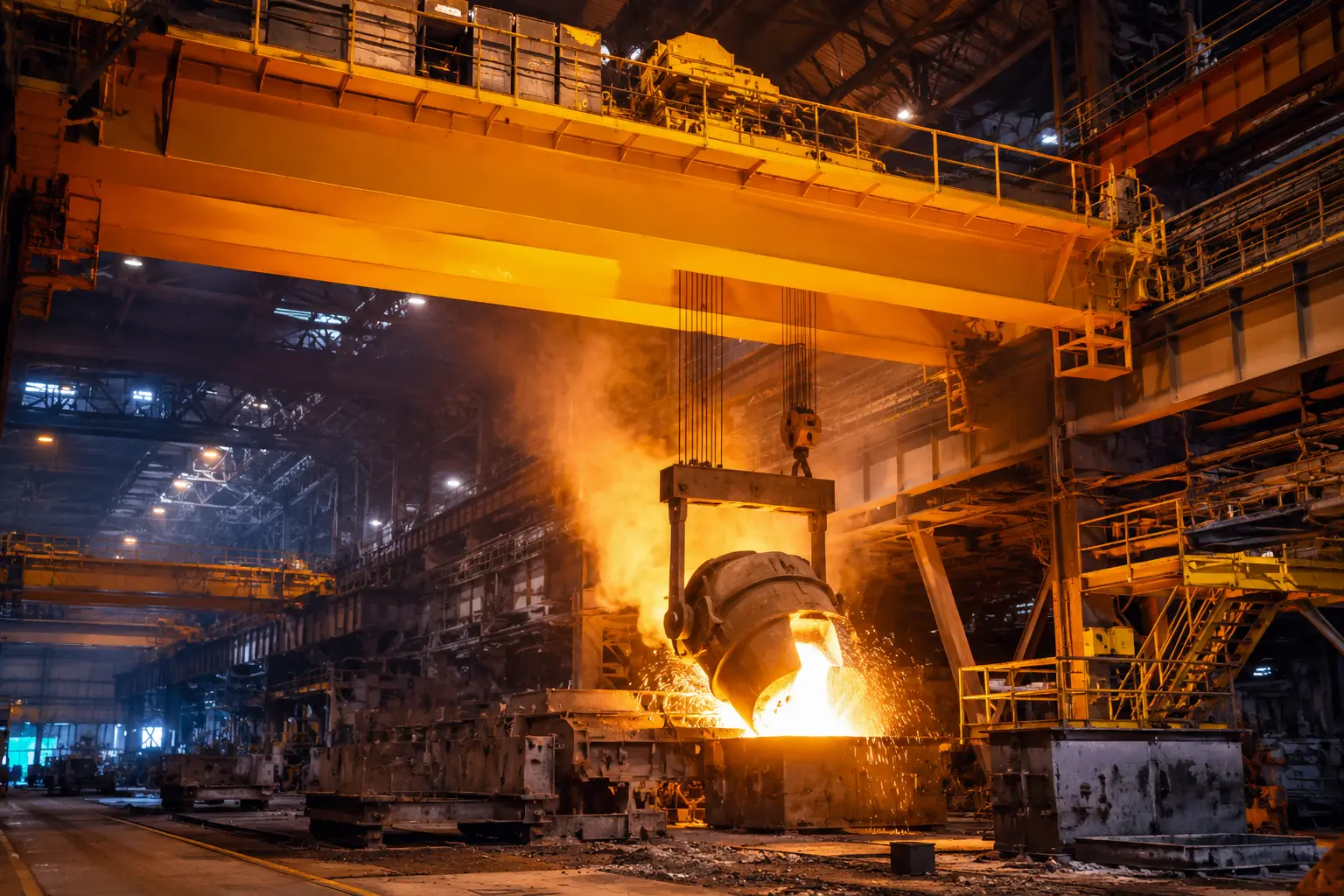
A molten metal crane transports or pours liquid material and requires safety measures proportionate to the consequences of failure.
Its final configuration must comply with the crane regulations, electrical requirements, and industry standards applicable to the installation location.
Braking, Limits, and Redundancy
For hot-metal hoisting units using power control braking, U.S. overhead-crane rules require at least two holding brakes.
Hoist holding brakes must apply automatically when power is removed. They must also have sufficient thermal capacity for the operating frequency of the crane.
The crane should be assessed for:
- Overspeed protection
- Overload limiting
- Upper and lower hoist limits
- Emergency stopping
- Travel limits and buffers
- Brake-status monitoring
- Motor and cabinet temperature alarms
- Control-system fault recording
The upper hoist limit is a protective device. It should not be used as the normal operating control, and its function should be checked according to the inspection procedure.
Molten-Metal Splash Protection
The layout should prevent molten metal or broken components from falling onto the operator or from the crane.
Heat shielding, protected cable routing, cab location, remote operation, emergency access, and restricted working zones should be reviewed against credible splash and component-failure scenarios.
Inspection and Preventive Maintenance
High temperature accelerates deterioration, so inspection intervals should reflect thermal exposure, operating duty, component condition, and failure consequences.
Recognized overhead-crane rules classify inspections as frequent, from daily to monthly, and periodic, from one to twelve months. Severe steel mill service may require shorter intervals.
Daily checks should cover:
- Brake response
- Operating controls
- Hoist limits
- Rope and hook condition
- Oil or grease leakage
- Abnormal noise or vibration
- Cooling fans and filters
- Warning devices
- Visible heat damage
Periodic work should examine brake wear, drums, sheaves, gearbox oil, alignment, wheels, rails, structural connections, heat shields, cables, control panels, and lifting attachments.
Record temperatures, motor starts, overload events, brake wear, and drive faults to reveal deterioration before shutdown.
How to Specify a High Temperature Overhead Crane
Provide the crane supplier with:
- Capacity, span, lifting height, and speeds.
- Load type and maximum load temperature.
- Ambient temperature and radiant-heat data.
- Duty class, cycles, starts per hour, and full-load ratio.
- Dust, fumes, humidity, and corrosive conditions.
- Motor insulation, cooling, and monitoring requirements.
- Brake redundancy, limits, overload, and emergency functions.
- Control method, cabinet location, and cable requirements.
- Maintenance access and inspection expectations.
- Applicable standards, testing, and documentation.
A common mistake is specifying only workshop temperature. Complete design connects heat exposure, duty, component ratings, safety, and maintainability.
FAQ
Is H Class Insulation Enough for a Steel Mill Crane Motor?
No. Motor suitability also depends on ambient temperature, permitted temperature rise, ventilation, operating duty, speed range, load, and starts per hour.
Why Does a Molten Metal Crane Need Two Brakes?
Two holding brakes reduce the risk of uncontrolled load descent if one braking element fails. The required arrangement depends on the governing rules and the crane’s braking system.
Does a High-Temperature Crane Need Special Wire Rope?
Often, yes. Rope core, lubricant, shielding, inspection frequency, and replacement criteria must match the actual heat exposure.
Where Should the Crane Control Panel Be Installed?
The panel should be positioned away from severe heat whenever possible. When installation on the crane is necessary, enclosure insulation, ventilation, cooling, contamination control, and maintenance access should be evaluated.
Plan Your High-Temperature Lifting System with Nante Crane
Nante Crane designs and manufactures industrial cranes and crane components, including overhead cranes, open-winch systems, electric hoists, travelling mechanisms, mobile power supplies, and crane control panels. Its control systems can support variable-speed operation, anti-sway, automation, data logging, and connected monitoring. Share your capacity, span, lift, temperature map, duty cycle, load details, and safety requirements to discuss a tailored high temperature overhead crane solution. Contact Nante Crane today to receive professional technical support and a customized project proposal for your high-temperature lifting application.