English


Bolted vs Welded Connections in Crane Structures: Choosing the Right Crane Structural Connection
Date: 2026-07-23 Share:
A Crane Structural Connection determines how lifting loads, trolley movement, wheel pressure, braking force, and vibration pass through a crane structure. In practical structural design, the decision between a bolted connection and a welded connection affects fabrication cost, transportation, erection speed, maintenance access, and long-term fatigue design. For crane girders, this decision is especially important because repeated load cycles can create fatigue cracks even when static strength looks acceptable.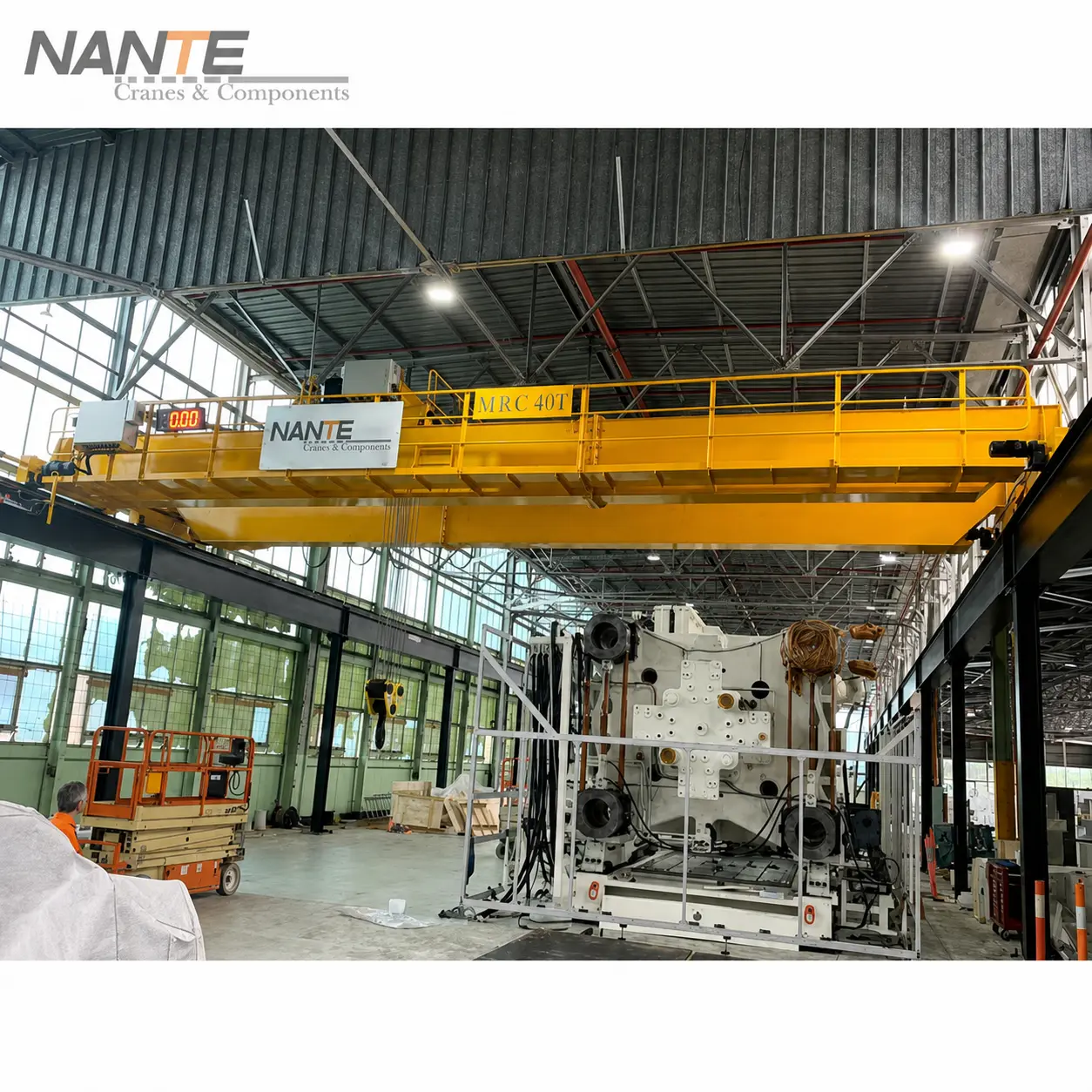
What Is a Crane Structural Connection?
A crane structural connection is a load-transfer joint for the structural members of a crane. These connections are typically found at such locations as: girder splices, end carriage joints, runway beam joints, such as for girders or end carriages, as stiffener plates, trolley frames, as rail support brackets, etc.
Crane structures are subject to a variety of different loads such as repeated vertical loads, lateral loads, acceleration and deceleration as well as local wheel pressure. Connections to steelwork in such structures must take account of all of these factors in addition to strength, stiffness, tolerance, access for inspection and fatigue life.
Bolted Connection in Crane Structural Design
How a Bolted Connection Works
In the structural design of cranes, a bolted connection can transfer forces by means of bolt shear, plate bearing, bolt tension or friction between two plates that have been clamped. The bolted connection is frequently used for field splices as well as for end carriage-to-girder connections. Other application areas for bolted connections are for example for removable brackets, for rail clips and for modular crane sections.
The design must control bolt grade, hole size, edge distance, tightening, installation access, corrosion, and slip resistance.
Advantages of Bolted Connections
Bolted connections are highly practical when crane parts must be transported in sections. A long girder can be fabricated as modules, shipped more easily, and assembled on site with splice plates.
They also improve maintenance. Bolts can be inspected, retightened, replaced, or removed when alignment correction or component replacement is needed.
Key advantages include:
- Easier modular transportation
- Faster site assembly
- Less field welding
- Better serviceability
- Lower risk of heat distortion at site joints
Limitations of Bolted Connections
Bolted joints require accurate hole alignment and good fabrication tolerance. If holes are misaligned, site erection becomes slow and difficult.
Potential problems include bolt loosening under vibration, slip between plates, hole elongation, bearing deformation, corrosion around holes, and added weight from splice plates.
Welded Connection in Crane Structural Design
How a Welded Connection Works
A welded connection is a type of connection that is joined by steel parts by fusion. In the field of crane structures, welded connections are widely used in box girders, web-to-flange joints, diaphragms, stiffeners as well as in trolley frames and permanent brackets.
Common weld forms are the Fillet Weld, the Butt Weld, the Partial Penetration Weld and the Continuous Seam Weld. A weld forms a very compact and stiff load path and that is particularly the case if it has been designed and fabricated in a workshop under proper control.
Advantages of Welded Connections
Welded connections are suitable for permanent crane components where disassembly is not expected. They reduce exposed plates and fasteners, giving the structure a cleaner and more compact layout.
Main advantages include:
- Compact structure
- High stiffness
- Clean appearance
- Efficient workshop fabrication
- Good performance for permanent crane girder welding
Limitations of Welded Connections
Welding introduces heat, shrinkage, residual stress, and possible distortion. Welded details can also create fatigue-sensitive points at weld toes, weld ends, stiffener terminations, and attachment plates.
Engineering research on crane runway girders identifies fatigue cracking as a common problem and notes that crack initiation is often linked to stress concentration, weld details, repeated stress range, and local imperfections.
Manufacturing, Transportation, and Erection Comparison
Workshop Manufacturing
Bolted connections require drilling, punching, reaming, trial fitting, bolt-hole tolerance control, and surface preparation.
Welded connections require edge preparation, qualified welding procedures, welder skill, heat input control, distortion control, and inspection.
In manufacturing, bolting is often easier to verify dimensionally, while welding requires stricter process control.
Transportation and Site Assembly
Bolted connections are ideal for large cranes that cannot be shipped as one piece. For example, a long-span overhead crane girder may be divided into two or three sections, transported separately, and connected on site by bolted splice plates.
Welded construction is more efficient when the whole girder or subassembly can be shipped from the workshop. Site welding should be limited in critical fatigue zones unless access, weather control, fit-up, and inspection are reliable.
Maintenance and Repair Comparison
Maintenance of Bolted Connections
Bolted joints are usually quite easy to inspect whilst in service. During routine maintenance, a number of things can be looked for such as; are all the bolts fitted? Is the joint in question tight enough? Is there any rust bleeding from the bolts or around the joint? Is the paint cracked around the joint? Is the two plates slipping relative to each other? Are there any signs of hole deformation?
Repairs can involve the replacement of bolts, addition of plates or even the complete removal and replacement of the removable section of housing.
Maintenance of Welded Connections
Welded joints require crack-focused inspection. Important areas include weld toes, bottom flange attachments, stiffener ends, bracket welds, and web-to-flange transitions.
Repair is usually more complex. It may require crack removal, grinding, re-welding, inspection, and repainting. Poor repair welding can shorten fatigue life, so repair planning must be treated as an engineering task, not only a maintenance task.
Crane Girder Welding Fatigue Design
Why Fatigue Design Matters
Crane girder welding fatigue design is critical because cranes operate through repeated cycles. A connection may be strong enough for one maximum lift but still vulnerable after thousands or millions of load applications.
Fatigue design focuses on stress range, number of cycles, detail category, geometry, and crack initiation points. Engineering guidance for crane-supporting steel structures highlights repeated loads and distortion-induced fatigue as important design issues.
Practical Fatigue Design Rules
Use these rules for fatigue-sensitive crane connections:
- Keep force flow smooth and direct.
- Avoid abrupt section changes.
- Minimize welds in high-tension zones.
- Avoid poor weld terminations.
- Reduce eccentric load paths.
- Provide access for inspection.
- Check bolt holes and welded toes as fatigue details.
- Match connection type to crane duty and operating cycles.
For welded crane girders, fatigue cracks often begin where cyclic stress meets a geometric discontinuity. For bolted joints, critical points are usually bolt holes, plate edges, and slip-prone interfaces.
Engineering Case: Hybrid Connection for a Long-Span Crane Girder
Project Situation
A factory requires a long-span double girder crane for frequent daily lifting. The girder is too long for one-piece transportation, and the duty cycle requires serious fatigue review.
Connection Decision
A practical solution is a hybrid design:
- Main girder body: shop welded
- Internal diaphragms: shop welded
- Transport splice: bolted
- End carriage connection: bolted
- Fatigue-critical zones: detailed for smooth stress flow
- Inspection points: kept accessible
Why the Hybrid Design Works
The welded girder provides stiffness and compact geometry. The bolted splice improves transportation, erection speed, and future maintenance.
This shows that the best Crane Structural Connection is not always purely bolted or purely welded. It depends on span, duty class, shipping route, site conditions, inspection capability, and lifecycle cost.
Suggested Force and Stress Diagrams
Diagram 1: Load Path in a Crane Girder
Show the wheel load entering the top flange, moving through the web and stiffeners, and reaching the connection. Mark stress concentration at weld toes and bolt holes.
Diagram 2: Bolted Splice vs Welded Splice
Show a bolted splice plate on one side and a welded joint on the other. Add arrows for shear, bending, and tension.
Diagram 3: Fatigue Crack Initiation Points
Mark common crack locations: weld toe, stiffener end, bolt hole edge, bracket weld end, and bottom flange attachment.
Quick Comparison Table
| Factor | Bolted Connection | Welded Connection |
| Manufacturing | Needs accurate holes | Needs welding control |
| Transportation | Better for modular shipping | Better for full sections |
| Site erection | Faster and cleaner | Needs welding access |
| Maintenance | Easier to replace | Harder to repair |
| Fatigue risk | Bolt holes and slip | Weld toes and residual stress |
| Best use | Splices and removable parts | Permanent shop-fabricated joints |
FAQ
Which is stronger: bolted or welded connections?
Both can be designed for required strength. The better choice depends on load path, fatigue demand, manufacturing quality, and maintenance strategy.
Are welded crane connections more fatigue-sensitive?
They can be Weld toes, weld ends, and residual stresses can become crack initiation points under repeated crane loading.
Are bolted crane connections easier to maintain?
Usually yes. Bolted joints are easier to inspect, remove, retighten, and replace.
Is crane girder welding still necessary?
Yes. Crane girder welding remains essential for box girders, stiffeners, diaphragms, and permanent structural details.
Nante Crane is a crane and crane components designer and manufacturer focused on lifting and material handling technologies, with product ranges including overhead cranes, gantry cranes, construction cranes, workstation cranes, offshore cranes, electric hoists, open winches, crane rails, crane travel units, and crane control panels; its official product pages list single girder overhead cranes, double girder overhead cranes, gantry cranes, launching cranes, jib cranes, offshore davit cranes, and control panels for hoisting, long travel, cross travel, and whole-crane control. Contact Nante Crane today to discuss the right crane structural connection and complete lifting solution for your project.