English


Flat Bar vs Square Bar in Crane Rail Installation: A Technical Comparison
Flat Bar vs Square Bar in Crane Rail Installation A Technical Comparison
Date: 2026-06-04 Share:
In crane rail systems, the choice between flat bar and square bar for runway rail support structures matters for performance, safety, and long service life. This crane rail support steel comparison looks at flat bar uses in crane systems and square bar installation methods. It focuses on strength, ways to install, and support roles. Good selection helps keep crane rail alignment support correct. It cuts down wear and meets machining tolerances for smooth work in overhead and gantry cranes.
Flat bars give a wider base for even load spread in heavier uses. Square bars give compact and simple weld options that fit lighter work and tight spaces. Engineers and crane operators need to check duty cycle, crane capacity, environmental conditions, and long-term maintenance when they decide. This technical guide gives a clear comparison to support an informed choice for runway rail support structures.
Understanding Flat Bar and Square Bar in Crane Rail Systems
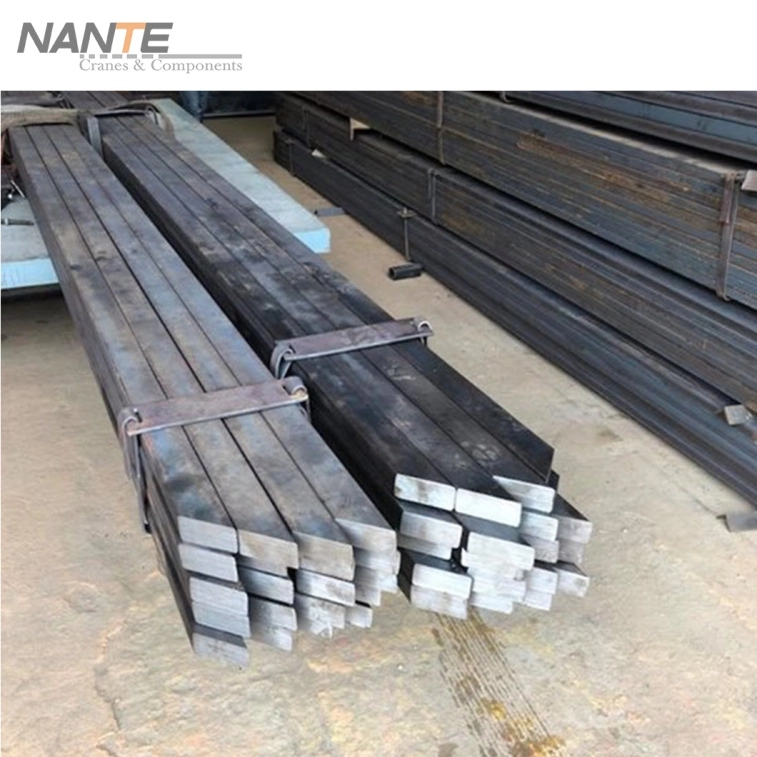
Flat bars have a rectangular cross-section with greater width than height. This creates a stable surface for crane wheels. Square bars have equal sides. This results in a more compact profile. Both work as cost-effective options instead of specialized profiled crane rails such as DIN or QU types in light to medium-duty applications.
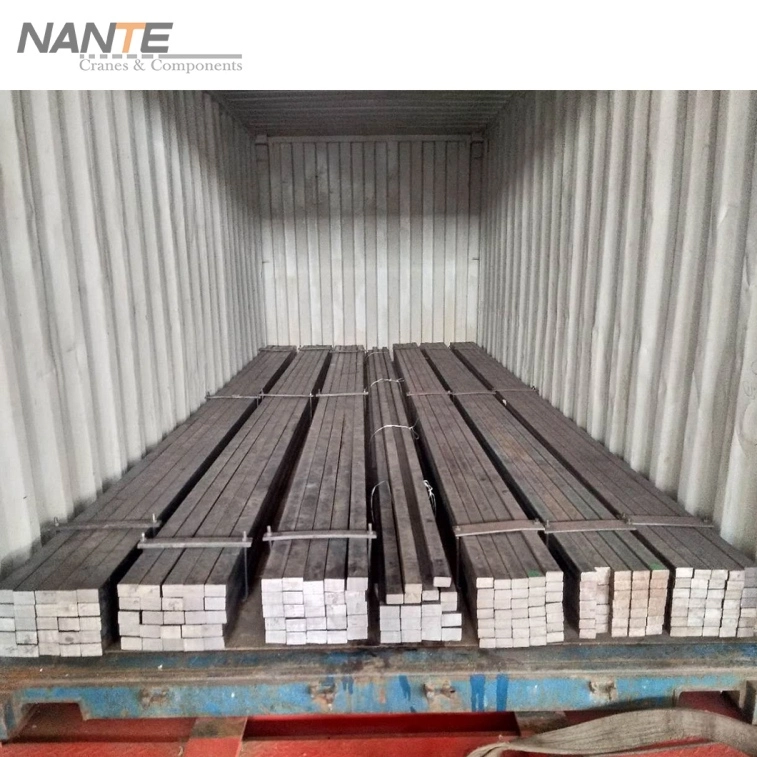
These bars usually come from high-strength structural steel like S355 (equivalent to ST52). This steel offers good weldability and durability. Nante Crane supplies flat bars in sizes such as 40×30, 50×30, 60×40, 70×40, and 100×60 mm. It supplies square bars in 40×40, 50×50, 65×65, and 80×80 mm. Options include customization for length and 45-degree end cuts.
In runway rail support structures, workers weld or bolt these bars onto supporting beams or embed them in concrete foundations. They fit applications where full crane rail profiles would cost too much or prove over-engineered. Flat bars perform well because of their larger contact area. This promotes smoother travel and longer wheel life. Square bars work well in compact setups because of their low profile and simple alignment.
Crane Rail Support Steel Comparison: Key Differences
Strength and Load-Bearing Capacity
Flat bars usually give better results under heavier loads (typically 20 tons and above). Their wider base spreads wheel pressure more evenly. This reduces bending stress and improves resistance to fatigue in high-cycle operations. These features make them suitable for demanding overhead and gantry crane systems in ports, steel mills, or manufacturing facilities with frequent use.
Square bars manage light to medium loads well (up to around 15-20 tons). They provide solid compressive strength. However, they can twist or show uneven wear if loads become imbalanced or if alignment stays imprecise. Their square shape works for lower wheel pressures. They may need extra support in higher-duty cases.
Comparison Table:
| Aspect | Flat Bar | Square Bar |
|---|---|---|
| Load Capacity | Better for 20t+ | Light-medium (up to ~20t) |
| Bending Resistance | Higher due to width | Good compression, potential twist |
| Wheel Pressure Distribution | Excellent, larger contact area | Adequate for lighter duties |
| Fatigue Performance | Stronger in high cycles | Suitable for low cycles |
Proper engineering calculations for wheel loads, beam deflection, and duty class (per FEM or CMAA standards) remain essential no matter the choice.
Installation Methods and Ease of Use
Square bar installation uses stay straightforward. They stay popular for their simplicity. The compact shape allows easy welding. Workers use stitch welds for light duty or continuous fillet welds for added strength. They attach directly to beam flanges. Their low profile fits tight spaces. Alignment becomes relatively simple. This reduces installation time and labor costs. They suit warehouses, workshops, and portable or semi-gantry setups.
Flat bar applications in crane systems provide flexibility. Workers can weld or bolt them. This gives a wider support base. Installation needs careful leveling to prevent uneven wear. However, the design allows adjustments more readily in some setups. Best practices include minimizing joints. They also include 45-degree cuts for smoother transitions and protective primer on welded sides.
Installation Comparison Table:
| Factor | Flat Bar | Square Bar |
|---|---|---|
| Welding | Fillet or full; wider area | Easy stitch or full fillet |
| Alignment | Needs precision leveling | Simpler due to symmetry |
| Tools/Skill Level | Moderate | Lower |
| Time Efficiency | Slightly longer for leveling | Faster in confined spaces |
Engineers should always follow engineering drawings for weld specifications. They must ensure proper joint preparation to avoid stress concentrations.
Support Applications and Runway Rail Support Structures
Flat bars fit well into heavy-duty runway rail support structures for overhead cranes, double-girder systems, and high-usage environments like material handling in logistics or metal processing. Their stability supports longer spans and higher speeds.
Square bars appear often in single-girder cranes, underhung systems, monorails, and space-limited warehouses. They work effectively when welded to supporting beams in light-duty transfer cars or workstation cranes. Both improve runway rail support structures when paired with soleplates or adjustable mounts for alignment.
Steel Bar Machining Tolerances and Crane Rail Alignment Support
Precise machining tolerances matter for crane rail alignment support. Deviations cause wheel flange wear, rail gnawing, vibration, and lower efficiency. Key parameters include straightness (for example, ≤1.5 mm per meter laterally, total bend ≤8 mm), elevation tolerances (±1/4 inch across span), and gauge consistency.
Flat bars often have rounded edges (for example, R3 radius) to protect wheel flanges and reduce wear. Square bars need symmetric machining to prevent torsion (typically <1/10000 of length). Both gain from tight tolerances on cross-section symmetry (±0.5-2 mm depending on dimension).
Alignment techniques use laser surveying or optical methods after installation under load. Allowable deviations stay at centerline ±1/4 inch and joint mismatch ≤1/32 inch. Regular maintenance checks prevent problems from foundation settlement.
Engineering Drawings and Installation Comparison Tables
Engineering drawings usually show cross-sections, weld symbols, support spacing, and expansion provisions. For square bars, drawings stress vertical fillet welds along the sides. Flat bar drawings highlight base width and possible bolting patterns for adjustability.
Beyond the tables above, consider these factors together: duty cycle (A1-A8 or CMAA classes), environment (corrosive, high-temperature), crane type, and total cost of ownership. Flat bars may need higher upfront machining but bring lower long-term wear costs in heavy use. Square bars perform well in budget-sensitive, low-maintenance light applications.
Best Practices
- Minimize rail joints and stagger them >600 mm on parallel tracks.
- Use thermal correction for deformations >10 mm.
- Inspect welds, alignment, and wear periodically.
- Match bar size to calculated wheel loads.
Advantages, Limitations, and Best Practices
Flat Bar Advantages
- Superior stability and load distribution.
- Longer wheel and rail life in medium-heavy duty.
- Flexible fixing options (weld/bolt).
Limitations: Requires precise leveling; wider footprint.
Square Bar Advantages
- Cost-effective and easy to install/weld.
- Low profile for space savings.
- Quick setup in modular systems.
Limitations: May twist under uneven loads; better for lighter duties.
Maintenance includes checks for cracks, wear (<3 mm recommended limit), loose connections, and alignment. Proper selection prevents safety issues like crane swaying or derailment risks.
Conclusion
In summary, flat bars suit higher-load and high-stability needs in robust runway rail support structures. Square bars offer economical and easy-installation solutions for lighter crane rail support steel applications. Evaluate specific crane rail alignment support requirements, including loads, space, and duty cycle, for the best results. Matching the bar type to operational demands ensures smooth performance, reduced downtime, and extended equipment life.
Partner with Nante Crane for Your Crane Rail Solutions
Nante Crane is one of China’s leading crane and crane components designers and manufacturers. It stays dedicated to innovative lifting solutions with over 30 years of experience. They offer high-quality flat bar and square bar rails in S355 material with various standard and customized dimensions. They also provide a comprehensive range of overhead cranes, gantry cranes, and components. Nante Crane serves over 50 countries with strong quality management (ISO9001, ISO45001, etc.) and global support. It delivers reliable and efficient products tailored to diverse industries. Contact Nante Crane today.
FAQ
What is the main difference between flat bar and square bar for crane rails?
Flat bars have a rectangular profile for better load spreading. Square bars stay compact with equal sides for easier welding in lighter applications.
Which is better for heavy loads?
Flat bars generally perform better for loads over 20 tons due to enhanced stability and bending resistance.
What tolerances are critical for installation?
Key tolerances include rail straightness (≤1.5 mm/m), elevation (±1/4 inch), and joint alignment to ensure smooth crane rail alignment support.
Can these bars be customized?
Yes, lengths, end cuts (for example, 45 degrees), and dimensions can receive tailoring to project needs.
How do they compare in cost and maintenance?
Square bars often cost less and install faster for light duty. Flat bars may offer lower long-term maintenance in heavier use.