English



Wireless Crane Remote Control for Safer and More Flexible Crane Operation
Date: 2026-03-20 Share:
Traditional crane operations often rely on pendant controls. These require operators to stay close to heavy loads and moving parts. Such closeness brings real dangers. For example, operators can get hit by swinging loads, crushed in tight spots, or trip on control cables. Restricted movement limits clear views around obstacles. It also causes more tiredness from pulling cables and slows down work in crowded industrial places. Wireless crane remote control systems remove these risks. They send commands through radio frequency (RF) signals. This lets operators stand in the best spots for good views and safe distances. A solid crane radio remote control system improves accuracy, cuts down accident chances, and increases output in workshops, yards, and facilities. Current systems combine strong safety measures, tough build quality, and adjustable options to handle tough industrial demands.
What Is a Wireless Crane Remote Control System?
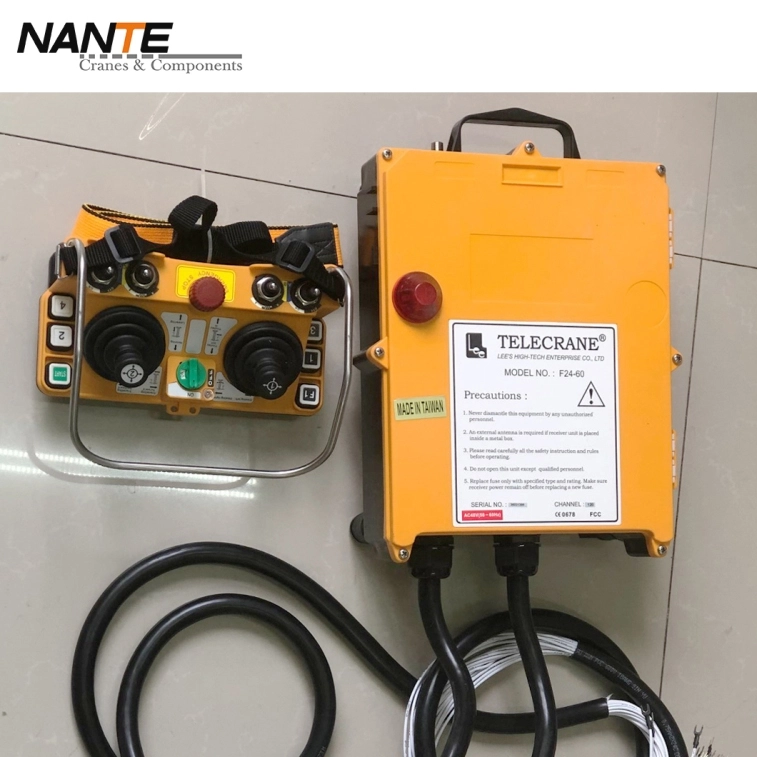
A wireless crane remote control system acts as a modern replacement for wired pendants. It uses RF technology for cable-free work. The basic setup has a portable transmitter for entering commands and a receiver fixed on the crane. The receiver links to the electrical control panel.
This setup allows quick control of main functions. These include hoist up/down movement, bridge and trolley motion, and extra actions. Without physical cables, the systems avoid tangles, cable breaks, and limits on movement. Wireless remote control for overhead crane setups works especially well in tight or machine-filled spots. There, operators can move around easily for improved load watching.
Key Components: Transmitter and Receiver
The transmitter is a small, handheld device with comfortable design. It usually runs on standard 2 AA batteries for long use—often up to 2 months in normal conditions. It contains buttons or joysticks for easy command input.
The receiver sits firmly on the crane. It connects straight to the control circuits with pre-wired cables for simple setup. Both parts have strong build to handle shakes, hits, and tough surroundings. Crane remote transmitter and receiver pairings focus on good matching. This reduces extra parts needs and makes upkeep easier.
How Wireless Signals Control Crane Movements
RF signals travel from the transmitter to the receiver. They include error-checking tools like Hamming code to keep things accurate. Watchdog circuits keep checking signal quality all the time. Any break causes automatic safe stops.
Commands carry out exact crane actions: movement in directions, speed changes (single, double, or stepless), and emergency stops. This wireless crane control communication beats wired options. It resists interference and responds right away, even with electromagnetic noise or metal structures around.
Main Features of Wireless Crane Remote Control Systems
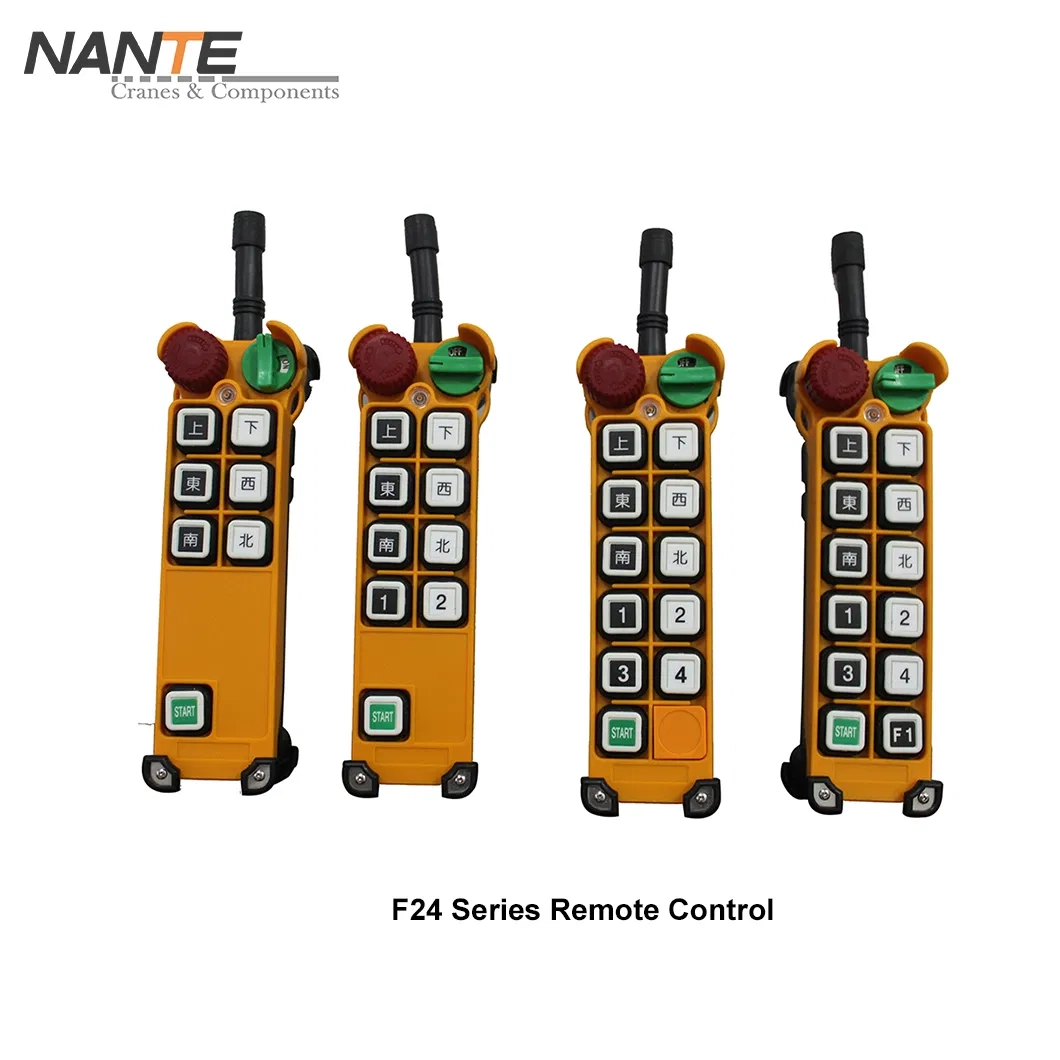
Modern industrial crane remote control systems offer flexible and very dependable performance. They fit hard applications well. Features center on user adjustments, longer lasting build, and better work flow.
Push-Button and Joystick Control Options
Options go from 2 to 12 buttons. They support single-speed for simple jobs or double-speed for stepped control. Models like F21-E1B (single-speed) and F24 series (double-speed) give clear push-button setups.
Joystick choices, such as F24-60D, allow stepless proportional control. This gives smooth and exact movements in careful tasks. These push button crane remote control and joystick crane remote control system designs reduce hand tiredness. They also handle complex multi-direction work.
Long Control Distance and Stable Signal
Standard range goes up to 100 meters. This fits big workshops or outside yards. Advanced RF uses frequency hopping or steady channels to fight interference.
Watchdog and error-correction keep crane remote control 100m range reliable. They stop signal losses in busy industrial areas with lots of signals.
Programmable Functions and Custom Configurations
Windows-based software lets users set button roles, speed limits, and safety locks. Dual-transmitter setups make operator switches easy. Signal sync helps with joint two-crane lifts.
Security comes from 4.3 billion unique ID codes to prevent signal mix-ups. These programmable crane remote control features allow fitting to certain work processes and crane kinds.
Safety Advantages of Wireless Crane Remote Control
Wireless crane remote control systems put operator safety first. They fix basic pendant problems. Added features match industry safety rules.
Keeping Operators Away from Dangerous Loads
Operators pick good spots for clear views. They stay out of load swing areas, falling objects, or tight danger zones. This remote crane operation safety cuts injury risks a lot in high-danger places.
Emergency Stop and Unique ID Security Codes
Special emergency stop buttons (on models like NXAC and XAC) give fast shutdown. Together with 4.3 billion unique IDs, Hamming code, and watchdog checks, systems block wrong access. They also give fail-safe action if signals fail. These crane remote emergency stop and crane remote unique ID code safety parts support rules and trust.
Shock-Resistant Housing for Industrial Environments
Nylon-fiber cases offer great hit protection. They have high IP ratings (often IP65 equivalent) to block dust, water, and oils. This durable industrial crane remote control stands up to drops, shakes, and rough settings for long use.
Applications of Wireless Crane Remote Controls
Wireless remote control for overhead crane and similar systems fit many material handling fields. They improve efficiency and safety.
Overhead Crane Remote Control in Workshops
Manufacturing sites gain better views around machines. Overhead crane wireless control allows exact moves in assembly lines or machining zones.
Gantry Crane Remote Control in Yards
Outdoor storage areas let operators walk over uneven ground freely. Gantry crane radio remote control helps safe lifting of big items without cable issues.
Industrial Hoist Remote Control Systems
Warehousing, upkeep, and light building jobs get more precision. Hoist wireless remote control makes controlled lifting easy in narrow or high spots.
How to Choose the Right Crane Remote Control System
Picking an industrial crane radio control means checking work needs against main points.
Number of Buttons and Speed Control Options
Simple hoists fit 2–8 button single-speed types. Multi-motion cranes work better with 10–12 buttons or 2–12 button crane remote control with joysticks for smooth precision.
Signal Reliability and Operating Distance
Choose RF steadiness in blocked spots. Check crane remote signal stability and range fit with on-site tests.
Compatibility with Crane Electrical Systems
Receivers need to match voltage, wiring, and panels. Pre-wired setups and wide matching make retrofits simple for crane remote control compatibility.
Why Switch from Pendant to Wireless Crane Remote Control?
Pendant systems tie operators down. They limit views, add tiredness, and expose people to risks like cable trips or close loads. Wireless options give better movement for views from many angles. They remove cable damage, shorten work cycles, and improve comfort. Output grows because operators stand in good spots without chasing loads. Safety gets better with distance and quick stops. This change matters for current efficiency and lower risks.
Ready to Upgrade Your Crane Operations?
Nante Crane, a leading manufacturer with over 30 years of experience, specializes in high-quality cranes—including overhead cranes, gantry cranes, and workstation cranes—and components like wireless crane remote control systems. Committed to safety, efficiency, modular design, and customization, Nante serves global industries across more than 50 countries with durable, innovative products backed by strict quality control and comprehensive support. Contact Nante Crane today to discuss the best wireless crane remote control solution for your operations and enhance safety and performance.
FAQ
What is the typical range of a wireless crane remote control?
Up to 100 meters or more, supported by stable RF and watchdog monitoring.
Are wireless crane remote controls compatible with existing cranes?
Yes, receivers integrate seamlessly with most control panels via pre-wired connections.
What safety features are standard?
Emergency stops (select models), 4.3 billion unique IDs, Hamming code, and enhanced watchdog circuits.
Can one transmitter control multiple cranes?
Yes, through programmable dual-transmitter or synchronization options.
How does it improve safety over pendant controls?
Operators maintain safe distances, achieve better visibility, avoid cable hazards, and access rapid emergency response.