English


Power Requirement of Open Winch Double Girder Overhead Cranes
Power Requirement of Open Winch Double Girder Overhead Cranes
Date: 2026-06-19 Share:
Introduction
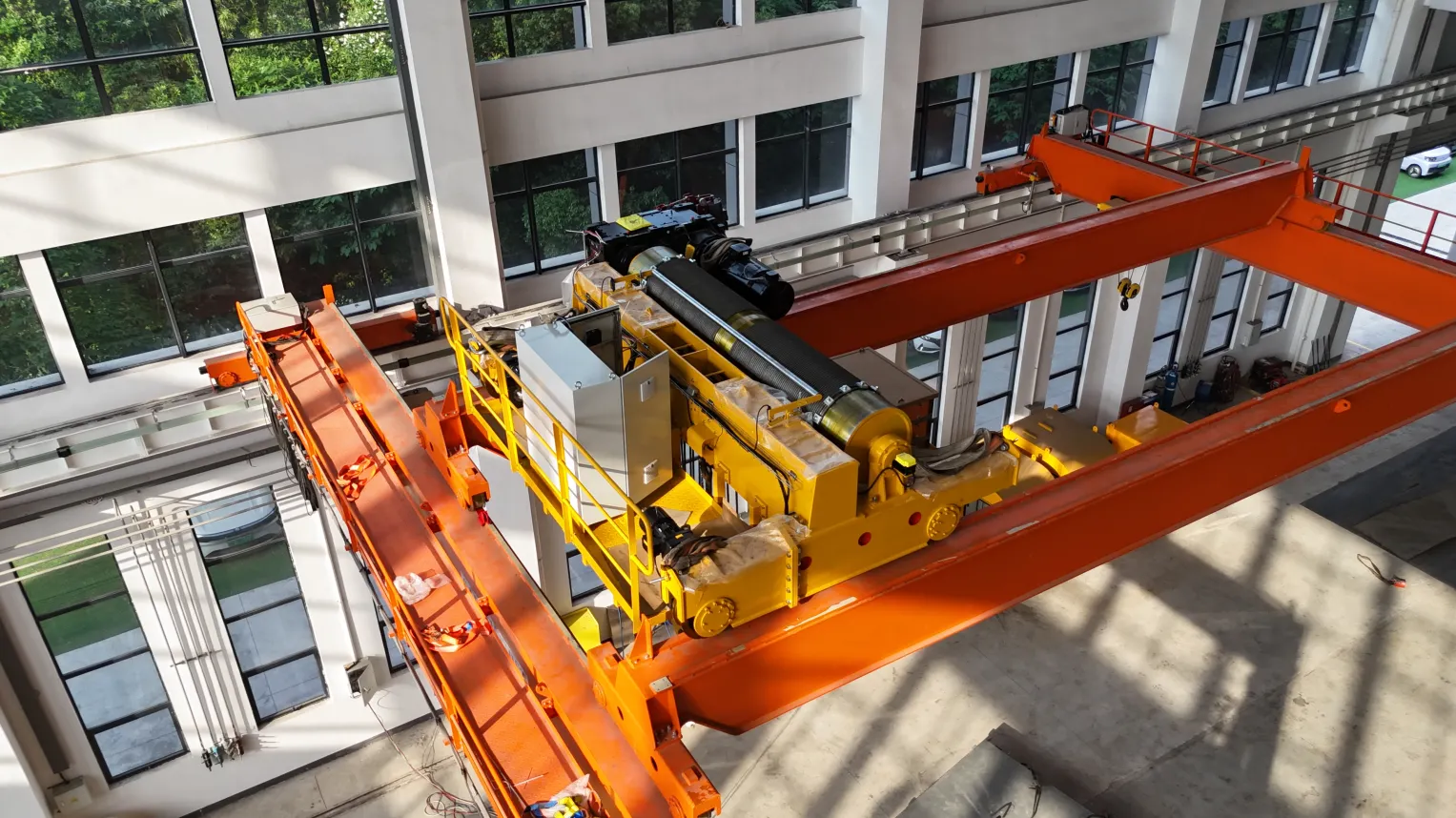
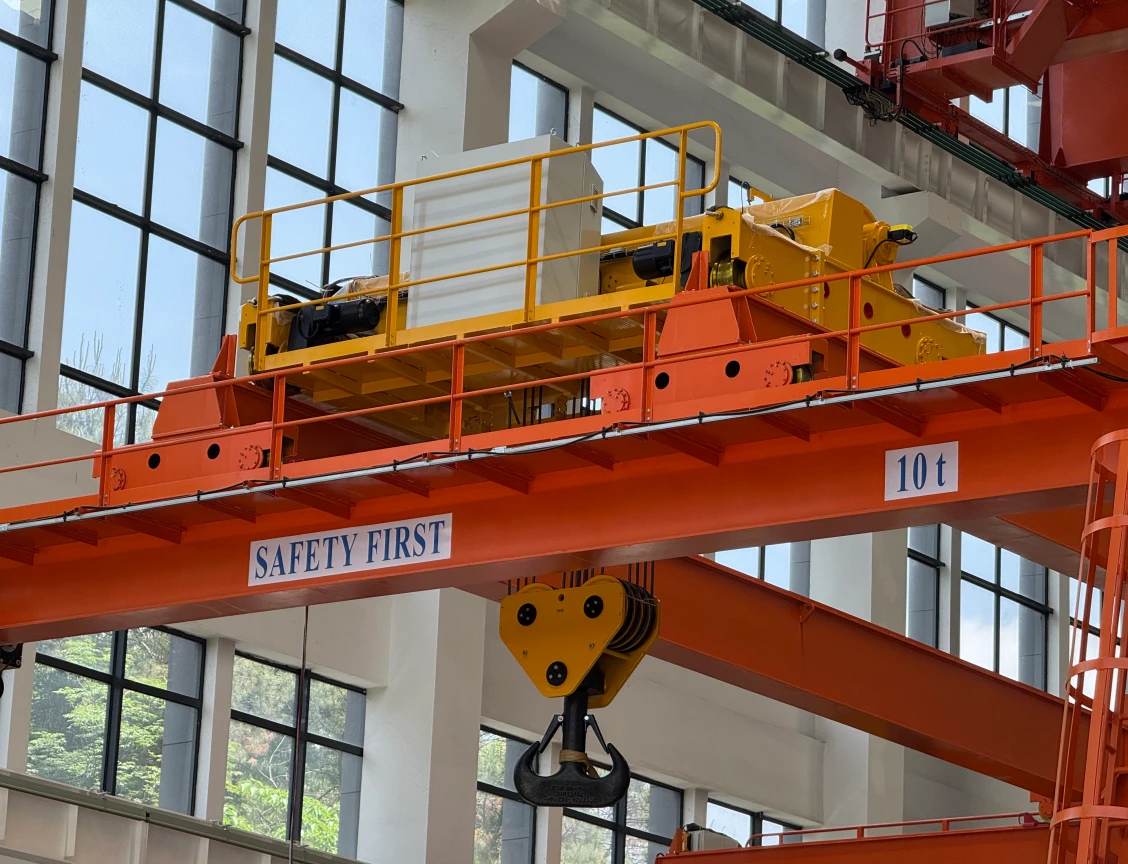
Open winch double girder overhead cranes are designed for heavy duty material handling in applications such as workshops, machinery plants, warehouses, shipyards, precast yards, steel construction and other industrial environments. The two girder design provides high rigidity, long span capability, stable lifting and high load capacity for its size when compared to lighter duty cranes.
The power required for a double girder EOT crane is a critical design parameter and affects the main hoist, auxiliary hoist, trolley, crane travel, control panel, conductors etc. Excessively low power installed can lead to excessive heat generation, poor lift, non – adequate braking, voltage drop etc. Excessively high power results in higher costs of motors, cables, switchgear & contactors and also transformers.
Understanding Power Requirement
The power requirement of an open winch double girder overhead crane is the rated electrical power required for lifting and traveling. This would include hoist motors, trolley motors, crane traveling motors, brakes, crane controls and other electrical auxiliaries.
Power requirement vs. power consumption.
Power requirement is a design value, typically expressed in kilowatts, which serves as the basis for selecting a suitable motor as well as for the electrical planning and design. Power consumption, on the other hand, is the actual amount of energy that is consumed by a machine while it is in operation. This amount of power is subject to a wide range of influencing factors, including the weight of the loads, the running time, the frequency of lifting, the acceleration and braking of the machine as well as site-related conditions.
Key points to know:
- The power requirement for a system can be used to size motors and the necessary electrical support for a system.
- Power consumption changes with actual workload.
- Undersized power can cause items to overload, overheat, cause circuit breakers to trip and even cause early component failure.
- Too much power can increase initial investment but not bring increased productivity.
- Accurate planning will enable a safe lift and extended life of the crane.
Power Requirement by Crane Capacity
The capacity of the crane determines the total installed power. A higher load requires a higher hoisting torque, larger motors, more powerful brakes and more powerful controls. The final power is also influenced by span, lifting height, lifting speed, the type of service, and whether the main hoist or auxiliary hoist is being used.
Light Capacity Cranes (5t, 10t)
Light-duty double girder cranes are typical for general manufacturing, maintenance, assembly and storing applications.
- The typical total power of a crane is between approximately 11 kW and 18 kW.
- The power required for hoisting motors are mostly around 7.5 kW up to 11 kW.
- Trolley and crane travel motors are mostly in the range 0.55 kW to 2.2 kW.
- Frequent starts and stops require appropriate measures for braking and control protection.
Medium Capacity Cranes (16/20t, 32/50t)
A Medium-Capacity Crane is typically found in Fabrication Plants, Heavy Machinery Workshops, Steel Processing facilities and Equipment Assembly sites.
- Total installed power is between about 30 kW and 80 kW.
- The power required for the main hoist motor may range from 15 kW up to 45 kW.
- The power of trolley and crane travelling motors can vary from 2.2 kW up to 7.5 kW and more.
- Variable frequency drives improve acceleration and reduce mechanical shock.
Heavy Capacity Cranes (100t, 150t, 200t and above)
The heavy open winch double girder cranes are used in steel production, in shipbuilding, in large fabrication shops, in handling of heavy equipment and in construction component handling.
- The total installed power is exceeding 100 kW and even reaches 150 kW.
- The main hoist motors are 45 kW, 55 kW or more.
- Other components such as auxiliary hoists, trolley travel, bridge travel, brakes and controls add to the hoist’s power.
- VFD control for starting, positioning and low-impact operation.
How Lifting Capacity Influences Motor Power
It will be noted that there is a direct relationship between the lift capacity and the required motor power. However, this relationship is not necessarily linear. The work to be done is affected by the lift speed. Higher lift creates longer running times and higher motor temperatures. A number of other factors also affect the choice of the final motor including gearbox efficiency, drum design, reeving, wire rope arrangement, acceleration, braking and dynamic load allowance.
Influence of Working Duty on Power Requirement
The working duty of a crane describes how frequently a crane is used and how heavy a load it is moved. An occasional maintenance crane will have different electrical requirements than a 24/7 production machine. The different classes of working duty have implications for the motor heat, brake wear, gearbox stress, control design and the amount of power reserve required.
An A5 duty crane is suitable for average industrial usage with only occasional heavier lifts. An A6 duty crane is designed for heavier and more frequent usage than an A5, and higher duty classes require larger motors, better heat dissipation and more robust electrical components.
Working duty affects power ratings in several ways:
- Higher duty class leads to longer running times and higher thermal load.
- Frequent starts and stops require a more powerful motor and stronger brakes.
- Heavy-duty operation requires larger safety margins.
- VFDs are able to reduce shock loads, and thereby extend the life of the motor.
For example a 5t A5 duty crane would require 11.6 kW total power as opposed to the 5t A6 duty crane at 16.5 kW. Likewise a 20t A5 duty crane would require 30.7 kW total power, whereas a 20t A6 duty crane would require 41.2 kW total power.
Other Key Factors Affecting Power Requirement
Span Length and Lifting Height
A longer span will increase the weight of the bridge structure and potentially increase the demand on the traveling power. A greater lifting height will increase the hoist running time and possibly require increased motor cooling and/or improved braking capacity.
Lifting Speeds, Trolley Speed, and Crane Travelling Speed
The speed with which you lift, move laterally with the trolley or travel along the bridge with the crane to increase the power required by hoist motor, trolley motor and bridge drive. If a crane lifts slowly, accelerates slowly to the required lifting speed, then decelerates slowly after reaching the required height, then less load swing and less mechanical stress is put on the crane for a given lifting height and speed.
Main Hoist vs. Auxiliary Hoist Power Needs
Most open winch double girder cranes are equipped with main and auxiliary hoists. The main hoist is used to move loads at ratings and heavier up to the rating of the main hoist, while the auxiliary hoist is used to move lighter loads at higher speed.
- The main hoist motors are the heaviest power users.
- These types of Hoists are smaller in size than material hoists but are used more frequently.
- Joint operation has to be taken into account when planning the electrical installation.
- By using separate protection and control logic the safety and reliability is improved.
Power Supply Standards for Double Girder Overhead Cranes
The majority of industrial double girder overhead cranes are designed to run on three-phase AC power. The typical voltage for these machines is 380V for 50Hz supply, but this can also be 400V, 415V, 440V, 460V or other voltage for 60Hz supply and other regions of the world.
FAQ
What power supply is required for a 10t double girder overhead crane?
A 10t crane requires around 11 kW / 18 kW of total installed power, dependent on the lift speed, crane span, height, the duty class of the application and the control system used.
Why does lifting speed affect motor power?
An increase in the lifting speed of a load requires an increase in energy to be lifted in a shorter time frame. Therefore the power required from the hoist motor increases with hoist speed.
What is typical power supply for double girder EOT cranes ?
Power distribution for three-phase AC is typical. While 380V/50Hz is used for many projects, other voltage and frequency standards might be applied.
Work with an Overhead Crane Manufacturer and Supplier for Projects
Nante Crane is a crane and crane component manufacturer focused on lifting and material handling technologies, with overhead cranes, gantry cranes, construction cranes, hoisting mechanisms, travelling mechanisms, mobile power supply systems, crane control and safety components, and rail accessories. For distributors, engineering contractors, factory investors, and industrial procurement teams, Nante Crane can support B2B project planning with crane design, component selection, application matching, service support, and customized lifting solutions for manufacturing, steel, shipbuilding, logistics, mining, aviation, infrastructure, and other industrial fields.