English



Overhead Crane vs Gantry Crane: How to Choose
Date: 2026-10-29 Share:
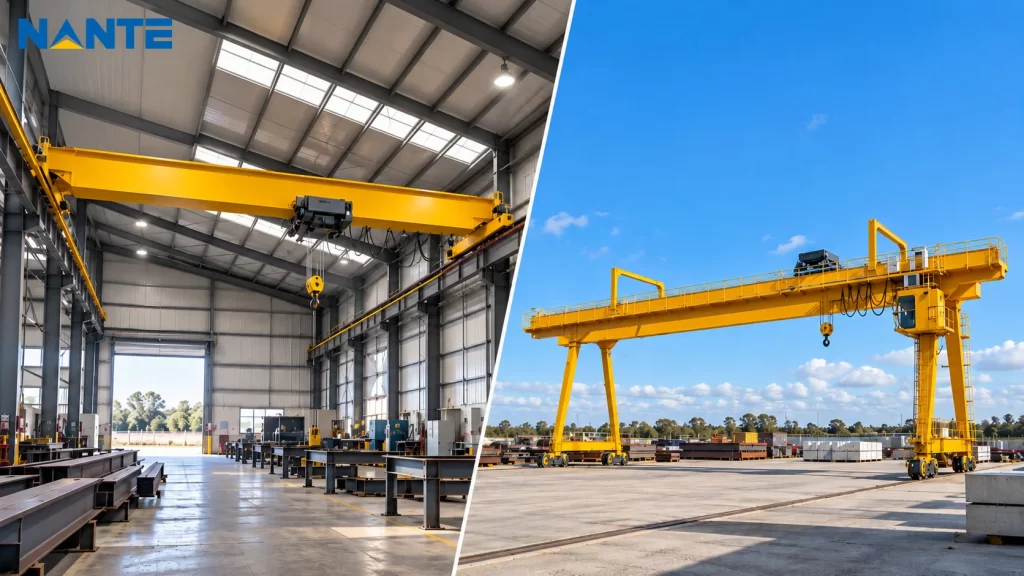
The choice in an overhead crane vs gantry crane comparison starts with the site. An overhead crane usually fits permanent, high-use lifting inside a suitable building. A gantry crane often works better when the building cannot carry crane loads, the work is outdoors, or relocation matters.
Choosing from equipment price alone can cause structural changes, restricted hook coverage, or installation delays. Buyers should compare the complete system, operating environment, and future production plans.
Overhead Crane vs Gantry Crane: Quick Comparison
Side-by-Side Decision Table
| Decision factor | Overhead crane | Gantry crane |
| Support structure | Bridge travels on elevated runways supported by the building or independent columns | Bridge is carried by legs that travel on ground-level rails or wheels |
| Building impact | Requires verification of runway beams, columns, bracing, clearances, and load paths | Reduces reliance on the roof structure but transfers loads to rails, pavement, or foundations |
| Installation | Runway alignment and building interfaces can be substantial | Leg assembly, ground travel system, rail or floor preparation, and stability controls are central |
| Initial cost drivers | Crane, runway, reinforcement, electrification, and installation | Crane, legs, rails or wheels, foundations, and installation |
| Mobility | Fixed to one runway bay | Fixed-rail, semi-gantry, portable, and rubber-tired arrangements may be available |
| Typical environment | Indoor production, warehouses, maintenance bays, and process lines | Outdoor yards, precast areas, stockyards, shipyards, and buildings unsuitable for elevated runways |
| Working area | Clear floor space and strong rectangular bay coverage | Legs occupy side zones; coverage can extend beyond a building or move between work areas |
| Main selection risk | Underestimating building and runway work | Underestimating ground, weather, travel path, and leg clearance |
This table is a screening tool. Capacity, span, lift height, duty class, load spectrum, travel distance, controls, and applicable regulations still need project-specific engineering.
Gantry Crane vs Bridge Crane: Structure and Runway Requirements
How an Overhead Bridge Crane Uses the Building
An overhead crane, also called a bridge crane, places the bridge above the work zone. The bridge runs along parallel elevated runway rails, while the trolley and hoist move across the bridge. This arrangement preserves valuable floor space and can provide consistent coverage across a production bay.
The building needs a verified load path for crane forces. A structural review should address runway beams, columns, brackets, bracing, rail connections, deflection, clearances, and inspection access. Visible rails or brackets do not prove that an existing warehouse is crane-ready.
Buyers evaluating overhead crane systems should provide building drawings and a structural assessment. A freestanding runway may be possible, but its columns and foundations become part of the installed scope.
How a Gantry Crane Carries Its Own Bridge
A gantry crane carries the bridge on legs traveling on rails, wheels, or a purpose-designed surface. The roof usually does not support the crane, making this arrangement practical for open yards or buildings that are difficult to strengthen.
“Self-supporting” does not mean “no civil work.” The project still needs verified bearing capacity, rail or foundation design, alignment, drainage, travel-path control, and protection against collision or derailment. A semi-gantry combines one elevated runway with one ground-supported leg.
Compare gantry crane configurations against the travel surface, clear width, side obstructions, and required outreach, not capacity alone.
Installation, Cost, and Mobility
Compare Installed Cost, Not Equipment Price
The lower crane quotation is not necessarily the lower-cost project. Overhead crane costs may include runway steel, reinforcement, surveying, power distribution, and shutdowns. Gantry projects may need rails, foundations, yard preparation, cable management, storm restraints, and controlled travel routes.
A comparable quotation should separate equipment, controls, structural or civil interfaces, documentation, testing, freight, erection, commissioning, training, spares, warranty, and exclusions. Lifecycle evaluation should include maintenance, downtime, and relocation. A crane total cost analysis helps frame these items beyond purchase price.
Mobility Is a Design Choice, Not a Default Feature
An overhead crane is tied to its runway. Relocating it is a significant project, but permanence is an advantage where production flow and lifting paths are stable.
A gantry can offer more relocation options, but rail-mounted units remain tied to a path. Portable or rubber-tired designs require suitable stability, steering, braking, floor quality, and controls. Specify whether “mobile” means occasional relocation, daily movement, or powered travel with a load.
Indoor Crane vs Outdoor Crane Applications
Indoor Operations Favor Clear Floors and Repeatable Flow
Indoors, an overhead crane preserves floor space because its supports are elevated. It can serve machines, assembly stations, storage, and loading positions without gantry legs crossing traffic routes.
A low roof, weak columns, congested utilities, or limited headroom may change the decision. A gantry can work indoors when the floor, travel path, and leg clearance suit production. Verified geometry matters more than the indoor label.
Outdoor Service Requires Environmental Engineering
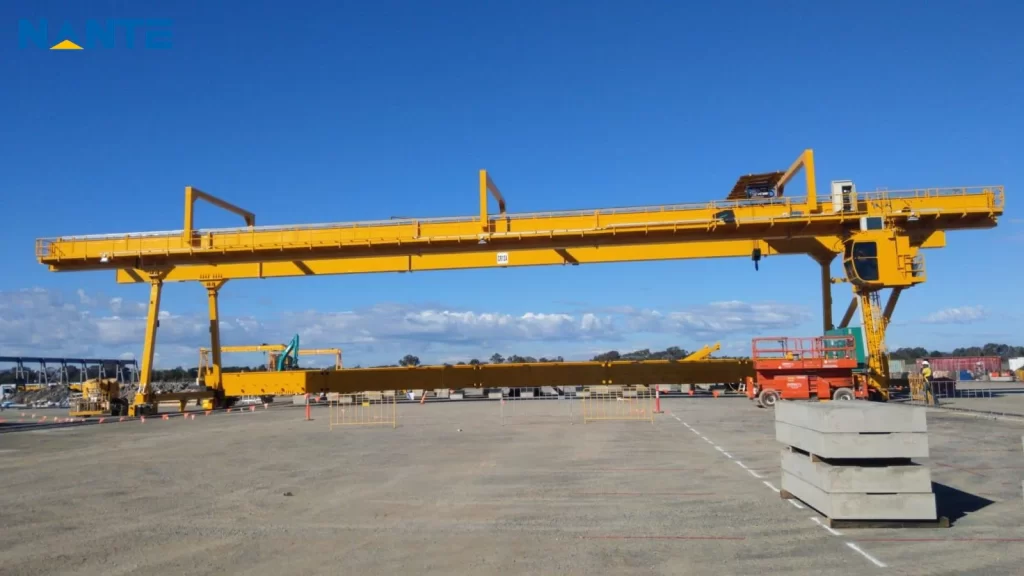
Outdoor yards often favor gantry cranes because no building runway is required. Weather exposure adds requirements for wind assessment, parking and anchoring, water and dust protection, corrosion control, drainage, temperature range, grounding review, and safe access.
At this stage, Nante Crane can be considered as one source for both categories, allowing buyers to request alternatives against the same inputs. Each proposal should document the destination, environment, applicable standards, and installation boundaries.
Working Area, Hook Coverage, and Site Logistics
Map the Required Hook Envelope
The useful working area is the space the hook can reach. Map pickup and drop-off points, load dimensions, obstructions, approach distances, hook height, maintenance zones, and required cantilever outreach.
An overhead crane gives rectangular bay coverage, but approaches, columns, and runway geometry create limits. A gantry may use cantilevers, but legs and wheel paths consume ground space. A layout drawing with the hook envelope marked is essential.
Check Traffic and Production Interfaces
Coordinate travel with vehicles, pedestrians, doors, utilities, process equipment, and emergency routes. A gantry adds ground-level wheel zones; an overhead crane adds building interfaces. Both need controlled lifting zones and maintenance access.
For brownfield projects, document shutdown windows, delivery access, assembly space, temporary supports, floor limits, and responsibility for site preparation.
Overhead Crane or Gantry Crane: A Practical Selection Method
Choose an Overhead Crane When
- The lifting process is permanent and concentrated within a building bay.
- Clear floor space and unobstructed traffic routes are priorities.
- The building or an independent runway can be engineered for crane loads.
- High-frequency, repeatable coverage across a defined area is required.
- Long-term production plans justify fixed runway infrastructure.
Choose a Gantry Crane When
- The work is outdoors or extends beyond an existing building.
- The roof structure cannot support an elevated crane runway.
- Relocation, cantilever outreach, or a temporary project phase has value.
- Civil work at ground level is more practical than building reinforcement.
- The site can safely accommodate legs, rails or wheels, power supply, and travel controls.
Use a Weighted Project Matrix
Weight structural feasibility, coverage, duty, environment, disruption, mobility, total cost, schedule, and expansion. Score both options using supplier drawings and site engineering; a failed structural or operational constraint is decisive.
The inquiry package should include capacity, span, lift height, duty, load spectrum, environment, power, controls, layout, travel distance, destination, installation scope, and standards. These inputs produce more comparable proposals.
How to Compare Supplier Proposals
Normalize the Technical and Commercial Scope
Use one compliance matrix for crane type, design basis, interfaces, runway or foundation responsibility, electrification, controls, documentation, testing, freight, erection, commissioning, training, spares, warranty, exclusions, and schedule assumptions.
Before manufacturing, approved calculations and drawings should define loads, dimensions, clearances, interfaces, power, controls, and access. Check certificate claims for legal entity, site, scope, issuer, validity, and expiry; a management-system certificate is not product compliance.
Verify Installation and Lifecycle Support
Clarify who surveys the site, checks alignment, supervises erection, commissions the crane, provides training, and resolves interface changes. Ask for manuals, spare parts, inspection points, wear limits, and warranty terms.
The strongest proposal connects the crane type to site evidence, identifies exclusions, and provides a traceable path from design review through acceptance and service.
Frequently Asked Questions
Is a Gantry Crane Cheaper Than an Overhead Crane?
Not automatically. A gantry may avoid building reinforcement, but it can require legs, rails, foundations, outdoor protection, and travel controls. Compare installed and lifecycle scope, not crane price alone.
Which Crane Is Better for a Workshop?
An overhead crane suits a permanent indoor bay with adequate structure. A gantry may be better when the building cannot carry crane loads, the layout may change, or work crosses indoor and outdoor areas.
Can a Gantry Crane Be Used Indoors?
Yes, provided the floor or rail system, clearances, traffic plan, power, and controls are suitable. Leg and wheel paths must not conflict with production.
Can an Overhead Crane Be Used Outdoors?
Yes, when the runway and crane are engineered for the outdoor environment. Weather protection, corrosion control, drainage, wind provisions, parking or anchoring, and maintenance access must be defined for the site.
Request a Project-Specific Crane Comparison
Project Inputs for a Technical Proposal
Plant engineers, contractors, and purchasing teams comparing these options should submit the site layout, capacity, span, lift height, duty and load pattern, environment, travel distance, power and control needs, destination, applicable standards, and expected installation scope. The engineering team can use those inputs to review feasibility and prepare an equipment recommendation with a project-specific technical and commercial proposal through the crane selection inquiry form.