English


How to Choose a Heavy Duty Overhead Crane for Heavy-Duty Applications
Date: 2026-11-06 Share:
A heavy duty overhead crane should be selected by its ability to sustain the intended production cycle, not simply its maximum lifting capacity. Load frequency, repeated starts, heat exposure, and maintenance conditions determine what the complete system must withstand.
For purchasing teams, the central question is practical: can the structure, hoist, motors, brakes, and cooling arrangements perform the required work together? A suitable proposal should connect each operating condition to a design requirement and evidence that can be reviewed before acceptance.
Define Heavy-Duty Conditions Before Requesting Quotations
Build a Representative Production Cycle
Start with a typical operating sequence: pick up the load, raise it, travel, position it, lower it, and return. Record the duration and distance of each movement, including waiting periods and repeated positioning adjustments.
Provide maximum and typical load weights, including lifting attachments. Describe how frequently the crane handles each load range rather than supplying only the heaviest lift.
This load spectrum helps distinguish occasional heavy lifting from repeated production service. Both can require substantial capacity, but they create different fatigue, wear, and thermal demands.
Record Environmental Exposure and Downtime Consequences
Document ambient temperature, localized radiant heat, dust, moisture, and corrosive exposure. Conditions at the hoist, brake, or electrical cabinet may differ from measurements taken elsewhere in the building.
Also identify whether crane downtime stops an entire production line. A production-critical application may justify additional condition monitoring, accessible replacement arrangements, or an agreed spare-parts package.
Describe expected future production separately. Suppliers should explain which requirements the proposed configuration satisfies and which increases would require reassessment.
Match a High Duty Crane to Its Actual Workload
Require Classification Assumptions, Not Just a Label
A high duty crane quotation should state the classification system, applicable edition, operating assumptions, and design life basis. “Heavy duty” alone provides too little information for technical comparison.
Request the basis for the crane structure and individual mechanisms. Hoisting, bridge travel, and trolley travel can experience different operating patterns within the same production cycle.
Where suppliers use different classification systems, require an engineering comparison against the common operating brief. Similar-looking designations should not be accepted as interchangeable without explanation.
Evaluate Cycle Capability Separately from Capacity
A higher rated capacity does not automatically provide greater tolerance for frequent starts, long operating periods, or repeated lowering. Those demands also depend on mechanism selection and thermal design.
Ask suppliers to confirm the proposed cycle at the stated loads, speeds, and environmental conditions. Any limitations on operating time or repeated movements should appear in the technical proposal.
For US general-industry installations, include applicable requirements from OSHA’s overhead and gantry crane standard in the project review. Duty classification is only one part of equipment selection, inspection, maintenance, and safe operation.
Assess Heavy Duty Crane Design for Repeated Loading
Check Fatigue Resistance and Structural Details
Heavy duty crane design must address accumulated loading throughout service. Static strength verification alone does not explain how welded details and connections will withstand repeated production cycles.
Request the structural calculation basis, fatigue assumptions, material specifications, and relevant load combinations. Ask how trolley movement, acceleration, braking, and the lifting attachment enter the assessment.
Manufacturing evidence should include agreed material traceability, welding procedures, dimensional checks, and inspection records. Inspection methods and acceptance criteria should be defined before production begins.
Verify the Runway Interface and Inspection Access
Obtain maximum wheel loads, wheel spacing, runway reactions, and clearance drawings. The building engineer should check the supporting structure against the proposed crane and its operating conditions.
Avoid treating a larger bridge as an automatic upgrade. Added crane weight can affect runway beams, columns, connections, and foundations.
Check access to structural inspection points, wheels, and rail fasteners. Maintenance platforms and safe access arrangements should support the planned inspection tasks without creating unresolved clearance conflicts.
Match Motors, Brakes, and Hoists as One System
Select Motors for Starts, Duration, and Speed Range
Motor selection should reflect the actual sequence of loaded running, acceleration, positioning, and rest. Request the applicable motor duty rating, thermal protection, and environmental limits.
Repeated starts and sustained low-speed operation deserve specific review. A motor that performs adequately during intermittent travel may require a different cooling arrangement for prolonged slow movement.
Variable-frequency drives can support controlled motion, but the motor, gearbox, drive, and brake must remain compatible. Ask suppliers to document operating limits and protective responses.
Review Brake Holding, Stopping, and Heat Dissipation
A brake needs sufficient holding capability and suitability for its assigned stopping duties. Repeated operation also requires consideration of heat, wear, adjustment, and inspection access.
Clarify which functions are performed electrically and which rely on mechanical brakes. Request an explanation of load behavior during power loss, emergency stopping, and relevant control faults.
Additional braking arrangements should follow the application risk assessment and applicable requirements. Brake quantity alone does not establish the safety or suitability of the complete hoisting system.
Compare Hoists by Mechanism Capability
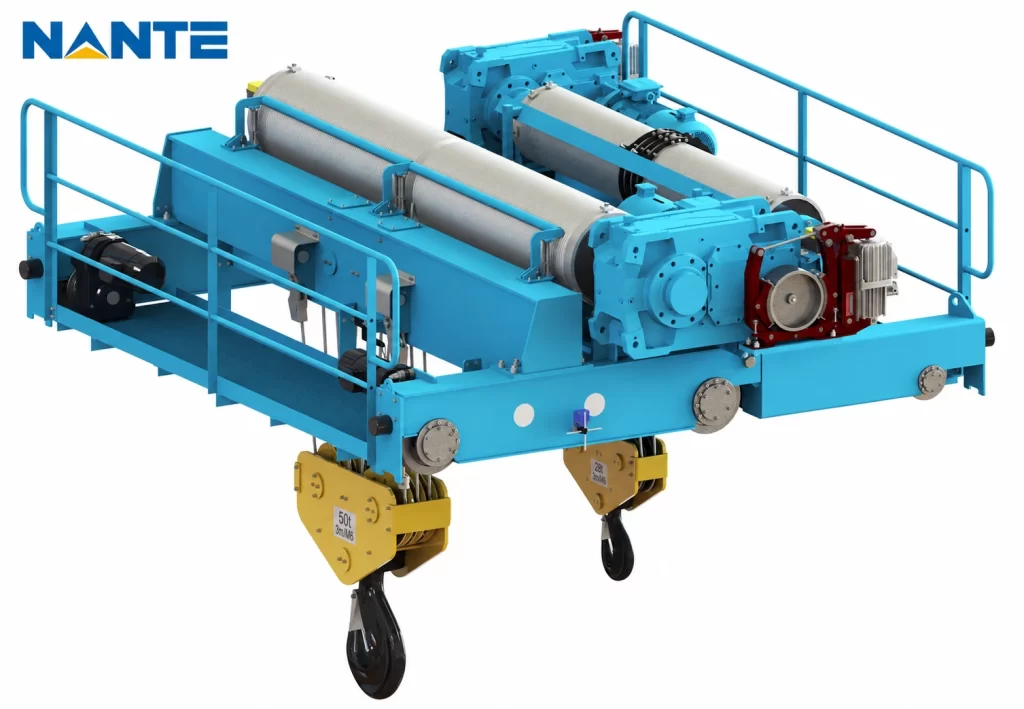
Evaluate the hoist using load spectrum, lifting distance, speed, reeving, positioning demands, and maintenance access. Confirm that the complete mechanism is suitable for the intended service.
Request information on rope inspection, drum and sheave access, gearbox lubrication, and component replacement. These details influence maintenance effort during sustained production.
Packaged hoists and open-winch arrangements should be compared against the same operating brief. Neither configuration should be selected solely because it is described as industrial or heavy duty.
Specify Cooling for the Actual Heat Sources
Separate Process Heat from Equipment Heat
Process heat comes from furnaces, hot products, and surrounding equipment. Motors, brakes, drives, and gearboxes also generate heat during operation.
The supplier should assess these sources together at the relevant equipment locations. A cabinet temperature assessment, for example, should consider internal electrical losses as well as external exposure.
Potential measures include shielding, ventilation, filtered cooling, or cabinet air conditioning. Their necessity and suitability should be established for the specific environment.
Make Cooling Maintainable and Verifiable
Ask how cooling performance will be checked during commissioning and monitored afterward. Identify filters, fans, alarms, and replacement items in the maintenance documentation.
Dust accumulation or restricted airflow can undermine an otherwise suitable arrangement. Access for cleaning and replacement should therefore form part of the design review.
At supplier evaluation, Nante Crane offers published overhead-crane and hoisting configurations for technical discussion. Application-specific duty and cooling suitability should be confirmed in the proposal rather than inferred from general product descriptions.
Translate Industrial Applications into Design Requirements
Define the Steel Mill Overhead Crane Process
A steel mill overhead crane handling coils faces different requirements from one transferring scrap or molten material. The process description must identify the load, attachment, temperature exposure, and operating sequence.
For molten-material handling, require a dedicated engineering and regulatory review. An ordinary workshop configuration should not be assumed suitable.
For other steel-handling tasks, specify concentrated heat exposure, attachment weight, frequent travel, and positioning requirements. These details help suppliers assess the relevant mechanism and environmental demands.
Distinguish Foundry, Machinery, and Shipbuilding Tasks
Foundry specifications should distinguish mold handling, casting transfer, and molten-material operations. Heat, abrasive dust, and access for cleaning may influence different components.
Machinery manufacturing often requires careful placement of heavy assemblies. Describe center-of-gravity variation, lifting points, turning operations, and auxiliary-hoist needs.
Shipbuilding workshops may handle large fabrications through restricted routes. Identify load dimensions, orientation changes, clearance limits, and any coordinated lifting requirement before choosing controls and hoisting arrangements.
Use a Heavy Lifting Crane Procurement Checklist
Connect Each Risk to Reviewable Evidence
A heavy lifting crane comparison becomes more useful when suppliers answer the same technical questions.
| Operating condition | Main concern | Evidence to request |
| Frequent loaded cycles | Accumulated fatigue | Classification basis and fatigue assumptions |
| Repeated starts or slow travel | Motor thermal suitability | Duty rating and cooling assessment |
| Frequent stopping or lowering | Brake heat and wear | Braking design basis and inspection requirements |
| Furnace or hot-product exposure | Local equipment temperature | Environmental limits and protective measures |
| Production-critical operation | Repair time and downtime | Maintenance access and spare-parts plan |
Normalize Scope Before Comparing Price
Compare equipment, controls, electrification, documents, testing, freight, installation, commissioning, training, warranty, and exclusions.
The published Double Girder Crane with Hoist provides a configuration reference, while the single-girder versus double-girder selection guide covers broader arrangement decisions.
For mechanism discussions, review the available Wire Rope Hoist and open-winch options. Require project-specific confirmation rather than assuming every listed option suits intensive service.
Frequently Asked Questions
Does a Larger Capacity Solve Heavy-Duty Requirements?
No. Capacity, fatigue capability, mechanism duty, braking, and thermal performance require separate verification against the operating cycle.
Can Cooling Upgrade an Underspecified Crane?
Cooling can address thermal conditions. It cannot replace adequate structural fatigue resistance, gearbox capability, rope selection, or braking design.
What Should Acceptance Testing Demonstrate?
The agreed plan should address functions, protective devices, controls, and specified performance. Clearly distinguish factory checks from tests requiring the installed crane and site conditions.
Request a Proposal Based on the Production Cycle
Submit the Operating Inputs for Technical Review
Purchasing teams should provide capacity, span, lifting height, load spectrum, cycle details, operating hours, temperature exposure, power supply, and workshop drawings. Include the destination and installation scope.
Nante Crane can review these inputs to recommend a configuration and prepare a project-specific technical proposal and quotation. Flag uncertain operating data when submitting a heavy-duty crane selection brief.