English


Crane Welding Standards: ISO Welding Standards and Quality Control for Crane Manufacturing
Date: 2026-07-24 Share:
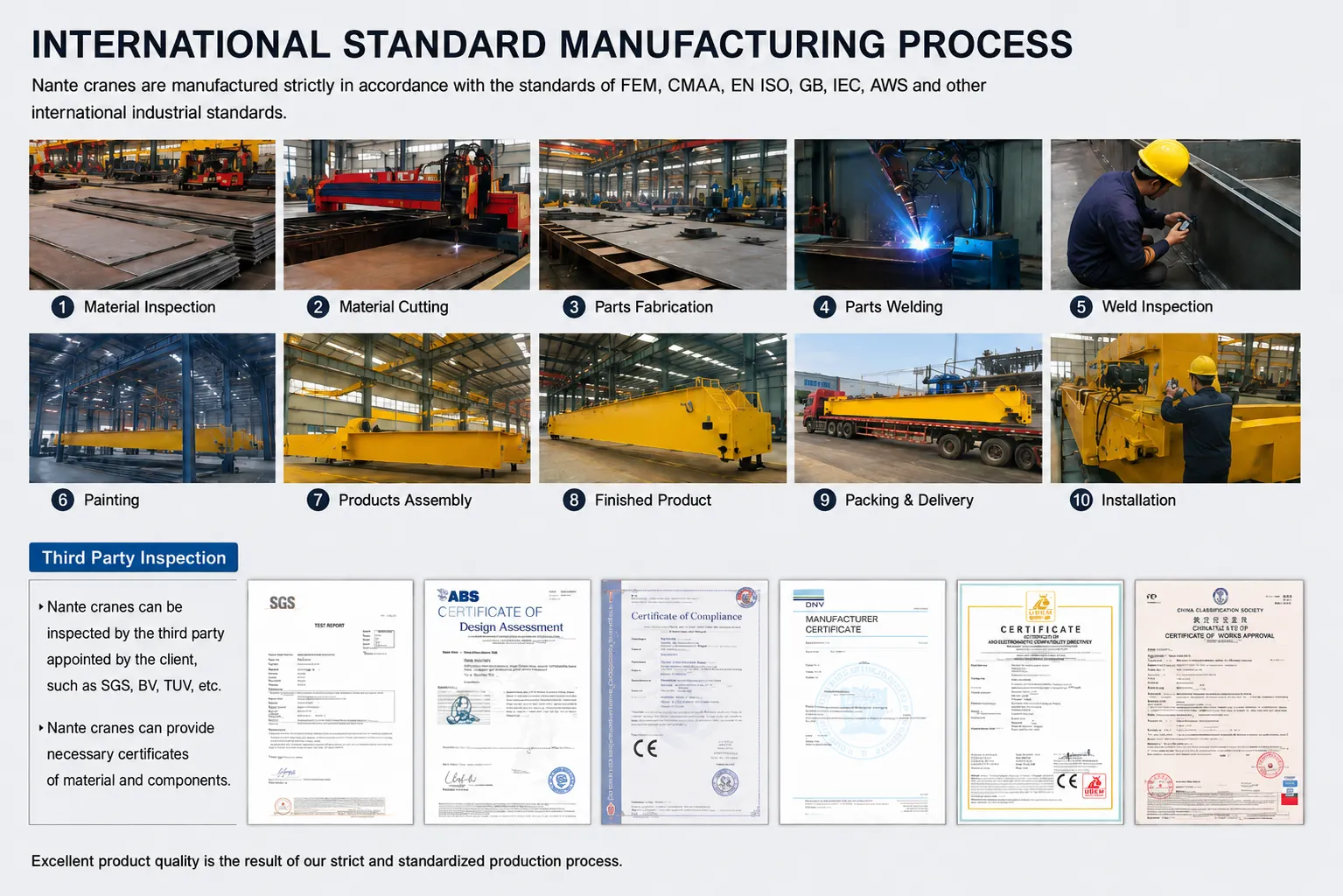
Crane Welding Standards are key to the manufacture of cranes that are safe, reliable and compliant with relevant regulations. Welded crane structures are subject to repeated loads, dynamic forces, vibration and fatigue and so must be subject to tight control throughout the welding quality process. The ISO welding standards, together with EN ISO 3834 welding quality requirements and ISO 9606 welder qualification for crane welding, provide a very practical means to control procedures, approve welders, inspect, record and finally accept a weld.
Why Crane Welding Standards Matter
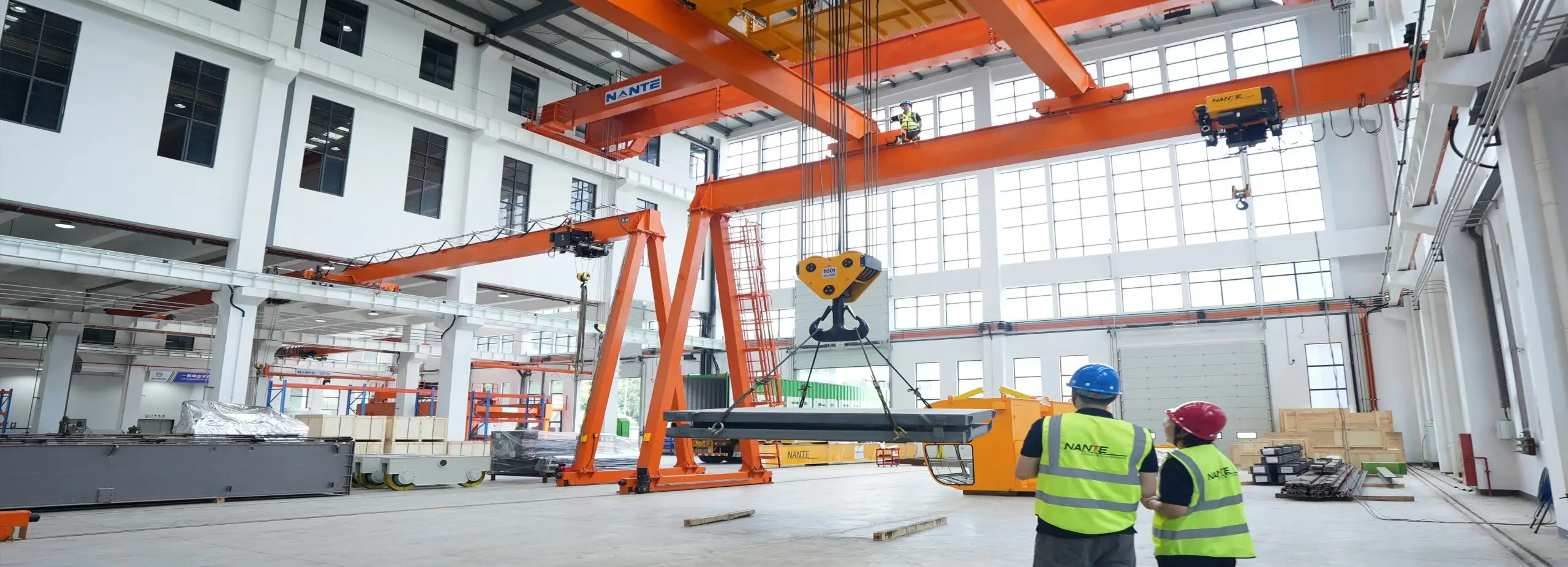
Cranes are safety-critical lifting systems. Welded parts such as main girders, end carriages, gantry legs, trolley frames, support brackets, and structural connections must perform under repeated lifting cycles and changing service conditions.
A weld defect is not only a production issue. It may reduce structural strength, create stress concentration, increase fatigue risk, or affect crane alignment. For this reason, welding quality should be controlled as part of the complete crane manufacturing system, not treated as a single workshop process.
Welding Quality and Compliance
Good compliance requires more than visual appearance. A crane manufacturer should be able to provide qualified welding procedures, qualified welders, material traceability, weld maps, inspection reports, repair records, and final quality documentation.
This is where ISO welding standards become valuable. They create a common technical language for buyers, manufacturers, inspectors, and project engineers.
Key ISO Welding Standards for Crane Manufacturing
EN ISO 3834 Welding Quality Requirements
EN ISO 3834 is a core standard series for fusion welding quality. ISO 3834-1 defines the general outline of the series and gives criteria for selecting the appropriate quality level for fusion welding of metallic materials. It applies to manufacturing in workshops and at field installation sites.
For crane manufacturing, EN ISO 3834 welding quality requirements help control:
- Contract and design review
- Welding procedure control
- Welder qualification
- Material and consumable control
- Inspection and testing
- Repair management
- Quality records
The standard series includes different quality levels. ISO 3834-2 covers comprehensive quality requirements, ISO 3834-3 covers standard quality requirements, and ISO 3834-4 covers elementary quality requirements. ISO 3834-5 identifies the documents needed to claim conformity to ISO 3834-2, ISO 3834-3, or ISO 3834-4.
ISO 9606 Welder Qualification for Crane Welding
ISO 9606-1 specifies qualification testing requirements for welders performing fusion welding of steels. It provides technical rules so welder qualification can be accepted systematically across product types, locations, examiners, and examining bodies.
For crane welding, welder qualification should match the real production conditions. Buyers should check whether each welder certificate covers the required welding process, base material, filler material, thickness range, weld type, and welding position.
A practical review should include:
- Valid welder qualification certificates.
- Welding process and material coverage.
- Welding position coverage.
- Continuity or renewal records.
- Traceability between welders and weld maps.
ISO 15614 Welding Procedure Qualification
ISO 15614-1 specifies how a preliminary welding procedure specification is qualified by welding procedure tests.
In crane manufacturing, welding procedure qualification helps ensure that the approved welding parameters can produce reliable welds before they are used in production. A typical workflow includes preparing a preliminary welding procedure specification, welding a test piece, testing the result, issuing the qualification record, and releasing the approved welding procedure for production.
ISO 14731 Welding Coordination
ISO 14731 identifies essential welding quality tasks and responsibilities for welding coordination. It also states that welding coordination personnel should be competent for the welding-related tasks assigned to them.
In crane manufacturing, welding coordination connects engineering, production, and quality control. The welding coordinator may control procedure approval, welder qualification, consumables, inspection planning, repair procedures, and final release.
Welding Quality Control in Crane Fabrication
Before Welding
Before welding starts, drawings, weld symbols, material certificates, joint preparation, and fit-up should be reviewed. The welding procedure specification should be available at the workstation.
Important checks include:
- Base material verification
- Groove and joint preparation
- Tack weld quality
- Preheating requirements
- Fixture and distortion control
- Consumable storage
During Welding
During welding quality depends on the right parameters and good workmanship. This can be controlled by monitoring the heat input, interpass temperature, the welding sequence, the cleaning of weld contacts between individual passes and the deformation.
For crane girders and long structural members, distortion control is especially important. Poor welding sequence can affect girder straightness, camber, rail alignment, wheel load distribution, and final crane travel performance.
After Welding
After welding a weld check has to be performed to verify that the weld in question is within the required acceptance level. In case of any defects these have to be repaired with the help of an approved repair procedure and have to be checked again after the repair before being put into operation.
Traceability is critical. Each weld should be linked to its drawing, weld ID, welder ID, welding procedure, inspection result, repair record, and final acceptance status.
Weld Inspection and Acceptance Standards
ISO 5817 Weld Imperfection Quality Levels
ISO 5817 provides quality levels for imperfections in fusion-welded joints in steel, nickel, titanium, and their alloys. It applies to material thickness of at least 0.5 mm and covers fully penetrated butt welds and fillet welds.
The common quality levels are:
- Level B:stringent quality level
- Level C:intermediate quality level
- Level D:moderate quality level
For crane welds, the selected level should depend on design requirements, weld category, fatigue exposure, inspection scope, and contract specification.
ISO 17635 Non-Destructive Testing
ISO 17635 gives guidelines for selecting non-destructive testing methods for welds and evaluating results for quality control. It considers quality requirements, material, weld thickness, welding process, and testing extent.
Common inspection methods for crane welding may include visual testing, ultrasonic testing, magnetic particle testing, penetrant testing, and radiographic testing where required.
Crane Standards That Support Welding Compliance
Welding standards control fabrication quality, while crane standards define the structural conditions that welded joints must withstand.
ISO 4301-1 establishes crane and mechanism classification based on service conditions, including working cycles, load spectrum factor, and average displacements.
ISO 8686-1 provides methods for calculating loads and selecting load combinations for proof of competence of crane structural and mechanical components.
Together, these standards help identify which welded areas are critical and how welding quality should be controlled.
Crane Welding Documentation Checklist
A complete welding quality file for crane manufacturing should include:
- Welding quality plan or EN ISO 3834 procedure.
- Welding procedure specifications.
- Welding procedure qualification records.
- ISO 9606 welder qualification certificates.
- Welding coordinator responsibility records.
- Material and consumable certificates.
- Weld maps and traceability records.
- Visual inspection reports.
- Non-destructive testing reports.
- Repair and re-inspection records.
- Final welding quality dossier.
How Buyers Can Evaluate Crane Welding Standards Compliance
Questions to Ask a Crane Manufacturer
Buyers should ask:
- Which ISO welding standards are applied?
- Which EN ISO 3834 quality level is used?
- Are welders qualified according to ISO 9606?
- Are welding procedures qualified according to ISO 15614?
- Which ISO 5817 quality level is required?
- Which welds receive inspection or NDT?
- Is a final quality dossier provided?
Common Red Flags
Warning signs include missing welder certificates, unclear welding procedures, no weld maps, vague inspection plans, unapproved repairs, and incomplete final documentation.
FAQ
What are the most important ISO welding standards for crane manufacturing?
The most important standards include ISO 3834 for welding quality, ISO 9606 for welder qualification, ISO 15614 for welding procedure qualification, ISO 14731 for welding coordination, ISO 5817 for weld imperfection quality levels, and ISO 17635 for NDT planning.
What is the difference between ISO 9606 and ISO 15614?
ISO 9606 qualifies the welder. ISO 15614 qualifies the welding procedure. Both are needed because a qualified welder should use an approved procedure to produce compliant crane welds.
Which ISO 5817 quality level should be used for crane welds?
The correct level should be defined by the design, weld category, fatigue requirement, project specification, and inspection plan.
Nante Crane is a crane and crane components designer and manufacturer offering overhead cranes, gantry cranes, construction cranes, workstation and offshore cranes, electric hoists, crane travelling units, mobile power supply systems, crane control panels, and related crane components. Nante Crane states that it designs and manufactures lifting equipment based on international standards and has built a reliable quality management system for global crane projects. Contact Nante Crane to discuss a compliant lifting solution for your application.