English



CE Certification for Cranes: Industrial Crane Compliance Requirements
CE Certification for Cranes: Industrial Crane Compliance Requirements
Date: 2026-07-30 Share:
CE certification of Crane is a requirement for manufacturers, importers, and integrators putting lifting devices into the market of the European Economic Area. A typical project usually includes CE marking of industrial cranes under Machinery Directive in combination with risk assessment, engineering verification, testing, technical documentation, and proper CE marking. In case of overhead lifting devices, compliance with EN 15011 is typically an integral part of the technical approach. Nonetheless, use of one standard or purchase of CE marked products does not mean that the entire crane is CE compliant.
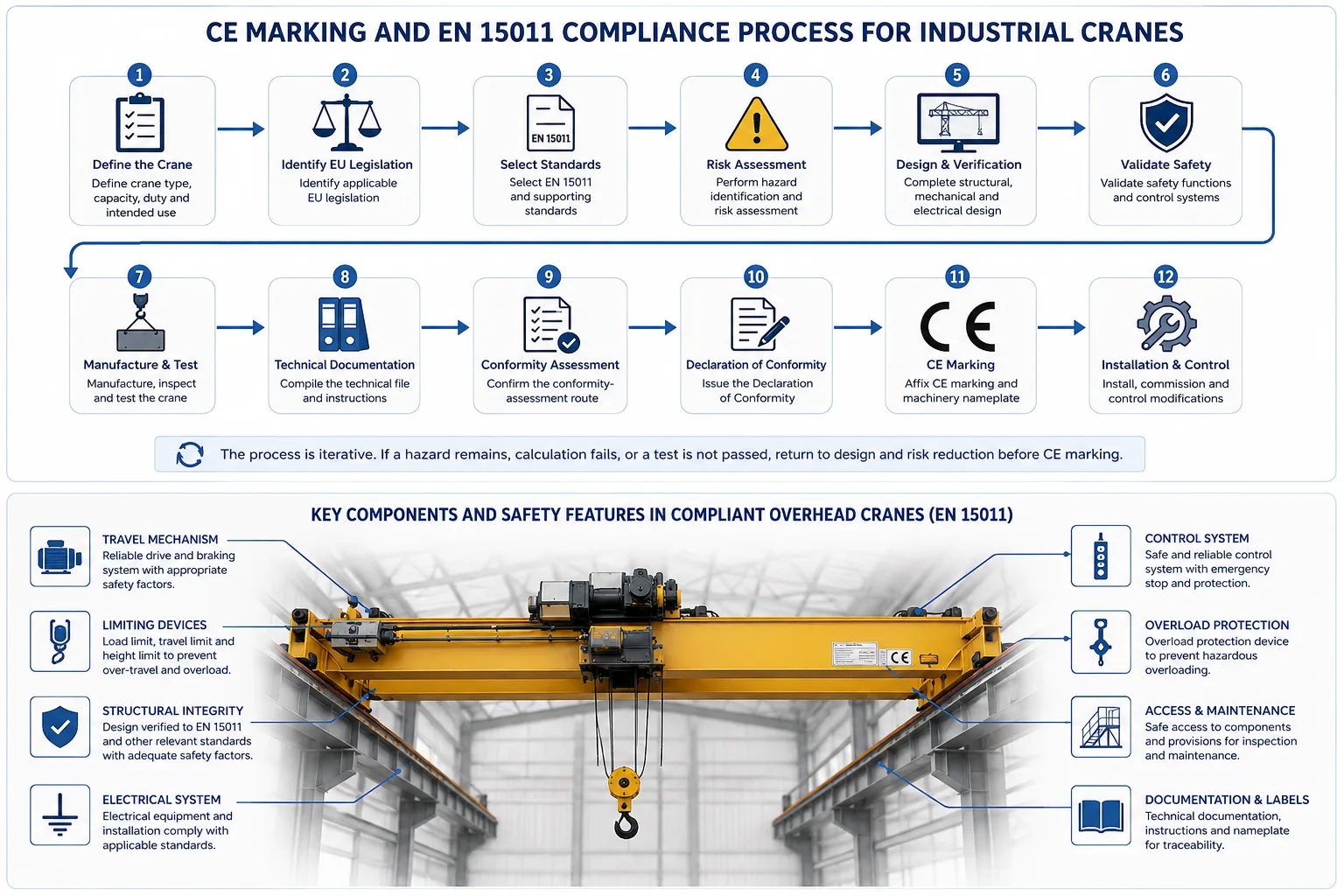
What Does CE Certification for Cranes Mean?
“CE certification” is a widely used search term, but CE marking is not a general quality award or approval issued automatically by an EU authority. By placing this stamp, the manufacturer guarantees that the crane meets all relevant EU legal regulations.
It is the duty of the manufacturer to ensure the process of conformity assessment, technical file creation, Declaration of Conformity and CE marking. The importer and distributor also need to ensure compliance with this equipment and documentation.
Complete Cranes, Components, and Partly Completed Machinery
The compliance route depends on what is supplied. A complete crane capable of performing its intended lifting function normally requires a Declaration of Conformity and CE marking.
A hoist, travel mechanism, control panel, or subsystem may have separate documentation. Nevertheless, the final crane assembler must assess how structures, mechanisms, electrical systems, controls, and safety devices interact. Component documentation cannot replace conformity assessment of the complete machine. EU guidance confirms that manufacturers remain responsible for the entire product, including systems and components supplied by other parties.
Machinery Directive CE Marking Process for Industrial Cranes
All industrial cranes introduced into the EU market before 20 January 2027 have to conform to Directive 2006/42/EC of Machinery. This directive integrates the mandatory Essential Health and Safety Requirements with harmonized optional standards which offer proven solutions to hazards.
The regulation (EU) 2023/1230 of Machinery will become mandatory as of 20 January 2027. Projects with long-term duration need to set out the market entry deadline in advance. The regulation incorporates the conformity assessment scheme and introduces the aspect of safety-related software, cybersecurity, higher risk machinery, and digital instructions.
EN 15011 Compliance for Bridge and Gantry Cranes
EN 15011:2020 is listed as a harmonised standard for bridge and gantry cranes under the Machinery Directive. As a Type-C standard, it provides machinery-specific safety requirements for crane categories within its scope.
Using a harmonised standard is voluntary. Correct application can create a presumption of conformity for the Essential Health and Safety Requirements it covers. Requirements outside its scope must still be evaluated through risk assessment and other relevant standards.
Supporting standards may address general crane design, electrical equipment, controls, limiting devices, access systems, powered hoists, and safety-related control systems. The project team should record each selected standard, edition, applicable subject, calculation, test, and required document in a standards matrix.
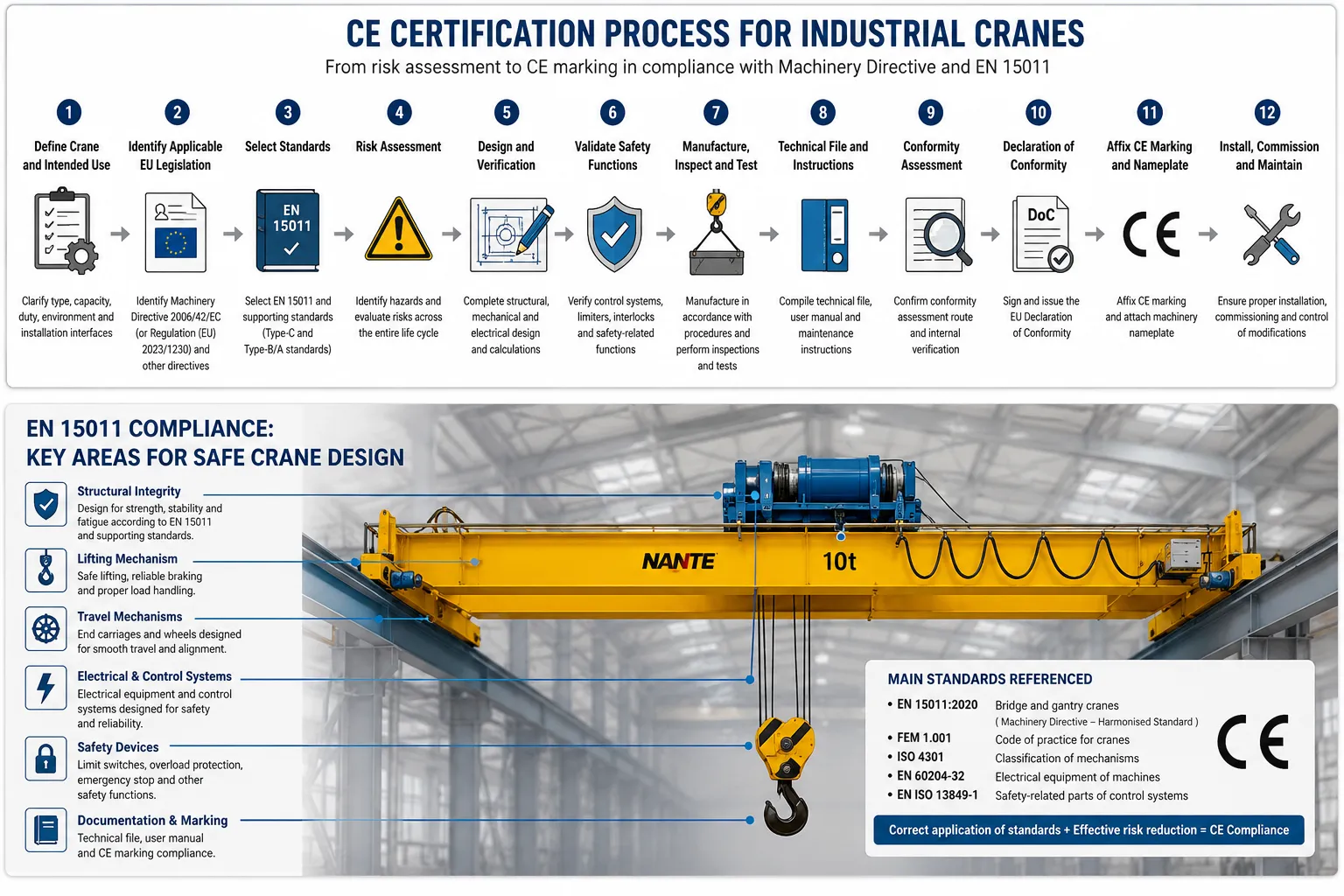
Step-by-Step Crane Compliance Procedure
1. Define the Crane and Its Intended Use
Document details of cranes, including type, rated capacity, span, lifting height, speed, duty, environment, control, load, and installation interfaces.
The intended-use statement must also include misuse that can reasonably be expected to occur, for example, side pulling, overloading, maintenance access, multiple motions at the same time, exposure to wind, special environmental conditions, etc. Clear limits need to be specified for calculations and for warnings.
2. Complete Risk Assessment and Design Verification
Risk analysis must take into account transport, assembly, installation, commissioning, operation, inspection, maintenance, troubleshooting, dismantling, and disposal.
Some common risks are load drop, structure failure, overspeed, unintended motion, collision, crushing, electrical shock, access problems, control failure, and lack of visibility.
Risk reduction should follow this order:
- Eliminate hazards through inherently safe design.
- Apply guards, limiting devices, interlocks, and safety functions.
- Provide warnings and information about residual risks.
Engineering evidence may include structural and fatigue calculations, mechanism selection, motor and brake sizing, wheel loads, rope selection, overload protection, buffers, limit switches, electrical diagrams, and safety-control validation.
3. Test and Validate the Crane
Inspection and testing must use defined acceptance criteria. The programme may include material and welding records, dimensional checks, electrical safety tests, emergency-stop verification, brake tests, travel and hoisting limits, overload protection, interlocks, alarms, and loss-of-power behaviour.
Functional testing should cover no-load operation, rated-load operation, required static or dynamic tests, simultaneous motions, anti-collision functions where fitted, and foreseeable faults.
Factory testing does not remove the need for site verification. After installation, check the runway, power supply, clearances, interfaces, movement directions, safety devices, and commissioning results.
4. Prepare Documentation and Apply CE Marking
The technical file should demonstrate how the crane meets applicable requirements. It normally contains:
- General description and intended-use statement
- Structural, electrical, and control drawings
- Design calculations and component specifications
- Risk assessment and Essential Requirements checklist
- Standards and legislation matrices
- Manufacturing, inspection, and test records
- Safety-function validation
- Installation, operation, and maintenance instructions
- Signed Declaration of Conformity
Under the Machinery Directive, the relevant technical file must generally remain available for at least ten years after manufacture, or after the last unit in series production.
The declaration should state manufacturer, crane, model/serial number, applicable laws, norms, Technical File approved representative, date and signature. The CE mark must be visible, legible, and indelible. The nameplate must match the delivered crane and documentation.
Common Crane Compliance Mistakes
Avoid these recurring problems:
- Treating CE marking as a certificate that can be purchased
- Applying EN 15011 without checking crane scope
- Using outdated standard editions or harmonised-standard lists
- Assuming CE-marked components guarantee complete compliance
- Completing risk assessment only after manufacturing
- Failing to validate safety-related controls
- Using generic manuals that do not match the crane
- Allowing modifications without a new compliance review
- Affixing the CE mark before nonconformities are closed
The European Commission specifically warns that voluntary certificates are not a recognised substitute for the conformity-assessment procedure required by EU legislation.
FAQ
Is a Notified Body Always Required?
No. Whether or not a notified body must be involved for conformity assessment depends on the machinery group, design, applicable regulation, and assessment method chosen. The manufacturer needs to explain why there is a need for the notified body or not. If self-assessment is allowed under the applicable regulation, then a notified body is not needed.
Is EN 15011 Relevant to All Industrial Cranes?
Not really. The standard EN 15011 only concerns itself with the bridge and gantry cranes. There are other types of cranes that require specific machinery standards.
What Happens to Projects Delivered After 20 January 2027?
Machinery placed on the EU market from that date must follow Machinery Regulation (EU) 2023/1230. Projects crossing the transition date should complete a documented gap analysis rather than merely changing the legislation number.
Plan Your Compliant Crane Project with Nante Crane
Nante Crane designs and manufactures overhead cranes, gantry cranes, construction lifting equipment, workstation and offshore cranes, electric hoists, travelling mechanisms, mobile power systems, and crane control panels. Its control solutions include hoisting, long-travel, and whole-crane panels, with options for automation, anti-sway functions, data logging, and connected operation. Contact Nante Crane to discuss operating conditions, technical specifications, control architecture, testing, and project documentation before finalising your crane configuration.