English


How to Evaluate a Crane Manufacturer’s Manufacturing Capability
How to Evaluate a Crane Manufacturer's Manufacturing Capability
Date: 2026-09-18 Share:
Manufacturing capability is evidence that a crane supplier can turn an approved design into a safe, repeatable and documented product. The question is not whether a factory looks large in a brochure, but whether it has the people, equipment, controls and testing discipline to deliver the specified crane.
Follow the product through incoming steel, cutting, machining, welding, painting, assembly, inspection and testing. This reveals bottlenecks and documentation gaps before they become field delays or rework.
Why Crane Manufacturer Capability Matters in Procurement
Translate the project brief into factory evidence
Start with the duty cycle and interfaces, not a generic capacity range. List rated load, span, lift and travel speeds, lifting height, operating hours, load spectrum, temperature, dust or corrosive exposure, power supply, control method and applicable standards. Each input should map to an output the factory can show: calculations, drawings, material certificates, weld procedures, inspection records or test results.
For example, a heavy-duty bridge crane may need different plate preparation, weld sequencing, drives and inspection hold points than a light-duty workstation crane. Clarifying these details before quoting indicates engineering discipline.
Separate crane manufacturing capacity from sales claims
Crane manufacturing capacity includes floor and storage space, qualified labor, machine capacity, production hours, subcontractor dependence and concurrent projects. An annual tonnage figure cannot describe all of them. Ask what is in-house, what is outsourced, how work is scheduled and how competing orders are controlled.
Assess capacity against the actual bill of materials and delivery sequence. Request a plan showing work centers, dates, inspection gates and critical-path items.
Evaluate Crane Factory Capability and Production Flow
Inspect factory size, layout and material movement
Factory size matters when it supports safe material handling and controlled workflow. During a visit or live video audit, look for receiving and quarantine areas, covered steel storage, calibrated measuring stations, welding bays, paint rooms, assembly zones and dispatch space. Clear aisles and lifting plans matter for large members.
Trace one component from receipt to shipment. Check heat-number identity after cutting, status tags on assemblies and physical separation of nonconforming items. Photos and time-stamped videos help when an in-person visit is impossible. A verified Crane Factory profile is only a starting point; current, product-relevant proof is still required.
Check crane production capability and bottlenecks
Production lines should reflect the crane type and order mix. Request the routing sheet and identify the constraint: plate cutting, beam welding, gear machining, paint cure time, panel build or final test. A current Manufacturing Process video can supplement the audit, while the supplier should explain how the constraint is protected across projects.
Review maintenance logs, spare-machine arrangements and operator coverage. Visible work-in-process limits and released drawings are stronger evidence of crane production capability than a busy-looking line.
Examine Production Equipment and Special Processes
Review steel preparation and machining
Steel preparation affects geometry and fatigue performance. Confirm identification, cutting, edge preparation and dimensional checks. For drums, sheaves, wheels, pins and gear interfaces, ask for machine capacity, gauges and revision-linked measurements.
Equipment lists should show availability, working envelope, accuracy, maintenance and operator qualification. A qualified partner is acceptable when the subcontractor, specification, inspection responsibility and traceability are documented. The Production Equipment category shows systems a manufacturer may integrate, but equipment-specific verification remains necessary.
Audit welding facilities and procedure control
Welding is a central indicator of crane manufacturer capability. Inspect fit-up fixtures, positioners, consumable storage, preheat equipment and ventilation. Request welding procedures, welder qualifications, material traceability and inspection plans.
Confirm revision control, welder assignment, repair records and re-inspection. NDT reports should identify the weld, inspector, equipment and acceptance criteria. The same drawing and procedure should produce comparable results across projects.

Verify blasting, painting and corrosion protection
Painting capability is more than color selection. Review blasting, surface-profile measurement, climate monitoring, paint mixing, stripe coats, recoat intervals and dry-film gauges. Link the system to the environment and coating data sheets.
Request batch numbers, environmental readings, inspection results and touch-up records. For outdoor or corrosive environments, confirm packing protection. Missing coating records indicate undocumented corrosion risk.
Verify Assembly, Commissioning and Testing
Observe mechanical and electrical assembly
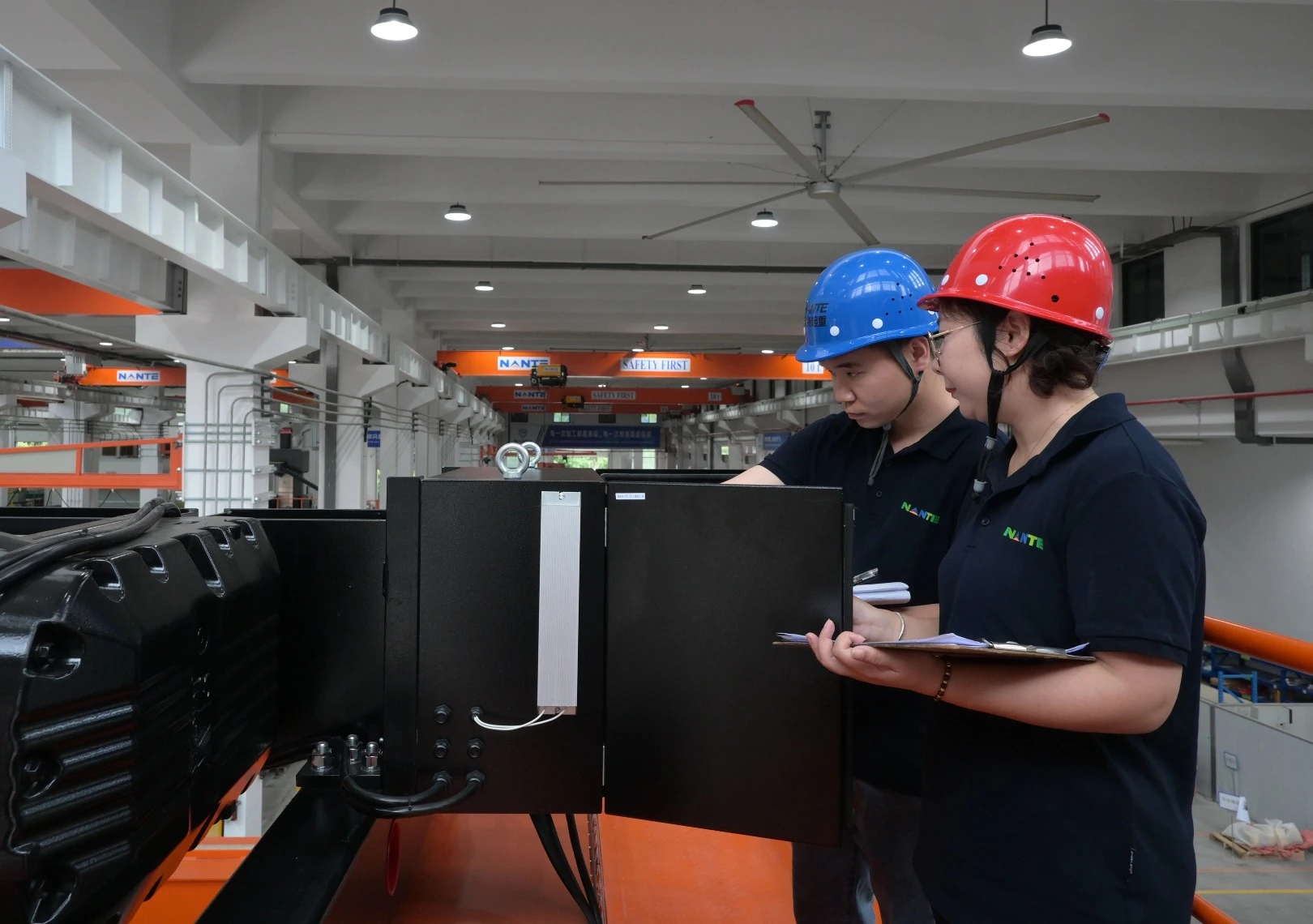
Assembly shows whether design intent survives production. Check girder alignment jigs, wheelbase measurement, brakes, gearboxes, rope reeving, bolted joints and cable routing. Panels should follow released schematics with labeled terminals and insulation or continuity checks.
Ask how discrepancies are logged and deviations authorized. Confirm hoists, motors, drives and safety devices against the approved bill of materials. A controlled checklist turns individual experience into repeatable release.
Require a documented test plan and FAT
Agree testing before fabrication. The inspection and test plan should define dimensional, no-load, limit-switch, emergency-stop, brake, alignment and electrical checks, plus rated-load tests where required. Acceptance criteria, instruments, calibration and witness points must be clear.
A customer- or third-party-witnessed Factory Acceptance Test (FAT) provides confirmation before packing. The dossier should include signed results, calibration references, punch-list closure and approved deviations. FAT does not replace site commissioning.
Audit Quality Documentation and Traceability
Build a quality-control evidence pack
A credible quality-control system connects each requirement to a record. Request an index covering calculations, drawings, material certificates, welding and NDT records, paint inspection, purchased-component certificates, calibration, FAT results and packing lists.
Check revision control, retention, readable names and dates, equipment IDs and project or serial references. The Quality Control page identifies service channels, but project-specific records remain necessary.
Check standards and certificate scope
Confirm the legal entity, site, issuer, scope, standard edition, validity and expiry. A management-system certificate describes process management; it does not alone prove product compliance.
Identify standards for design, fabrication, electrical equipment, lifting components and inspection in the destination country. Define third-party review deliverables and hold points in the purchase order.
Compare Capability Against Project Risk
Normalize quotation scope before comparing price
Use identical matrix headings: structure, hoist, controls, interfaces, engineering documents, testing, packing, freight, installation, commissioning, training, spares, warranty, exclusions and changes. Record assumptions; a lower price may omit inspection, documents or site support.
Compare equivalent configurations. A double-girder overhead crane needs the same duty group, hook approach, controls, environmental protection and maintenance access. Choosing a crane duty group helps align load spectrum before final offers.
Use a focused factory-audit question set
Ask for evidence, not assurances:
- Which operations are in-house, and which are subcontracted?
- What is the current loading of each critical machine and test bay?
- How are drawing revisions, material heat numbers and weld repairs controlled?
- Which inspections are hold points, and who may release them?
- What happens when a test fails or a supplier component changes?
- Which records will be delivered with the crane, and in what format?
Score evidence quality, ownership and project relevance. A workshop video is context; signed records and traceable samples are stronger proof.
What Verified Evidence Looks Like from Nante Crane
Review public capability statements critically
Its company profile says Nante Crane designs and manufactures industrial, offshore, construction, workstation and component products. It describes international-standard design, WPRQ and welder certificates based on EN ISO and AWS, NACE Level-II painting and NDT inspection credentials, and third-party-witnessed FAT capability.
These are starting evidence, not approval. Ask for certificate scope, named personnel, procedure numbers, sample reports and confirmation that site and legal entity match the quotation. Confirm coverage of load spectrum, environment, interfaces and destination requirements.
Convert evidence into contract deliverables
Put agreed evidence into the purchase order: drawing dates, inspection and test plan, material and weld records, paint reports, FAT protocol, spares, manuals and final dossier. Assign approval and witness responsibilities.
Crane Manufacturing Capability FAQ
How does factory size affect supplier selection?
Size matters when it supports workflow, storage, lifting access, skilled labor and test space. A smaller specialist can suit a project if capacity, subcontractor controls and records match it. A large site can still lack traceability or inspection control.
What production records should a buyer request?
Request drawings, calculations, material certificates, welding qualifications, dimensional and NDT reports, paint records, calibration references, purchased-component certificates, FAT results, punch-list closure and the data-book index. The contract and destination rules determine the final list.
Is third-party FAT always necessary?
Not for every crane. An independent witness is valuable when load, duty cycle, environment, regulatory exposure or project consequence is high. Write the risk-based decision into the inspection and test plan.
Request a Capability-Based Quotation
Submit the inputs that drive manufacturing decisions
Provide capacity, span, lift height, duty class or load spectrum, speeds, operating hours, environment, power and controls, applicable standards, layout, delivery destination, installation scope and documentation requirements. Include interface and third-party inspection expectations.
With those inputs, Nante Crane can review the application and prepare a project-specific technical response covering equipment scope, documents and testing points. Send the brief and quotation questions through Contact Nante Crane.