English



Overhead Crane Capacity Calculation: How to Calculate Crane Capacity
Date: 2026-08-20 Share:
An overhead crane capacity calculation should start with the maximum total load suspended from the crane hook—not simply the weight of the material being moved. A reliable overhead crane load capacity calculation must include the payload, lifting beam, spreader, grab, sling, shackles, and other below-the-hook equipment. A complete crane lifting capacity calculation should also consider load spectrum, operating frequency, duty requirements, lifting height, span, environment, and future production needs.
Understanding these factors helps engineers select an appropriate crane rated capacity without confusing actual operating load with structural design factors.
What Does Crane Rated Capacity Mean?
The first step is to understand what the crane’s stated capacity actually represents.
Under U.S. OSHA requirements, rated load means the maximum load for which a crane or individual hoist is designed and built by the manufacturer and shown on the equipment nameplate. OSHA separately defines the load as the total superimposed weight on the load block or hook.
Crane Rated Capacity vs. Actual Operating Load
Crane rated capacity is the approved maximum capacity marked on the crane or hoist.
Actual operating load is the total load imposed on the hook during a particular lifting operation.
In simple terms:
Actual Suspended Load ≤ Crane Rated Capacity
For example, a crane rated for 10 tons does not necessarily have 10 tons of usable capacity available for the workpiece. If a 0.8-ton lifting beam and rigging system is suspended below the hook, those components consume part of the crane’s rated capacity.
OSHA states that an overhead crane must not be loaded beyond its rated load except for permitted testing purposes.
What Is the Maximum Crane Load?
The maximum crane load during normal operation is limited by the marked crane rated capacity and any application-specific restrictions.
If a crane has multiple hoists, each hoist may also have its own rated load. OSHA requires the crane rating to be marked and requires individual ratings for multiple hoisting units.
Therefore, engineers should never calculate allowable payload simply by looking at the workpiece weight.
Overhead Crane Load Capacity Calculation: What Weight Should Be Included?
The practical calculation begins by identifying everything that will be suspended from the crane hook.
Maximum Payload
Determine the heaviest workpiece or material the crane must handle.
Use the maximum expected weight, not:
- Average production weight
- Typical batch weight
- The most common daily load
- Current product weight if heavier products are planned
For tanks, containers, molds, coils, machinery, or process equipment, include any contents or tooling that will remain attached during lifting.
Lifting Devices and Rigging
Below-the-hook equipment can significantly reduce the payload available from the crane.
Typical items include:
- Lifting or spreader beams
- C-hooks
- Grabs
- Magnets
- Tongs
- Special fixtures
- Slings
- Shackles
- Master links and connectors
Because OSHA defines the load as the total superimposed weight on the hook or load block, detachable lifting devices suspended from the hook must be considered when establishing the actual suspended load.
Sling capacity must also be checked separately. Sling angle can increase tension in individual sling legs even though the total gravitational weight being lifted has not increased. OSHA guidance therefore considers loading angle, hitch configuration, material strength, and other factors when determining sling rated loads.
Crane Lifting Capacity Calculation: Step-by-Step Formula
For preliminary crane capacity selection, the calculation can be expressed as:
Maximum Suspended Load = Payload + Lifting Device + Rigging + Other Suspended Equipment
Or:
Wₛ = Wₚ + Wᵦ + Wᵣ + Wₐ
Where:
- Wₛ= maximum suspended operating load
- Wₚ= maximum payload
- Wᵦ= below-the-hook lifting device weight
- Wᵣ= sling and rigging weight
- Wₐ= other suspended equipment
Then:
Required Crane Rated Capacity ≥ Maximum Suspended Load
Calculate Capacity Utilization
Engineers can also calculate how closely a lift approaches the crane rating:
Capacity Utilization (%) = Suspended Load ÷ Rated Capacity × 100
This figure is useful for understanding operating load level, but it does not replace crane duty classification, fatigue analysis, or structural design calculations.
Consider Future Capacity Requirements
Before selecting the final rating, consider whether future production could introduce:
- Heavier products
- Larger batches
- Heavier fixtures
- New lifting beams
- Different material-handling processes
- Automated lifting systems
Extra capacity may be selected deliberately for future production flexibility. However, this must not be interpreted as permission to exceed the final marked crane rating during operation.
Worked Example: How to Calculate Crane Capacity
Suppose an industrial facility needs to lift:
- Maximum workpiece: 0 t
- Lifting beam: 6 t
- Slings and shackles: 2 t
The total suspended load is:
8.0 + 0.6 + 0.2 = 8.8 t
Therefore:
Required crane rated capacity ≥ 8.8 t
If a 10-ton crane is selected:
Capacity Utilization = 8.8 ÷ 10 × 100 = 88%
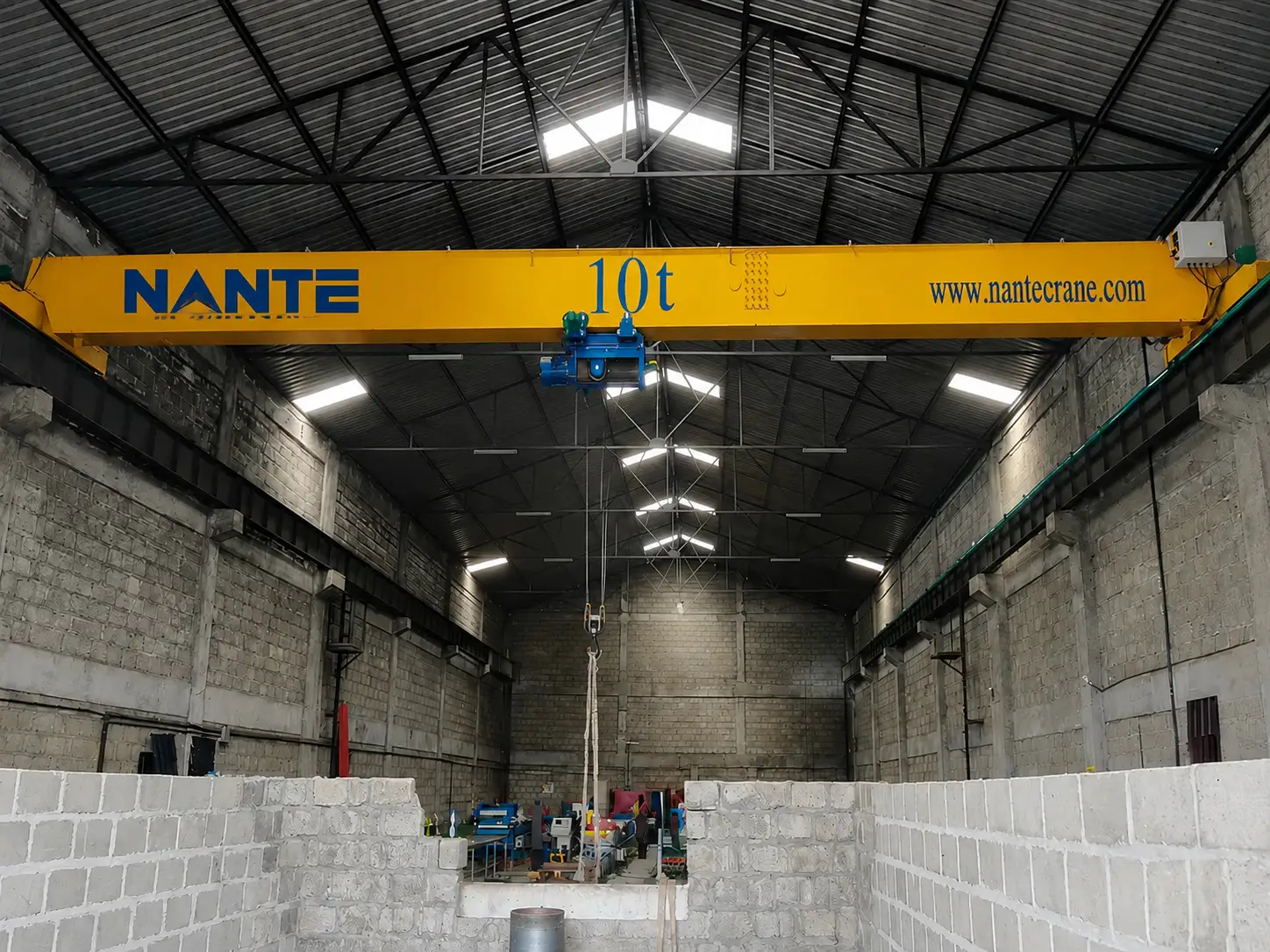
The 10-ton crane satisfies the basic load-capacity comparison, assuming the crane is suitable for the required duty and no other restrictions apply.
Now assume a future product weighs 9.5 tons with the same 0.8 tons of lifting equipment:
9.5 + 0.8 = 10.3 t
A 10-ton rated crane would no longer be sufficient.
This example illustrates why engineers should calculate capacity from the maximum total suspended load, including foreseeable production changes.
Overhead Crane Capacity Selection Table
| Application Example | Payload | Lifting Equipment | Suspended Load | Preliminary Capacity Decision |
| Light fabrication | 1.6 t | 0.2 t | 1.8 t | Rated capacity must be ≥1.8 t |
| General workshop | 4.5 t | 0.4 t | 4.9 t | 5 t may satisfy the basic capacity check |
| Worked example | 8.0 t | 0.8 t | 8.8 t | 10 t gives 88% utilization |
| Future heavy load | 9.5 t | 0.8 t | 10.3 t | 10 t is insufficient |
| Special lifting device | 14.0 t | 2.0 t | 16.0 t | Rated capacity must be ≥16 t |
This table is a preliminary selection aid, not a complete crane design chart. Crane configuration, duty classification, span, runway capacity, operating environment, and applicable standards still need engineering verification.
Why Load Spectrum Matters
Maximum weight alone does not fully describe how demanding an application is.
ISO 4301-5:2025 specifically classifies bridge and gantry cranes according to service conditions that include the total number of working cycles during design life, the load spectrum factor representing the relative frequency of different loads, and average load displacement.

Maximum Load vs. Frequency of Heavy Lifts
Consider two 10-ton cranes.
One may lift 9 tons only occasionally while spending most of its operating life moving 2-ton loads.
Another may repeatedly lift 8–10 tons throughout multiple shifts.
Their rated capacities may be identical, but their long-term service demands are very different.
Engineers should therefore estimate:
- Lifts per hour
- Hours per shift
- Shifts per day
- Working days per year
- Expected service life
- Percentage of light, medium, and heavy lifts
This load spectrum helps determine the appropriate crane and mechanism classification.
Dynamic Loads and Design Considerations
A simple payload calculation determines the minimum required operating capacity. It is not the complete structural crane design calculation.
ISO 8686-5:2017 applies crane load and load-combination design principles specifically to overhead travelling and portal bridge cranes. These engineering calculations are used when verifying crane structures and mechanical components.
Is a 125% Safety Factor Required?
A common mistake is to see a 125% test value and treat it as available working capacity.
In the United States, OSHA states that rated-load test loads should not exceed 125% of rated load unless otherwise recommended by the manufacturer. However, OSHA separately requires the crane’s normal operating load to remain within its rated load.
Therefore:
125% proof testing does not mean a 10-ton crane may normally lift 12.5 tons.
Dynamic factors and structural safety margins belong in the crane design and verification process. They should not be converted into an operational overload allowance.
Other Factors That Affect Crane Capacity Selection
Capacity in tons is only one part of crane selection.
Span, Runway, and Building Structure
Increasing crane capacity may also increase crane dead weight and wheel loads. Existing runway beams, rails, columns, and building structures should therefore be checked before installing a heavier-capacity crane.
Lifting Height and Headroom
Specify both the required hook lifting height and available building clearance. An adequately rated crane may still be unsuitable if its geometry cannot provide the necessary hook height or approach distance.
Speed and Control
Required hoisting, cross-travel, and long-travel speeds should match the production process.
Acceleration and deceleration also matter. OSHA specifically requires care to avoid sudden acceleration or deceleration of a moving load.
Multiple-Crane Lifts
Never assume that using two cranes simply doubles available lifting capacity.
Load distribution, rigging, crane positions, runway loads, and movement coordination must be evaluated. OSHA requires a qualified responsible person to analyze and direct an operation when two or more cranes lift one load.
Common Overhead Crane Capacity Calculation Mistakes
Avoid these common errors:
- Using only workpiece weightand ignoring below-the-hook equipment.
- Using average load instead of maximum load.
- Treating proof-test capacity as operating capacity.
- Ignoring load spectrum and operating cycles.
- Selecting capacity without considering future products.
- Assuming multiple hoists automatically increase total crane capacity.
- Adding an arbitrary safety percentage instead of following applicable design requirements.
- Ignoring runway and building structural capacity.
A good capacity calculation should therefore combine load data with actual operating conditions rather than relying on one number.
FAQ
How Much Can an Overhead Crane Lift?
An overhead crane can normally lift up to its approved rated capacity under the conditions for which it was designed. There is no single universal maximum crane load because overhead cranes can be engineered for very different applications.
For practical payload planning:
Available Payload ≈ Rated Capacity − Suspended Lifting Equipment Weight
Always verify the actual equipment rating and project requirements before lifting.
How Do You Calculate Overhead Crane Capacity?
Start by calculating:
Maximum Payload + Lifting Device + Rigging + Other Suspended Equipment
The selected crane rated capacity must be at least equal to this maximum suspended operating load. Then evaluate load spectrum, duty, span, runway loads, environment, speeds, and future production requirements.
Does a Lifting Beam Count Toward Crane Capacity?
Yes. If the lifting beam is suspended from the crane hook, its weight contributes to the total load imposed on the hook and reduces the remaining capacity available for the payload.
Do Slings and Shackles Count Toward Crane Capacity?
Their weight should be included where relevant because they are part of the suspended load. Their own rated capacity must also be checked independently, especially when sling angles or hitch arrangements increase individual leg tension.
Can an Overhead Crane Lift More Than Its Rated Capacity?
Not during normal operation. OSHA states that the crane must not be loaded beyond its rated load except for authorized test purposes.
Does Load Spectrum Affect Crane Selection?
Yes. Two cranes with the same rated capacity can experience very different fatigue demands if one frequently lifts near maximum capacity while the other normally handles lighter loads. ISO 4301-5 uses working cycles and load spectrum as important crane-classification parameters.
Get a Crane Recommendation for Your Project
Nante Crane designs and manufactures overhead cranes, hoisting equipment, crane components, and control systems for industrial applications.
If you are planning a new crane project, replacing an existing crane, or need help confirming the required capacity, contact Nante Crane with your load, span, lifting height, and operating requirements. Our team can help you select the right crane capacity and configuration and provide a project-specific technical recommendation and quotation. Send us your project requirements to discuss the right overhead crane solution for your application.