English



How to Reduce Overhead Crane Downtime with Smarter Overhead Crane Maintenance
How to Reduce Overhead Crane Downtime with Smarter Overhead Crane Maintenance
Date: 2026-07-10 Share:
Overhead Crane Maintenance more than just repairing an Overhead/Traveling Crane after it has failed. In reality, it is a planned reliability strategy aimed at reducing the number of times an Overhead/Traveling Crane fails thereby reducing the amount of time that the crane is down and allowing production to operate within established time-frames while ensuring safe lifting practices. A good program includes a preventive maintenance check list for overhead cranes, predictive maintenance, training of the crane operators, and a good spare parts management to prevent crane downtime due to minor defects turning into major failures.
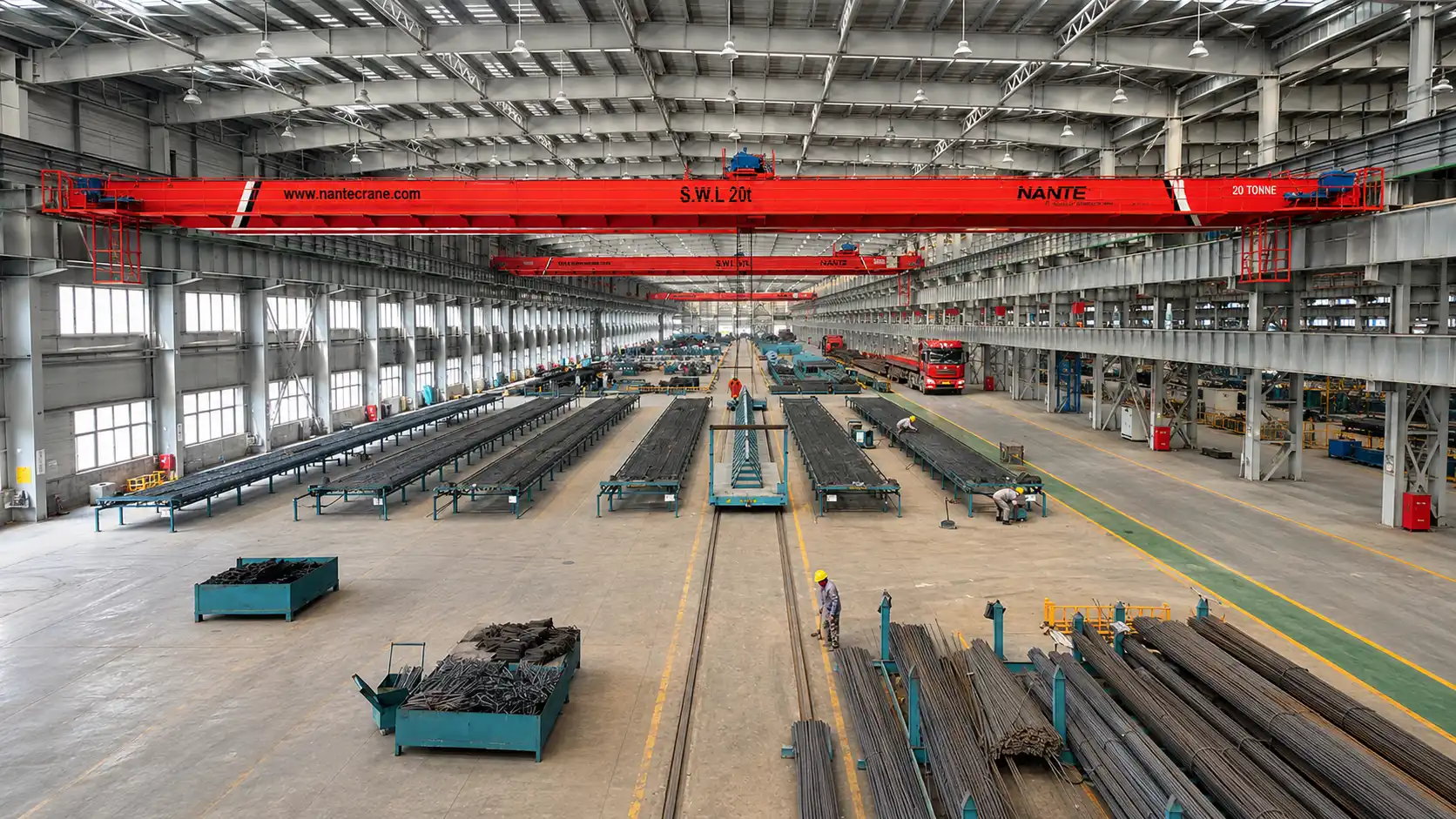
Why Overhead Crane Downtime Happens
Mechanical Wear on Critical Parts
Most crane downtime starts with wear that is not found early enough. Hooks, wire ropes, hoist chains, brakes, wheels, drums, sheaves, bearings, shafts, and gears all work under repeated load cycles. For facilities using a wire rope hoist, regular inspection of the rope drum, sheaves, brake, gearbox, and lifting mechanism is especially important for reducing unexpected downtime. Heavy use, dust, heat, humidity, poor lubrication, and shock loading can make these parts deteriorate faster.
Frequent checks should cover operating parts, hooks, hoist chains and rope routes. Periodic inspections should cover structural parts, bolts, sheaves, drums, brakes, indicators and electrical equipment.
Electrical and Control System Faults
In addition to broken hooks and torn wire ropes, cranes also can cease operation due to loose electrical terminals, worn-out contactors and cables, stuck limit switches, faulty control signals and an unstable power supply. These kinds of failures at first may express themselves as temporarily failing, delayed response, unusual motion and repeat alarms.
Build a Preventive Maintenance Program
Set the Right Inspection Frequency
Preventive maintenance should match the crane’s workload, service severity, and environment. A light-duty indoor crane does not need the same schedule as a high-cycle crane working in a hot, dusty, or corrosive area.
A practical schedule includes:
1. Daily checks before operation.
2. Monthly inspections for wear and adjustment.
3. Periodic inspections every 1 to 12 months, depending on activity and service conditions.
Regulatory guidance divides regular-service crane inspection into frequent inspections from daily to monthly and periodic inspections from 1 to 12 months.
Keep Maintenance Records
Document every inspection. For each crane inspection, record the following information: crane ID, inspection date, name of the person conducting the inspection, found defects, replaced parts, corrective actions, and the date for the next scheduled inspection.
Use Predictive Maintenance to Find Problems Earlier
Monitor Real Crane Conditions
Predictive maintenance uses actual equipment condition to decide when service is needed. Instead of relying only on a fixed calendar, teams can monitor vibration, motor current, bearing temperature, brake condition, load cycles, overload events, and operating frequency.
Research on predictive maintenance shows that vibration sensors, data analysis, and pattern recognition can help predict equipment breakdowns before failure.
Turn Data into Planned Repairs
The real value of predictive maintenance is acting on trends. Rising vibration, higher temperature, longer stopping distance, increasing current draw, or repeated alarms should trigger inspection. This allows the team to order parts, prepare tools, and repair the crane during planned downtime.
Improve Spare Parts Management to Reduce Crane Downtime
Identify Critical Spare Parts
What looks like a simple repair can turn into a lengthy shutdown for lack of the right part. In order to prevent crane downtime through effective spare parts management, attention should be paid to the immediate stop parts.
Common critical parts include:
· Wire ropes
· Hooks and hook blocks
· Brake pads and brake coils
· Limit switches
· Contactors and relays
· Pushbutton pendants
· Bearings, wheels, and sheaves
· Couplings
· Control panel components
· Lubricants and fasteners
Classify Parts by Risk and Lead Time
Divide spare parts into critical parts, high-wear parts, long-lead parts, and standard consumables. Critical parts should be stocked or have a reliable supply plan. High-wear parts should be linked to inspection results. Long-lead parts should be ordered before failure risk becomes urgent.
By integrating condition-based maintenance and spare parts planning, equipment condition data can be used to decide what to replace, when to replace it and what to stock up on.
Overhead Crane Maintenance Checklist
Daily Checklist
Before Shift – Use this checklist for overhead cranes for preventive maintenance.
· Check hooks for cracks, twisting, or deformation.
· Wire ropes must be inspected for broken wires, kinks, corrosion, etc. and for incorrect reeving.
· Test hoist, trolley, and bridge movement.
· Test brakes and emergency stop.
· Check upper and lower limit switches.
· Confirm warning lights or alarms work.
· Listen for abnormal noise or vibration.
· Oil leakages, loose parts or damaged cables must be detected.
· Make sure the load path is clear.
· Report any abnormal condition before lifting.
Monthly Checklist
· Check brake wear and adjustment.
· Inspect wheels, rails, drums, sheaves, and bearings.
· Check bolts and structural connections.
· Inspect electrical cabinets and wiring.
· Verify lubrication points.
· Review fault records and operator reports.
· Confirm safety devices work correctly.
· Check hook, chain, and rope records.
Annual Checklist
· Check main structure of tank for cracks, deformation or corrosion.
· Check runway alignment and rail condition.
· Review load test and maintenance records.
· Inspect the complete electrical system.
· High-risk wear parts need to be replaced based on wear and working hours.
· Update the preventive maintenance plan.
Train Operators to Prevent Avoidable Downtime
Improve Pre-Shift Inspection Habits
Operators are frequently the first to notice unusual sounds or other signs of trouble. They are also in the best position to notice brake drift, slow response or other control problems. Their training should teach them what to check, when to stop for repairs and how to report any problems they do find.
Avoid Misuse and Shock Loading
Poor operating habits increase wear on hoists and cranes. Start hoists and cranes up slowly and allow them to come to a stop slowly as well. Never allow a hook to be used to pull from the side of a hook or to drag objects along the floor. Never overload a hoist or crane, and never lift a load while the hook is not positioned directly above the center of the load. Make sure loads are properly secured, are balanced, and are lifted slowly and smoothly to prevent any type of swing or impact.
Standardize Repair Procedures
Make Repairs Safe and Repeatable
Before starting maintenance or repair work remove the crane from service and position it safely. Switch off the controllers and ensure the main switch is open and clearly locked. Place visible warning signs around the area to alert others of the work being carried out. Ensure any other unsafe items discovered during the inspection are corrected before returning the crane to service.
Track Maintenance KPIs
Useful indicators include downtime hours, mean time between failures, mean time to repair, preventive maintenance completion rate, spare parts stockout rate, and repeat failure rate. These KPIs show whether the program is actually reducing crane downtime.
FAQ
What is the best way to reduce overhead crane downtime?
Combining preventive maintenance with predictive maintenance, optimal spare part management, training of the operators, and clear repair procedures is the best method.
How often should an overhead crane be inspected?
For key functions that are checked on a daily basis, more general inspections are recommended on a monthly or periodic basis depending on use, service conditions and environment.
Why is spare parts management important?
Because crane downtime often continues after the fault is found if the replacement part is not ready.
Nante Crane is a crane and crane components designer and manufacturer with products covering overhead cranes, gantry cranes, construction cranes, workstation cranes, offshore cranes, electric hoists, travel units, mobile power supply systems, crane rails, and crane control panels. Its control panel solutions can support hoisting control, long travel control, whole-crane control, anti-sway, automation, IoT, and data logging. If your facility wants to improve overhead crane maintenance, reduce crane downtime, and build a more reliable lifting system, contact Nante Crane for suitable crane solutions and components.