English


Offshore Crane Safety Risk Assessment for Oil Rigs & FPSOs
Offshore Crane Safety Risk Assessment for Oil Rigs & FPSOs
Date: 2025-12-11 Share:
Running an offshore crane on an oil rig or FPSO means tough, pricey choices where mistakes cannot happen. Strict follow-up of offshore crane safety standards, steady checks, and tough load testing stay vital to guard workers, gear, and timelines. This guide looks at usual offshore crane dangers, rule systems, check steps, load testing ways, and how Nante Crane’s offshore crane design keeps steady work in rough sea settings. Project engineers will pick up useful tips to handle crane safety and rules well.
Understanding Safety Risks in Offshore Crane Operations
Offshore crane work faces special problems not seen on land. Moving sea actions—pitch, roll, and heave—can shake hanging loads. This raises the chance of swing or drop. Even mild wave heights create big dynamic amplification factors (DAF). These must be figured out in lift plans.
Rust and metal wear from saltwater speed up structure breakdown. Constant contact with salty mist eats away protective layers. It weakens welds, mainly in boom and pedestal parts. Wear builds fast from repeated lifts under changing loads. This often causes tiny cracks in high-stress spots.
Operator mistakes still lead many accidents in tense, costly lift jobs. Bad talk, wrong load paths, or weak risk checks during blind lifts can start huge failures. Results include deaths, oil spills, platform harm, and delays that cost millions.
Offshore Crane Safety Standards and Regulatory Frameworks
Following known offshore crane safety standards builds the base for risk control. Three main systems—API, DNV, and OSHA—give full advice for design, running, and upkeep.
API Standards for Offshore Lifting Operations
API RP 2D stays the key guide for offshore crane work in the U.S. and around the world. It demands trained operators, clear upkeep plans, and risk-based check times. API Spec 2C rules crane design. It requires study of all failure types, including boom collapse, wire rope failure, and slew bearing seizure.
The standard stresses pre-lift plans. It needs load charts changed for offshore motions. Emergency recovery steps are required too. Regular reviews make sure offshore crane safety risk assessment uses weather data like wave height and wind speed.
DNV Standards for Offshore Cranes
DNVGL-ST-0378 offers a strict certification path for offshore and platform lifting tools. It demands structure strength checks under extreme moving loads. This includes 1.3–2.0 DAF based on sea state. Rust protection systems must last 20+ years in sea settings.
Safety devices—load moment indicators, anti-two-block systems, and emergency load release—are needed. The certification steps include design check, build survey, and watched load testing. These prove fit with offshore crane safety standards.
OSHA Guidance for Offshore Equipment (Supplementary)
Though OSHA 1910.179 mainly covers onshore cranes, its ideas shape offshore safety control. It requires daily sight checks, monthly work tests, and yearly full exams. For offshore use, these match BSEE rules under 30 CFR 250.
Common checks target moving parts—wire ropes, sheaves, brakes. Regular checks look at structure parts and control systems. Records must show operator certifications and fix logs.
Offshore Crane Inspection and Maintenance Requirements
A strong check plan stops failures before they start. Sea settings need more often and detailed exams than land ones.
Visual and Functional Inspections
Daily before-use checks cover wire ropes. Operators look for broken strands, rust, or bends. They check hooks for shape change or latch work. Sheaves and hydraulic parts get reviewed too. Operators must test brake action and limit switch work.
Regular deep checks—usually yearly—need certified inspectors. They judge full structure strength. This includes ultrasonic testing of welds. Magnetic particle inspection finds cracks. Rust tracking uses coating thickness measures.
Load Testing Requirements for Offshore Cranes
Proof load testing checks crane power under controlled extra load. Usual way uses 1.1× Safe Working Load (SWL) still. Then dynamic testing copies sea motion and wind loads. Tests must copy worst-case offshore states.
After install, big fixes, or every five years, full load testing is required. Third-party watchers record results. This ensures tracking for rule fit and insurance needs.
Critical Inspection Checklist
- Structural: Boom, pedestal, slew ring, welds, fatigue cracks
- Lifting components: Hooks, ropes/chains, shackles, slings
- Mechanical: Hoists, brakes, limiters, hydraulic/power systems
- Safety systems: Load moment indicator, anti-two-block, emergency stops
- Documentation: Maintenance records, load charts, certificates
Use this checklist during every offshore crane safety risk assessment to keep audit-ready files.
Nante Crane Offshore Design for Reliability and Safety
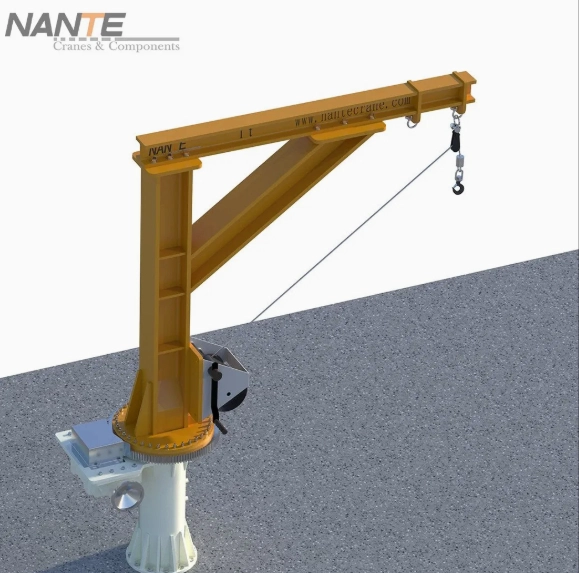
Nante Crane focuses on offshore lifting answers built for extreme sea states. Their workstation offshore cranes (150kg–50t capacity) mix advanced materials and backup systems. These beat offshore crane safety standards.
Rust-resistant coatings and stainless steel parts guard against saltwater harm. High-strength, low-alloy steels cut weight but keep structure strength under moving loads. Explosion-proof electrical systems meet Zone 1 and Zone 2 needs for oil and gas platforms.
Backup safety systems include dual load cells. They have independent emergency braking and fail-safe hydraulics. Motion-compensated choices reduce load swing during FPSO offloading. All designs get third-party checks (DNV, ABS, BV). They fit API Spec 2C and DNVGL-ST-0378.
Nante Crane cuts work risk with IoT-based predictive upkeep. This lowers surprise stops. Project engineers gain from custom pedestal, knuckle boom, or telescopic setups. These match specific rig layouts and lifting needs.
About Nante Crane
Nante Crane is a leading manufacturer of offshore cranes, lifting appliances, and marine winches for oil rigs, FPSOs, and offshore platforms worldwide. With over 30 years of engineering skill, Nante gives custom answers that fit DNV, API, and international class standards.
Products include davit cranes (150kg–10t), workstation offshore cranes (5t–50t), and heavy-lift pedestal cranes. All are built for harsh marine environments. Focus areas cover rust resistance, work safety, and low upkeep.
Services include technical advice, project-specific crane choice, install oversight, check help, and certification aid.
Conclusion
Offshore lifting needs full follow of offshore crane safety standards. From moving risk checks to tough inspection and load testing, each step guards lives and assets in high-risk settings.
Trusty crane design—such as Nante Crane’s rust-resistant, backup systems—forms the last shield against failure.
Schedule a technical consultation for your offshore lifting project with Nante Crane today.
FAQ
How often should offshore cranes be inspected?
Annual thorough inspections and periodic load testing every 5 years (or after modifications/repairs). Daily visual and monthly functional checks are also required per API RP 2D.
What is involved in offshore crane load testing?
Static and dynamic tests at 1.1× SWL, simulating offshore conditions (wave motion, wind). Tests verify structural, mechanical, and safety system integrity, with results certified by third parties.
What makes offshore crane inspections different from onshore?
Harsh sea conditions, dynamic loads, and accelerated corrosion require specialized NDT methods, environmental monitoring, and stricter documentation under DNV/API standards.
How does Nante Crane improve offshore safety?
Engineered with corrosion-resistant materials, redundant safety systems, motion compensation, and full compliance with DNV/API offshore crane safety standards for reliable performance in extreme conditions.